Five Star Nothingness
20 September 2026

I spend a lot of time teaching people about the importance of customer centricity. I’ll talk about how we need some kind of yard stick to determine where we are so that, when we make changes, we can measure again to see whether the improvements made a difference. I’ll mention in sessions “that’s why we all get so many emails asking us ‘How did we do?’, text messages asking us whether we could ‘press 5 if you would recommend us to a friend’, pop ups that materialise on our computer screen just as we complete a transaction on your laptop.
I receive all of these requests and, given what I care about, I diligently fill them out when the service has been fantastic but, thinking about it, I often fill them out positively even when the service outcome hasn’t been, because the person who I was talking was lovely. 🙈
I often DON’T fill them out when I have actually experienced problems because I know how such feedback scores can be used. I guess I’m conscious that maybe if I have been speaking to a human, that they’re working in a broken system, maybe something terrible has happened to them, maybe their boss is awful and that maybe their job or bonus is dependent on ‘success’ within that customer satisfaction rating.
Sometimes people are really desperate for that rating. I remember in Manchester station once, after I bought some food and drink for the train ride home, being handed a slip of paper with a QR code and a “Please rate us on Google and if I’ve been helpful, quote Clarice”. I did think “Jeez Clarice, it was just a chicken baguette and a Pepsi Max”, so as I sat on the train, scanned the QR code in the tiny piece of paper in my hand and told the world that Clarice really did scan those items excellently, the first seeds of ‘I’m not sure customer rating systems really work do they’ were planted.
I am regularly reminded of this encounter as Google checks in with me to tell me about how many views my reviews have got. My most popular one is the one I left for a local balloon company who made a lovely balloon arch for my Mum’s 70th birthday. It’s had over 5000 views you know.
So I give out ratings and reviews but am not immune to receiving them myself. There’s lots of ways that your lecturing and teaching is reviewed and assessed. Whether it’s an Executive Education feedback sheet or a Module evaluation as part of Post Graduate Teaching Surveys. Often they are really positive (thanks guys), but there’ll always be one or two comments that irk me and feel desperately unfair or unkind. Such as a recent “I didn’t learn anything new”. Pleased to meet you too mate.
(Let’s not even go near how there have been multiple studies which show how much harshly women are critiqued within teaching as compared to their male peers. Ahem.)
So yes, I guess it’s always in the back of my mind how horrible it is to be ‘rated’.
Nothing has felt as unjust however as when one Uber driver gave me a shocking rating one night, God knows why, but it dented my, otherwise perfect Uber rating significantly to where I now stand, 4.92, WHICH I HAVE NEVER SEEMINGLY BEEN ABLE TO RECOVER FROM. It never changes. It’s been 4.92 for over a year. That bloke must have given me a 1. (Uber tells me ‘not to despair if my average isn’t 5.0. Things that seem small to you can matter to your partner-driver (weird term) such as if I accidentally slammed a door’ for example).
I guess being rated as a customer works because now I am always super courteous, polite and always tip (except when they have really annoyed me) but yes, they always get 5 stars because I’m scared that they’ll 1 star me if I don’t. I am now so paranoid about how I shut the door as I leave the taxi, I always take great care to not shut the metal seat belt into the metal inners of the car and cause that horrible KERUNK sound, that, thinking about it, must make me look a tad deranged (minus 1 star).
Hmm. Is shutting a car door in an Uber the most care I practice in life? 🤔
Zoiks.
Anyway. Something about all of this feels a bit wrong.
I am the customer. I’m meant to be the ‘always right’ one. Since when did rating me and how well I use YOUR service become so acceptable?
Airbnb is the same. I’m almost scared to stay in Airbnb’s now. I took my daughter to one in West Wales and she kicked off about something as soon as we arrived, screaming the absolute house down. It was meant to be a lovely mother and daughter trip, but yeah, it instantly started going wrong and as I sat there, pondering my life choices and wondering why and where our once lovely relationship has seemingly gone so wrong, I also feared for my Airbnb status.
I spent the rest of the stay making sure not to accidentally make any marks on their walls, drop any of their cups and not say anything that could be deemed a slight irritant to my daughter for fear of the owner living in that locked shed in the garden awarding me even more minus points.
Fun, tenterhook times.
I was prompted to muse on this topic by one of my musical faves, Laura Marling (see hexagon of Female Singersongwriter Joy) who is not only a wonderful singer songwriter, but also writes beautiful blogs. She, like often me, chickened out of publicly saying what she really thought in a recent holiday experience – https://lauramarling.substack.com/p/on-leaving-london-leisure/ What was really interesting to me was that she has identified the homogeneity of experience that such rating systems seem to generate.
It’s impossible to think of an Airbnb experience where the owners hadn’t thought of everything. Is there something a bit spooky about how perfectly that cutlery and utensil drawer has been arranged and how it covers every possible mini break requirement? *shivers*
Unlike my stay, Laura’s holiday home owners must have left their shed and turned up unannounced for cups of tea (the temptation to drink tea with a wonder such as Laura Marling must have been strong, so I somewhat sympathise with the owner’s predicament).
What solidified choosing this month’s blog topic for me was a recent Linked In post by Lou Barton who shared @minxgenie’s hilarious review of a Sainsbury’s large brown onion.
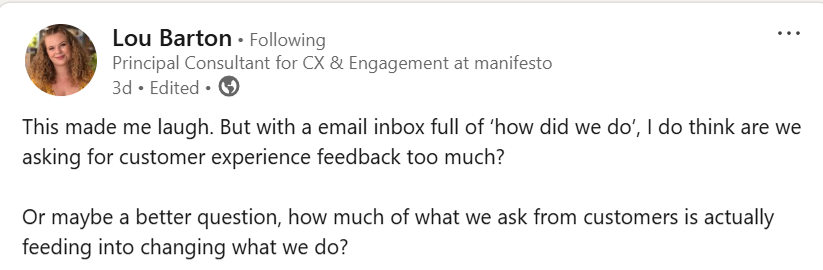
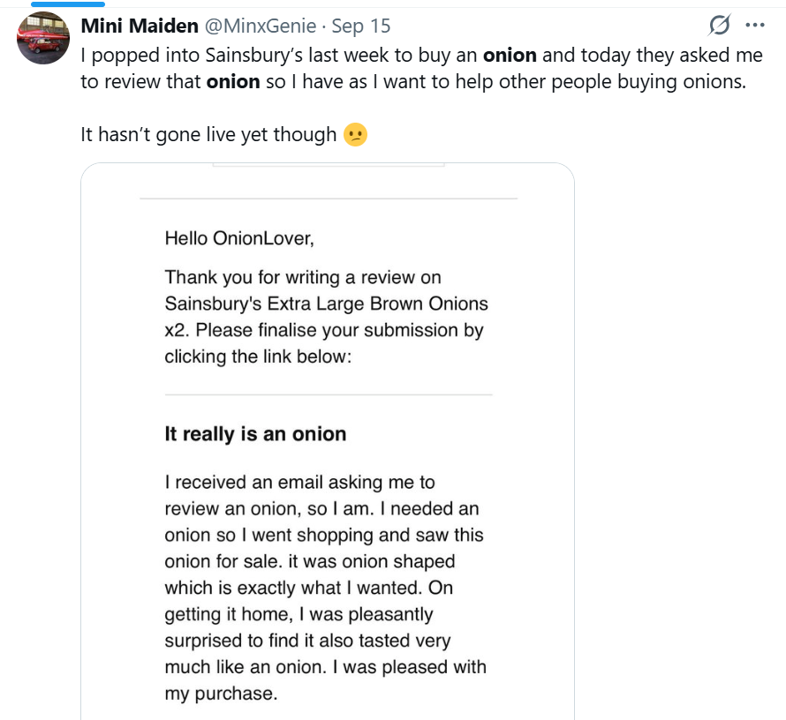
Methinks the reviews might hath gone too far.
Lou asks “how much of what we ask from customers is actually feeding into changing what we do?” an interesting question indeed, but I’d also suggest adding “and even if we do listen, how much of what customers are telling us is actually true?”
I am a major fan of ‘stepping into your customer’s shoes. Service Design rather fancifully calls doing this going on a ‘customer safari’. It’s basically trying the service yourself, feeling your way through it, recognising points of annoyance and seeing the service you deliver through your customer’s perspective, as a customer yourself. This is the closest you can get to a ‘true’, unfiltered experience I think. Plus it’s less about the human involved, and more about what the service itself is delivering.
I’m not suggesting that we should get rid of all ratings and customer questionnaires, but we do need to look at them with caution, particularly if the customer themselves is being rated as part of the exchange. Being rated at the same time as you offer your own feedback does tend to curb your tongue somewhat.
Plus, as we all know, some people can be overly kind … and some people can be overly mean.
And lets not go near those services where the agent tells you that if you don’t award them full marks they’ll lose money. Yes that has happened to me, and I’m sure you, more than once.
So immerse yourself in your own service experiences, with no hidden agenda other than to seek the real truth, the whole truth and nothing but the truth, and then, I guess, make sure you act on what you discover.
- Five Star Nothingness
- Turning Sad Times into Happy Times
- Gwybod and Nabod. To Know and TO KNOW.
- You’re Not Doing it Right!
- Systems Leadership
- Working Smarter and Harder to Overcome Friction
- Mesmerising Mnemonics
- Recharging Batteries
- Marketing Magic
- What’s My Job Again?
- The Reports Have Gone to Her Head
- Cross Stitch Standards and Creativity
- Hefin David and the Aeroplane Arms
- Hankering for a Handbook
- Window of Light
- Defensive Organising
- McMullin’s Tandem of Co-Production
- The Joy of John Parry-Jones
- The Perils of Disappointment
- The Shield of Shame
- Customer Care and Organisation Innovation
- Hooray for Humanity!
- Angry Lemons
- Double Meanings
- Ticketing Masterplans
- When will it all end …
- Lifetime Loyalty and Taylor Swift
- Looking at Things Differently
- Networking Noodles
- Addicted to Truth
- Designs on Service Design
- The Multiple Joys of Universal Design
- Hungry Cultures
- Event Lean
- The Traffic Analogy
- Moving on Up
- Rosé Cava Revolution?
- Powerpoint Sneaky Lean
- Writing about Writing
- ChatGPT Response: Exploring the Art of Expression: Unveiling the Magic of Writing in the Style of Sarah Lethbridge
- September 2026 (1)
- June 2026 (1)
- May 2026 (1)
- April 2026 (2)
- February 2026 (2)
- December 2025 (1)
- November 2025 (1)
- October 2025 (2)
- September 2025 (1)
- August 2025 (2)
- July 2025 (1)
- June 2025 (1)
- April 2025 (1)
- March 2025 (2)
- February 2025 (1)
- January 2025 (1)
- December 2024 (1)
- November 2024 (1)
- October 2024 (1)
- September 2024 (1)
- July 2024 (2)
- June 2024 (1)
- May 2024 (1)
- March 2024 (1)
- February 2024 (2)
- December 2023 (2)
- October 2023 (2)
- September 2023 (1)
- July 2023 (3)
- June 2023 (1)
- May 2023 (1)
- April 2023 (1)
- March 2023 (1)
- February 2023 (1)
- January 2023 (1)
- November 2022 (1)
- October 2022 (2)
- August 2022 (2)
- July 2022 (1)
- May 2022 (2)
- April 2022 (1)
- February 2022 (1)
- January 2022 (1)
- December 2021 (2)
- November 2021 (1)
- October 2021 (1)
- September 2021 (1)
- August 2021 (1)
- July 2021 (1)
- May 2021 (2)
- April 2021 (1)
- March 2021 (1)
- January 2021 (1)
- December 2020 (1)
- October 2020 (3)
- August 2020 (1)
- June 2020 (2)
- April 2020 (1)
- March 2020 (1)
- February 2020 (1)
- December 2019 (2)
- October 2019 (1)
- September 2019 (1)
- August 2019 (1)
- July 2019 (1)
- June 2019 (1)
- February 2019 (3)
- October 2018 (1)
- September 2018 (1)
- March 2018 (10)
- April 2016 (1)
- January 2015 (3)
- July 2014 (9)
- September 2013 (1)