You’re Not Doing it Right!
29 April 2026

In Working Smarter and Harder to Overcome Friction I discussed the notion of employees doing MORE to ultimately help customers do less, ergo, making the service they provide more helpful and productive.
The example that I used to illustrate this phenomenon was where a NEW service action was being created. The challenge was ‘how could we enact the task that we need to complete so that it makes things easier for our customers’?
I’d like to now examine the same ‘working smarter AND harder’ phenomenon but from a different starting point – from where the service has already been created but its customers are having a problem engaging with it.
What can happen in these examples is that upon engaging with the process and finding a lack of progression through it, you are told that the problem is …
“You’re not doing it right”
You haven’t filled out the form correctly, you’ve gone to the wrong webpage, you’ve classified your problem incorrectly, you haven’t clicked the right option.
Anyone that reads these blogs regularly might possibly be able to anticipate how I might receive such a response in the face of MY supposed inadequacy and erroneous actions.
*Cut to intense close up of lip quivering rage and squinting eye of injustice*
I take some deep breaths, compose myself, and then embark on an explanation which details why the problem is not actually me, it’s how they’ve designed their process. (I mean, IT IS me, but that’s precisely the point. Often processes are designed by the experts in the organisation that need the information. They know the language, they know the intent. They come at the problem from their institutional perspective, NOT the customers’ and sometimes fail to appreciate what the customer is thinking or feeling as they are approaching the task. This leads to tasks not being completed the way that they were intended.)
So i’ll helpfully point out the problems from my ‘customer’ perspective, the opportunities for confusion, and then, if feeling generous, I’ll usually end by letting them know what they might do about it.
People love this I find.
Hehe.
Of course they don’t.
Most people DETEST it.
Call centre agents, canvassing political candidates, colleagues, friends, children, husbands, cats.
I won’t be deterred of course because I have righteousness and lean on my side.
You see, lean absolutely runs on this ability – the ability to call out problems and for people to receive them in the manner to which they are intended i.e. progress can only be made when these issues are surfaced, discussed and acted upon.
It sounds cheesy as hell but really, this is the basis of how psychologically safe continuous improvement cultures are created. The ability for someone to go ‘something is wrong here’ and for that disclosure to be treated respectfully, thoughtfully and acted upon.
Unfortunately, in my life at least, this is rarely the reality.
Upon hearing such feedback, most people’s ‘backs’ are instantly ‘up’. The problem then is that they aren’t able to absorb the information, it is defensively batted back and often, cause them to ‘double down’ on their stance.
If I hadn’t drunk long and hard at the cold crystal waters of the pool of honesty, I could probably be more ‘strategic’ (vomit) in terms of how I delivered this information and my results would probably be better. I’d stop and think ‘how can I relay this information in a way that doesn’t feel threatening? For top results, ‘how could I make them realise themselves what is going wrong and why’?
We know that coaching on the shop floor, using the socratic method, is the ultimate way to deal with these types of issues, but the ability to coach often relies on a managerial dynamic which, as a customer, you simply don’t have.
As much as we’d like every problem to be surfaced through coaching and self-propelled evaluation, the reality is, lean environments absolutely need to support the ability for people to say that something is going wrong and for people to not react terribly to this information.
Even better, we’re looking for a culture where the response when these sorts of problems are surfaced and named doesn’t react with a “You’re not doing it right!” rather, the following, beautifully curious, questions are asked:
“Why isn’t the customer doing it right?”
“What might we need to do differently?”
Some companies DO have these kinds of cultures however. They take great pains to create environments where this kind of ‘radical candor’ are appreciated and rewarded. Amazon for example. If you didn’t get the chance to be participate in our Amazon Breakfast Briefing about how they create their innovative culture then I ABSOLUTELY recommend you taking some time to watch it. Explore the Culture of Innovation with Amazon Web Services Breakfast Briefing – YouTube. It’s a brilliant explanation of the steps that they take to constantly innovate to deliver customer centricity.
I was also recently heartened to see a brilliant example of ‘problem reporting’ and resulting action demonstrated by the CEO of Walmart, Ron Vachris
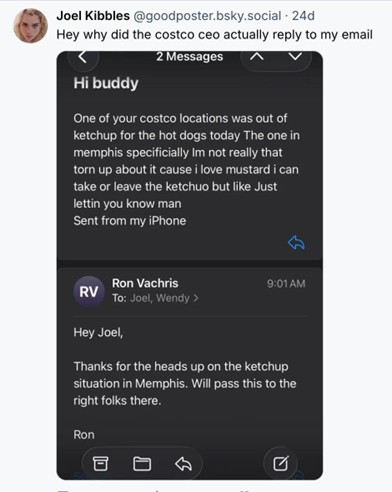
How beautiful. What amazing leadership. A customer spotted a problem, a swift reply to alert that this information had been acted upon and that happens AT EVERY organisational level, even from the very top.
No defensiveness, no arguments, just action.
The dream.
- Five Star Nothingness
- Turning Sad Times into Happy Times
- Gwybod and Nabod. To Know and TO KNOW.
- You’re Not Doing it Right!
- Systems Leadership
- Working Smarter and Harder to Overcome Friction
- Mesmerising Mnemonics
- Recharging Batteries
- Marketing Magic
- What’s My Job Again?
- The Reports Have Gone to Her Head
- Cross Stitch Standards and Creativity
- Hefin David and the Aeroplane Arms
- Hankering for a Handbook
- Window of Light
- Defensive Organising
- McMullin’s Tandem of Co-Production
- The Joy of John Parry-Jones
- The Perils of Disappointment
- The Shield of Shame
- Customer Care and Organisation Innovation
- Hooray for Humanity!
- Angry Lemons
- Double Meanings
- Ticketing Masterplans
- When will it all end …
- Lifetime Loyalty and Taylor Swift
- Looking at Things Differently
- Networking Noodles
- Addicted to Truth
- Designs on Service Design
- The Multiple Joys of Universal Design
- Hungry Cultures
- Event Lean
- The Traffic Analogy
- Moving on Up
- Rosé Cava Revolution?
- Powerpoint Sneaky Lean
- Writing about Writing
- ChatGPT Response: Exploring the Art of Expression: Unveiling the Magic of Writing in the Style of Sarah Lethbridge
- September 2026 (1)
- June 2026 (1)
- May 2026 (1)
- April 2026 (2)
- February 2026 (2)
- December 2025 (1)
- November 2025 (1)
- October 2025 (2)
- September 2025 (1)
- August 2025 (2)
- July 2025 (1)
- June 2025 (1)
- April 2025 (1)
- March 2025 (2)
- February 2025 (1)
- January 2025 (1)
- December 2024 (1)
- November 2024 (1)
- October 2024 (1)
- September 2024 (1)
- July 2024 (2)
- June 2024 (1)
- May 2024 (1)
- March 2024 (1)
- February 2024 (2)
- December 2023 (2)
- October 2023 (2)
- September 2023 (1)
- July 2023 (3)
- June 2023 (1)
- May 2023 (1)
- April 2023 (1)
- March 2023 (1)
- February 2023 (1)
- January 2023 (1)
- November 2022 (1)
- October 2022 (2)
- August 2022 (2)
- July 2022 (1)
- May 2022 (2)
- April 2022 (1)
- February 2022 (1)
- January 2022 (1)
- December 2021 (2)
- November 2021 (1)
- October 2021 (1)
- September 2021 (1)
- August 2021 (1)
- July 2021 (1)
- May 2021 (2)
- April 2021 (1)
- March 2021 (1)
- January 2021 (1)
- December 2020 (1)
- October 2020 (3)
- August 2020 (1)
- June 2020 (2)
- April 2020 (1)
- March 2020 (1)
- February 2020 (1)
- December 2019 (2)
- October 2019 (1)
- September 2019 (1)
- August 2019 (1)
- July 2019 (1)
- June 2019 (1)
- February 2019 (3)
- October 2018 (1)
- September 2018 (1)
- March 2018 (10)
- April 2016 (1)
- January 2015 (3)
- July 2014 (9)
- September 2013 (1)