Systems Leadership
6 April 2026

I’ve been called a lot of things in my life, but my absolute favourite is that I’m ‘perspicacious’. Admittedly, I had no idea what this word actually meant when it was suggested to me, but when I googled it, I was like, “YES. FINALLY!”

Proud, I told my mum, who replied “doesn’t that mean something negative?”
Bums.
I quickly googled again …. “no, no, pretty sure it’s a good thing, honest”.
But I can see why it might be perceived as something negative.
We all know that I can be annoying.
But my perspicacity means that I pretty much always have my finger on the pulse guys.
Sorry, I can’t help it. I’m perspicacious.
And let me tell you that what is hot right now, and is going to get hotter …. behold…..
Welcome to …. SYSTEMS LEADERSHIP.
It’s been around for a while, I’ve been advocating it for aeons, but it feels like it’s now making waves.
I have been advocating for it for ages because when looking at the world of work the problems are nearly always because the organisation isn’t working together as a cohesive system.
Some typical observations:
Problems happen as work moves between teams. Honestly, just map a process and mysterious delays happen when one piece of work leaves one team and moves to another. Sometimes this is because the organisation values team effectiveness as opposed to end-to-end effectiveness, so operations are optimised within a department but the delay pre and post departments are not ever visible, discussed, or worried about. Far too many organisations have no conception of end-to-end lead time and this is because often we don’t take the time and trouble to connect different teams’ work seamlessly together.
Problems can also occur when some departments are primarily concerned with delivering the core activities of the department rather than the needs of their customers or delivering the purpose that they are meant to fulfill within organisation. This leads to the department becoming isolated and disconnected from other parts of the organisation. Engaging with these teams can feel a bit like a battle, where you feel like you have to beg the department to work with you to achieve what needs to be achieved.
Some teams are pushing, some teams are pulling, some teams are chill, some teams are motoring at a frightening rate, work is falling between the gaps, work is piling up between the gaps. It’s a mess. If you start to imagine the organisation as an ‘alive’ entity, it can feel like it’s writhing all over the place, uncomfortable, unrelenting and potentially in pain.
I think its helpful to think of organisations as alive organisms that act in surprising ways and can do shocking things. To think of them as beings that can become sick and unhealthy but that, with care and attention, can become happier, healthier entities that thrive. It was most pleasing to me when I saw that Werner and Le-Brun have released a book entitled “The Octopus Organisation” which challenges the comparison of an organisation to that of a “Machine” (The Machine that Changed the World anyone?!) instead they’d rather we think of successful organisations as the clever and adaptive octopus. Something that “thrives in complexity and embraces continuous change”. Something that is alive.
Indeed Systems Theory originated from the work of a biologist. We just have to think of the complexity of our own bodies as a myriad of systems within systems within interconnected systems. Each cell in our body is, in itself, a tiny system, cells come together to form an organ, say a lung, which is itself, a system, working within the respiratory system, that both energises, and is fuelled by, the circulatory system.
Organisations have loads of these complicated, interconnected system ‘human beings’ working within them. Human beings who are not only comprised of the mechanics of their existence, but are full of the emotions and psychology that develop as a consequence. Politics, histories, sadnesses, anxiety which can all manifest in that most gobsmacking of revelations within organisations – the phenomenon that is Defensive Organising.
Basically we’re talking INTENSE COMPLEXITY.
That’s what’s great about “Systems Leadership”. It doesn’t try to fight the complexity, it tries to unify through it … with a lightness of touch, an acceptance of the sprawling tensions, but has a laser focus on what brings the constituent parts together – the reason why the organism exists. It asks leaders to not cling to boundaries and walls, but to lead with impermanence, encouraging porosity, respecting first and foremost, purpose, not power.
This Systems Leadership Definition from the NHS guide to Developing-Systems-Leadership is useful:
“Leadership across organisational and geopolitical boundaries, beyond individual professional disciplines, within a range of organisational and stakeholder cultures, often without direct managerial control.”
Leadership that succeeds without direct managerial control and doesn’t care about organisational boundaries. It’s the antithesis of defensive organising.
This Gov.UK Systems Leadership Guide also provides an excellent overview.
I also, really like this CLEAR Framework for Leading Systems Change from Harvard Kennedy School’s Lisa Dreier, David Nabarro and Jane Nelson within Systems Leadership for Sustainable Development. (It helps me greatly that there is so much alliteration and assonance).
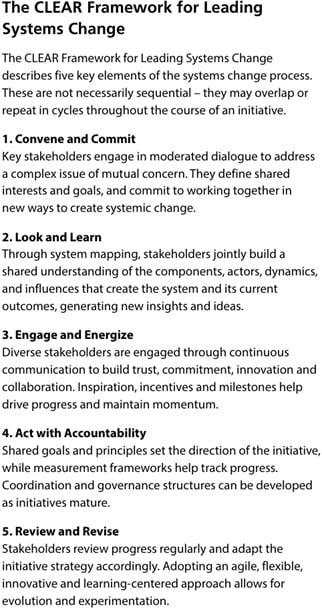
Dreier, Nabarro and Nelson, 2019
When writing this, as per usual, I put on Spotify’s trusty and ever changing “Focus Instrumental Mix” where I’m delighted by beautiful piece of music after beautiful piece of music, none of which contain any singing, which would basically completely distract me and make me lose focus. I can just concentrate, write and vaguely feel the melodic feelings. For a moment I pay more attention to a Bridgerton version of Paramore’s ‘All I Wanted’ by the Vitamin String Quartet. The beautiful ‘tos’ and ‘fros’ of the different parts of the orchestra, rise and fall, all with hugely different sounds, but together, when melodically working in harmony, the different parts complement each other and provide symbiotic moments of euphoria. That’s what Systems Leadership is seeking to achieve. Organisation and organisations that work in beautiful harmony, and together, make wonderful music.
- Five Star Nothingness
- Turning Sad Times into Happy Times
- Gwybod and Nabod. To Know and TO KNOW.
- You’re Not Doing it Right!
- Systems Leadership
- Working Smarter and Harder to Overcome Friction
- Mesmerising Mnemonics
- Recharging Batteries
- Marketing Magic
- What’s My Job Again?
- The Reports Have Gone to Her Head
- Cross Stitch Standards and Creativity
- Hefin David and the Aeroplane Arms
- Hankering for a Handbook
- Window of Light
- Defensive Organising
- McMullin’s Tandem of Co-Production
- The Joy of John Parry-Jones
- The Perils of Disappointment
- The Shield of Shame
- Customer Care and Organisation Innovation
- Hooray for Humanity!
- Angry Lemons
- Double Meanings
- Ticketing Masterplans
- When will it all end …
- Lifetime Loyalty and Taylor Swift
- Looking at Things Differently
- Networking Noodles
- Addicted to Truth
- Designs on Service Design
- The Multiple Joys of Universal Design
- Hungry Cultures
- Event Lean
- The Traffic Analogy
- Moving on Up
- Rosé Cava Revolution?
- Powerpoint Sneaky Lean
- Writing about Writing
- ChatGPT Response: Exploring the Art of Expression: Unveiling the Magic of Writing in the Style of Sarah Lethbridge
- September 2026 (1)
- June 2026 (1)
- May 2026 (1)
- April 2026 (2)
- February 2026 (2)
- December 2025 (1)
- November 2025 (1)
- October 2025 (2)
- September 2025 (1)
- August 2025 (2)
- July 2025 (1)
- June 2025 (1)
- April 2025 (1)
- March 2025 (2)
- February 2025 (1)
- January 2025 (1)
- December 2024 (1)
- November 2024 (1)
- October 2024 (1)
- September 2024 (1)
- July 2024 (2)
- June 2024 (1)
- May 2024 (1)
- March 2024 (1)
- February 2024 (2)
- December 2023 (2)
- October 2023 (2)
- September 2023 (1)
- July 2023 (3)
- June 2023 (1)
- May 2023 (1)
- April 2023 (1)
- March 2023 (1)
- February 2023 (1)
- January 2023 (1)
- November 2022 (1)
- October 2022 (2)
- August 2022 (2)
- July 2022 (1)
- May 2022 (2)
- April 2022 (1)
- February 2022 (1)
- January 2022 (1)
- December 2021 (2)
- November 2021 (1)
- October 2021 (1)
- September 2021 (1)
- August 2021 (1)
- July 2021 (1)
- May 2021 (2)
- April 2021 (1)
- March 2021 (1)
- January 2021 (1)
- December 2020 (1)
- October 2020 (3)
- August 2020 (1)
- June 2020 (2)
- April 2020 (1)
- March 2020 (1)
- February 2020 (1)
- December 2019 (2)
- October 2019 (1)
- September 2019 (1)
- August 2019 (1)
- July 2019 (1)
- June 2019 (1)
- February 2019 (3)
- October 2018 (1)
- September 2018 (1)
- March 2018 (10)
- April 2016 (1)
- January 2015 (3)
- July 2014 (9)
- September 2013 (1)