The Reports Have Gone to Her Head
5 October 2025

The contribution to lean that I am most proud of is my (frankly brilliant) Elements of Improvement model which illustrates all of the key, core, improvement ideals that organisations need to focus on in order be amazing. It’s a web of interconnecting blocks because all of the concepts need to work together. Each block is drawn from a mix of Lean, Systems Thinking, the Theory of Constraints and my own brand of improvement science. You need to flex the focus on each block depending on your organisational context. Perhaps one day the world will appreciate its genius, but in the meantime…
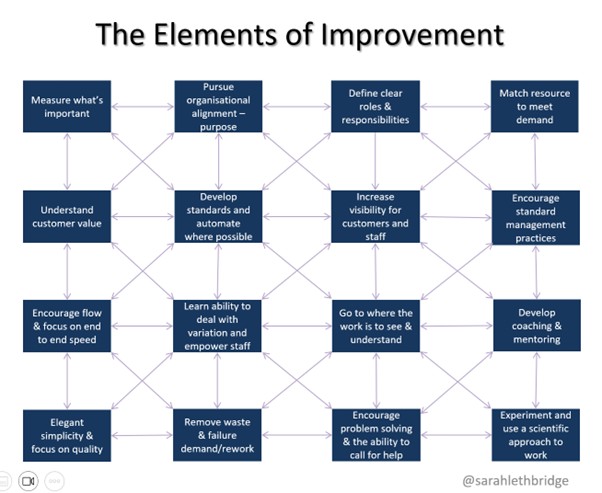
I thought of the ‘ability to call for help’ block when watching footage of the recent Panorama documentary which clearly displayed extremely serious issues within the Metropolitan Police’s Charing Cross Station. I watched a female officer challenging, as best as she was able, her superior officer’s indefensible treatment of a pregnant woman who had suffered violent domestic abuse. Whilst she was making a cup of tea in the kitchen and talking to the undercover Panorama reporter she shared how wrong she thought his actions were, but that there was little she could do, “he had stripes on his shoulder” ergo, she was powerless to do anything about it.
I tried to think what I’d do in that situation. Would I raise the alarm and ‘call for help’? I honestly don’t know. The truth is, that it completely depends on your organisational culture and your experience of reporting within that organisation. Related to all these things, how much you need your job.
The uncertainty I’d feel as an employee is very different to the certainty I feel as a consumer – I’m one of life’s ‘reporters of things’. I blame Lean and it’s absolute belief in customer centricity. Each ‘call for help’ that I issue that then leads to some kind of success (and most of them do), emboldens me further, making me more convinced to report the next thing encountered. If I get to a ripe old age (please God) I’m sure I’ll be completely obnoxious (if not already), reporting absolutely everything that’s worrying, incorrect or out of order. I am aware that my ability to report could be considered as quite irritating. 😁
Trouble is, the success is intoxicating and self perpetuating. In the last few weeks my reports have ranged from the extremely trivial – 1) finally getting round to emailing the Alumni Office of Birmingham University to delete one of the two incidents of my email address on their database (I always receive two emails of every mailout which is deeply annoying) – RESULT – an email confirmation that I would only receive one email in future. 2) Emailing my boiler company after the same fault code appeared on my boiler after I paid for a fix for the same issue last year – RESULT – free fix of the fault and levels of empathetic customer service that completely made me do a complete 180 on my perception of the company (‘service recovery’ is amazing folks – but let’s just see first if it happens again next year…) to 3) reporting a life-threatening potential incident. Let me explain…
I discovered a genius way to get home from work one night after having enough of a mega-queue waiting to turn right at a hideous roundabout. Instead of going round the roundabout, you go over the flyover and then you can swing a right around a pub that is on an island (it has classic olde tavern on a crossroads vibes) and then there is a dedicated left hand lane, with no traffic lights, to enter the main road that I need to travel on to go home. It cuts out the roundabout altogether. I do this slingshot manoeuvre now regularly but I have kind of lost count of the times that, when I wait to go round the pub, I can most definitely smell gas.
“Maybe it’s just from the pub’s kitchen?” I’d ponder, but, perhaps buoyed by my recent boiler success (which did include a sentence about how I invested a lot of money on a good boiler because of how important they are “making houses homes” (proud of that one) whilst potentially being able to explode at any point), so that when I smelt it this time, I thought, “no, I must tell someone when I get a moment”.
I googled “reporting potential gas leaks” and was greeted by a number for the National Gas Emergency Service. The number is 0800 111 999 which made me slightly pause for thought given the inclusion of those famous 3 9s. I’d smelt gas so many times and done nothing, there hadn’t been a gigantic explosion, so was calling a, slightly longer than usual 999 number, a step too far?
I rang it and got through to someone quite quickly, reported my findings “err yeah, when I turn the corner in my car I often smell gas for a couple of seconds”, gave my number, and they, slightly worryingly, said that someone would be there within the hour.
Zoiks.
I put the phone down and felt concerned. I kind of just wanted to tell someone and it enter a list of medium to longer term things to investigate or something? Hmm… I hadn’t even smelt it that day…. maybe I needed to chill a bit more and report a bit less. Can you get prosecuted for wasting a gas detector’s time? 🫤
Anyway, sure enough, a little time later, I was called by a gas engineer who, perhaps unsurprisingly, wanted a bit more information than, “yeah I go round this pub and smell gas”. He seemed a nice fellow, but again my fear of over-reporting crept up inside me. I gave all of the information I possibly could and then left to go home.
As I approached the pub, I could see a man holding some kind of aerial device in the air as if searching for some kind of paranormal activity. Again, the fear and shame rose. Desperately concerned that I had wasted the National Gas Emergency Service and related employees’ time, I pulled into the pub and went to speak to him. “Yes, I’m the insane woman that you just spoke to. Sorry. It just happens so often I thought I should tell someone” – all whilst most definitely smelling zero amounts of gas. 😁 He didn’t seem too perturbed to be honest, thanked me, and I went on my way and as I looked in my rear view mirror, he continued to wander the streets, wand aloft, searching for the invisible predator.
I drove home, face locked mid grimace, giving myself a serious talking to about how maybe I shouldn’t make the world’s problems my business all the time.
Imagine my delight when the next day, on my way home, I was greeted with roadworks, exactly where I always smell the gas! They were there for days! I mention the length of time the roadworks were there in an attempt to illustrate that there must have been a problem, that surely they didn’t just dig up the road in search of something a random woman’s exceptionally sensitive nose smelt every now and then. The magical wand must have detected something (I think, and hope).
I mean the roadworks in exactly the same spot might be a complete coincidence, but in the absence of email or text message confirmation (missed opportunity National Gas Emergency Service), I’m choosing to believe that I’ve just saved multiple citizens of Cardiff from certain death.
So yeah, there are few things as exhilarating as reporting something and it leading to positive action. It’s just a shame that it often feels easier to do this as a ‘customer’ than as an employee.
Going back to the problems experienced in organisations, and in particular the Metropolitan Police, in my opinion, they need to skip over any kind of mass training exercise of the sorts of behaviours that they want to see and focus mainly on the ability for members of staff to effectively ‘call for help’. There is something seriously going wrong with the effectiveness of their current system and nothing will change until members of staff feel able to voice their concerns without fear or retribution. They need to be listened to, believed, and then appropriate action taken. The ability to call for help is SUCH a powerfully effective device.
I genuinely believe you can detect how successful an organisation is by how easy they make it to report and how they then deal with these reports. Yet, as I’ve said before, lots of organisations make it very difficult to report things and to make complaints, for their customers, let alone their staff. And how much they miss. Reports of issues and complaints are ‘weak signals’ and they are organisational improvement gold.
An organisation that is tuned into them, that takes them seriously, however big or small, is one that cares – cares about action and doing things right. Fix after fix after fix, particularly if learning happens after each fix, increases the speed of their organisational tempo. Importantly, their customers think they are brilliant. How amazing if they listen and react to both customers and employees. Why then they are unstoppable.
So whether I’ve saved the citizens of Cardiff or not, I truly believe in the importance of confidently putting your hand up, without fear, and saying ‘this isn’t right, can you help?’ – my reporting days are most certainly NOT over.
- Working Smarter and Harder to Overcome Friction
- Mesmerising Mnemonics
- Recharging Batteries
- Marketing Magic
- What’s My Job Again?
- The Reports Have Gone to Her Head
- Cross Stitch Standards and Creativity
- Hefin David and the Aeroplane Arms
- Hankering for a Handbook
- Window of Light
- Defensive Organising
- McMullin’s Tandem of Co-Production
- The Joy of John Parry-Jones
- The Perils of Disappointment
- The Shield of Shame
- Customer Care and Organisation Innovation
- Hooray for Humanity!
- Angry Lemons
- Double Meanings
- Ticketing Masterplans
- When will it all end …
- Lifetime Loyalty and Taylor Swift
- Looking at Things Differently
- Networking Noodles
- Addicted to Truth
- Designs on Service Design
- The Multiple Joys of Universal Design
- Hungry Cultures
- Event Lean
- The Traffic Analogy
- Moving on Up
- Rosé Cava Revolution?
- Powerpoint Sneaky Lean
- Writing about Writing
- ChatGPT Response: Exploring the Art of Expression: Unveiling the Magic of Writing in the Style of Sarah Lethbridge
- Help to Grow Coldplay Style
- Caring IS Everything!
- Institutional Flapping
- “Just Do the Next Right Thing”
- Trust Thermoclines
- February 2026 (2)
- December 2025 (1)
- November 2025 (1)
- October 2025 (2)
- September 2025 (1)
- August 2025 (2)
- July 2025 (1)
- June 2025 (1)
- April 2025 (1)
- March 2025 (2)
- February 2025 (1)
- January 2025 (1)
- December 2024 (1)
- November 2024 (1)
- October 2024 (1)
- September 2024 (1)
- July 2024 (2)
- June 2024 (1)
- May 2024 (1)
- March 2024 (1)
- February 2024 (2)
- December 2023 (2)
- October 2023 (2)
- September 2023 (1)
- July 2023 (3)
- June 2023 (1)
- May 2023 (1)
- April 2023 (1)
- March 2023 (1)
- February 2023 (1)
- January 2023 (1)
- November 2022 (1)
- October 2022 (2)
- August 2022 (2)
- July 2022 (1)
- May 2022 (2)
- April 2022 (1)
- February 2022 (1)
- January 2022 (1)
- December 2021 (2)
- November 2021 (1)
- October 2021 (1)
- September 2021 (1)
- August 2021 (1)
- July 2021 (1)
- May 2021 (2)
- April 2021 (1)
- March 2021 (1)
- January 2021 (1)
- December 2020 (1)
- October 2020 (3)
- August 2020 (1)
- June 2020 (2)
- April 2020 (1)
- March 2020 (1)
- February 2020 (1)
- December 2019 (2)
- October 2019 (1)
- September 2019 (1)
- August 2019 (1)
- July 2019 (1)
- June 2019 (1)
- February 2019 (3)
- October 2018 (1)
- September 2018 (1)
- March 2018 (10)
- April 2016 (1)
- January 2015 (3)
- July 2014 (9)
- September 2013 (1)