Mesmerising Mnemonics
3 February 2026

You’ll be pleased to hear that I’ve cheered up a little since my last blog of bleakness. One of the things that has brought me some comfort is a joyous podcast that my cousin recommended to me which is the culmination of two of my loves – deep investigative thought, and Taylor Swift. It brings together a literary scholar and historian uncle, Dr Jerry Coates, and his devoted Swiftie niece, Angela Wyatt McDow, who, within each episode, dissect one of Taylor’s songs and draw parallels from poetry, history and art. It’s called The Swiftie and The Scholar and you can watch and listen at all the places you get your pods.
It’s teaching me the names of lots of literary devices and helping me to see songs I know and love with new emotional depth. I also love witnessing the connection that Angela and her Uncle have. It’s so respectful and yet fun, you can just see how much they value and appreciate each other. It’s delightful.
One of these delights is Jerry’s ability to quote reams of relevant text from different authors as he draws on the parallels between Taylor’s work and Charles Dickens, or Emily Dickinson. Angela can do this too, but for Taylor Swift songs! I binged all of the episodes over the Christmas break and one of them gave me an idea for a blog. It was actually an episode that was a bonus chat, not a song analysis, but Dr Uncle Jerry talked about how he had been incentivised to memorise poems, a dollar a time, by his Grandmother. This had impressed upon him the usefulness of being able to quote texts, initially for his financial gain, then for teaching, and now for Taylor Swift podcasts. He explained that he was assisted in this endeavour by one of his teachers “Mrs Martin” who had taught him the power of using mnemonics to help him to memorise things.
I too, love a mnemonic – a method to help you remember.
I mean firstly, there’s the word itself. An M and N snuggled up together at the beginning of the word?! Mnadness. Let alone the fact that it’s a one word alliteration party.
The mnemonic mentioned in the podcast is:
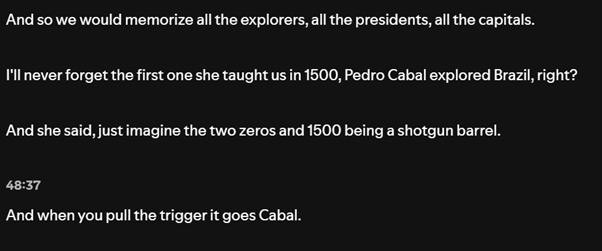
Someone, maybe Mrs Lydon, a teacher in my Primary School, taught me the power of mnemonics too.
“It is necessary for a vicar to wear one collar and two socks”.
A sure way to remember that spelling necessary involves the deployment of one collar C and two socks SS.
Emboldened by its genius when young I set about creating my own mnemonics to help me remember things. My most valuable device helps me to spell the oft tricky ‘calendar’ for example.
To spell calendar correctly you need to LEND A CAR.
You have to remember to hide the LEND A in the middle of CAR for this to work but it does work for me every time.
Maybe it will work for you too?
You’re welcome.
So now to Lean and its mnemonics! Most of the Mnemonics I can think of are acronyms, TIM WOODS, Tiger’s brother, being the most famous:
- Transportation – the product or service moving around the organisation
- Inventory – the amount of product or service present within a process
- Motion – the employee moving around the organisation to enact the process
- Waiting – the time spent for the good or service to progress to the next stage
- Over-production – making and/or delivering products or services that customers don’t want
- Over-processing – doing more than is necessary to create the good or service
- Defects – the consequences of doing something wrong within the process
- Skills – the waste of not using human intelligence
Some people prefer the acronym DOWNTIME as a way to remember the genius wastes, I guess because Tim has no immediate connection to lean but DOWNTIME is something that lean works hard to reduce. *Lean Nerd Alert* HOWEVER, downtime isn’t bad if the demand isn’t there for the goods that you are making, plus downtime can also be when necessary improvement work takes place.
Don’t diss all downtimes guys.
- Defects
- Overproduction
- Waiting
- Non-Utilized Talent
- Transportation
- Inventory
- Motion
- Excess Processing
When tackling the wastes, ECRS, is a good guide. What can we Eliminate, what tasks can we Combine, what work can we Reduce and where can we Simplify?
- Eliminate
- Combine
- Reduce
- Simplify
Of course, we should always focus on delivering FIFO – First In First Out within our processes – and we can’t just apply these lenses once, we have to engage in what Eli Goldratt calls POOGI. A Process Of OnGoing Improvement.
The Lean Principles themselves, well how do I remember those? I tend to just hone in on the key words within each principle i.e. VALUE (always, most important), VALUE STREAM (end to end), FLOW (the stream flows), PULL (at the rate the customer wants it to), PERFECTION (we POOGI – the classic ‘and we’ve just got to keep doing these things forever ‘END’ of every improvement methodology out there).
To me they are easy to remember because their sequence makes complete sense within the world of work. I encourage my students to remember them because if they reside in your head, alongside the wastes, they are honestly so helpful within a range of different meetings and conversations with customers or suppliers. They keep you on track, keep you focused, help you to remember what’s important.
Years of teaching lean have ingrained these frameworks in my brain, but every time I try to recap the principles with a group that I’ve been working with for a while, it hurts my heart that people just can’t remember them the way that I can! I throw out pop quizzes and the only people who are able to answer me are also those that seem to keep glancing at their computer screens….. HMMMM.
So let me attempt now to come up with a mnemonic that I can share with people to hopefully help to remember them.
I value the stream that flows when I pull …. erm … ahem … this is going to need some work.
- Working Smarter and Harder to Overcome Friction
- Mesmerising Mnemonics
- Recharging Batteries
- Marketing Magic
- What’s My Job Again?
- The Reports Have Gone to Her Head
- Cross Stitch Standards and Creativity
- Hefin David and the Aeroplane Arms
- Hankering for a Handbook
- Window of Light
- Defensive Organising
- McMullin’s Tandem of Co-Production
- The Joy of John Parry-Jones
- The Perils of Disappointment
- The Shield of Shame
- Customer Care and Organisation Innovation
- Hooray for Humanity!
- Angry Lemons
- Double Meanings
- Ticketing Masterplans
- When will it all end …
- Lifetime Loyalty and Taylor Swift
- Looking at Things Differently
- Networking Noodles
- Addicted to Truth
- Designs on Service Design
- The Multiple Joys of Universal Design
- Hungry Cultures
- Event Lean
- The Traffic Analogy
- Moving on Up
- Rosé Cava Revolution?
- Powerpoint Sneaky Lean
- Writing about Writing
- ChatGPT Response: Exploring the Art of Expression: Unveiling the Magic of Writing in the Style of Sarah Lethbridge
- Help to Grow Coldplay Style
- Caring IS Everything!
- Institutional Flapping
- “Just Do the Next Right Thing”
- Trust Thermoclines
- February 2026 (2)
- December 2025 (1)
- November 2025 (1)
- October 2025 (2)
- September 2025 (1)
- August 2025 (2)
- July 2025 (1)
- June 2025 (1)
- April 2025 (1)
- March 2025 (2)
- February 2025 (1)
- January 2025 (1)
- December 2024 (1)
- November 2024 (1)
- October 2024 (1)
- September 2024 (1)
- July 2024 (2)
- June 2024 (1)
- May 2024 (1)
- March 2024 (1)
- February 2024 (2)
- December 2023 (2)
- October 2023 (2)
- September 2023 (1)
- July 2023 (3)
- June 2023 (1)
- May 2023 (1)
- April 2023 (1)
- March 2023 (1)
- February 2023 (1)
- January 2023 (1)
- November 2022 (1)
- October 2022 (2)
- August 2022 (2)
- July 2022 (1)
- May 2022 (2)
- April 2022 (1)
- February 2022 (1)
- January 2022 (1)
- December 2021 (2)
- November 2021 (1)
- October 2021 (1)
- September 2021 (1)
- August 2021 (1)
- July 2021 (1)
- May 2021 (2)
- April 2021 (1)
- March 2021 (1)
- January 2021 (1)
- December 2020 (1)
- October 2020 (3)
- August 2020 (1)
- June 2020 (2)
- April 2020 (1)
- March 2020 (1)
- February 2020 (1)
- December 2019 (2)
- October 2019 (1)
- September 2019 (1)
- August 2019 (1)
- July 2019 (1)
- June 2019 (1)
- February 2019 (3)
- October 2018 (1)
- September 2018 (1)
- March 2018 (10)
- April 2016 (1)
- January 2015 (3)
- July 2014 (9)
- September 2013 (1)