Cross Stitch Standards and Creativity
10 September 2025
I seem to be living in the past a bit at the moment, probably due to recent sadnesses. After my blog on company handbooks, I couldn’t help but buy a copy of the Brownie Handbook that I referred to on eBay, in an attempt to quench my appetite for a happier and simpler time. It was a complete delight to look through again, warm feelings of nostalgia washed over me, making me hungry for more messages from yesteryear.
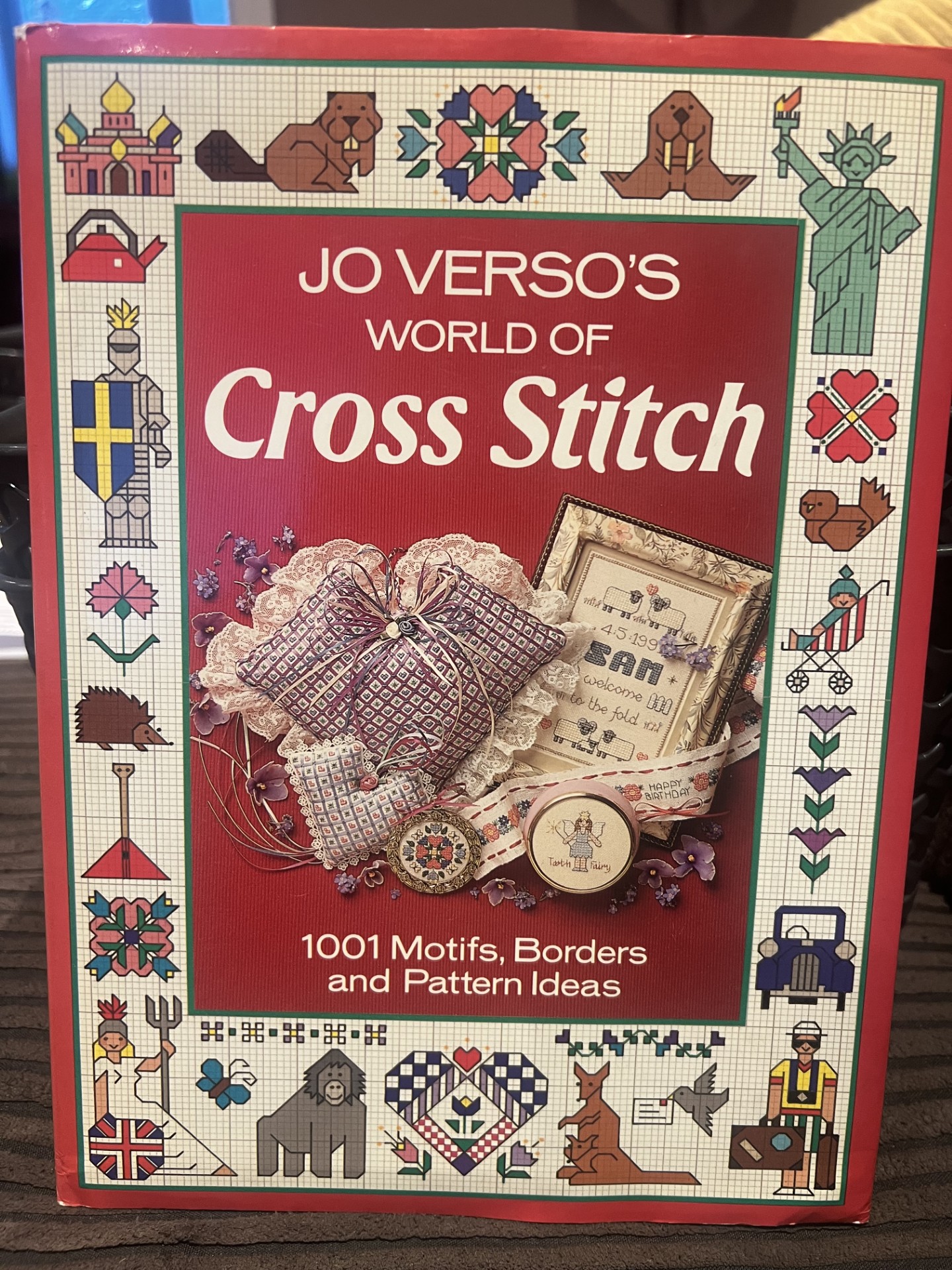
In a recent trip to Hobbycraft (my daughter’s favourite shop), when passing the book section, I was reminded of another important text from my youth. I hunted for it on the shelves but crochet seems to be much more in vogue in 2025 than cross stitch was in 1992. “Jo Verso’s World of Cross Stitch” is a genius tome, I worshipped every page, but alas, it was nowhere to be found. On reflection, it’s another book that has laid the foundation for of a key part of my personality.
I’m reminded of the Disney film Inside Out, where the key protagonist Riley collects pivotal life moments that forge the ‘islands’ of her psyche – ‘Family Island’ created from a memory of baking cookies with her parents, ‘Hockey Island’ from when she scored her first goal in a hockey game. In the same way, ‘Cross Stitch Island’ will always be a part of me. (If you haven’t watched Inside Out, you absolutely must. One of my absolute favourite people in the world is Amy Poehler, who is the main ‘feeling’ JOY within the film (btw I seriously recommend her brilliant ‘Good Hang’ podcast which is released to the world every Tuesday. In a handy moment of serendipitous connection to help to explain the film ‘Inside Out’, in today’s episode I saw a comment online which reads: “I hope that somehow Amy sees this but I’ve worked in a paediatric psych unit for years and the amount of times we use Inside Out for group therapy, emotion identification and expression, and coping, is unlike anything else I’ve seen used. It has been such a WONDERFUL tool to help the kids with their relationship to their emotions, and an even better one for us to be able to convey big things to little dudes on their own level. So thank you for that’).
It’s a beautiful and important film.
Anyway, when I couldn’t find the book on the shelves of Hobbycraft (surely Jo Verson’s world of Cross Stitch should be a seminal Hobbycraft text?! *Looks up Hobbycraft’s CEO on CEOemails.com*) I returned home to spend a frantic four hour FAILED hunt for MY book which then necessitated a visit to my Mum and Dad’s house to hunt for it too. This was a last ditch, knowingly pointless, attempt to locate it because my mum has been very effective over the years at handing over items that were conveniently ‘left behind’ by 25 year old me. Only my cassette and minidisc collection remain (they neatly fit in their respective drawers and so have thus far evaded eviction).
I cannot imagine that I would have ever have willingly disposed of it, so it’s probably in a pile of ‘stuff’ somewhere or I’ve lent it to someone (unlikely #onlychild) but thanks to ‘the world’ being literally at the end of our fingertips, I could secure a replica copy (probably in better condition than mine) from Ebay for £2.53 which would arrive in 2-3 days.
Whilst I was waiting for it to arrive I attempted to go down an internet Jo Verso rabbit hole, only to sadly learn that she tragically died, far too young, in a car crash in 2002. Unfortunately, I could find only three useful references to her life on the internet. One, a moving, beautiful blog from her daughter Jo Verso | unepetiteheure, second, a blog which has a picture of a two page spread from the ‘Cross Stitcher’ magazine about a course that Jo Verso ran (that is unfortunately of insufficient quality to be able to read) – Jo Verso – Janet Granger’s Blog and lastly a crafter’s ‘stitchblisscorner’ youtube video about her – the most complete attempt I could find at memorialising her contribution to the world, other than her books themselves I guess.
I was really shocked. In another (terribly sad) blog I comment on how grateful I am that the internet has preserved lots of lovely conversations between people I’ve lost, but it just feels like, that because Jo Verso died before the internet got into full swing, she hasn’t perhaps got the visible, searchable, legacy that she truly deserves.
Jo’s husband comments on the Youtube video to thank the creator for her episode, to which Mary Rose replies “In my opinion, Jo’s influence on stitching history is immeasurable, and through her books she is still influencing and contributing to it”. I completely agree.
Does the fact that her legacy hasn’t been memorialised to a sufficient extent on the internet mean that she hasn’t got one? Absolutely not, but yet, when you spend so much time ‘online’, if you’re not present in multiple places, maybe, it can, wrongly, kind of feel that way? I feel like if Jo Verso had have had Instagram, it would have been a complete delight and yes, feel slightly better now that hopefully this blog post might be able to be found by a fellow devoted fan’s “Jo Verso” search.
Back to Cross Stitch Island and how Jo Verso’s beautiful ‘elegantly simple’ TM designs are somehow ingrained in my soul. When I think about it, her books were the first ones that actually empowered me to be truly creative. Beautifully written, the joy of the books she created was that she gave you the templates you needed to make your own patterns. I was a demon cross stitcher before I found Jo Verso, but this just involved following a pattern as part of an embroidery kit such as Trimits Meow Mini Cross Stitch Kit 13cm x 13cm | Hobbycraft. The kits provided the right colours and amounts of threads, all you had to do was follow a pattern. I got a lot of pleasure from completing these kits (Mum would happily buy them for me … hmm… sudden thought … how many peaceful parenting hours did they generate…) but Jo Verso took things to a new level.
In the ‘World of Cross Stitch’ she gave you lots of beautiful small designs which provided you with the template to come up with your own solution. She’d encourage you to get out the graph paper and to create your own pattern that was personal to you. She provided an example of the type of thing that she was suggesting by sharing the sampler that she made for her own family.
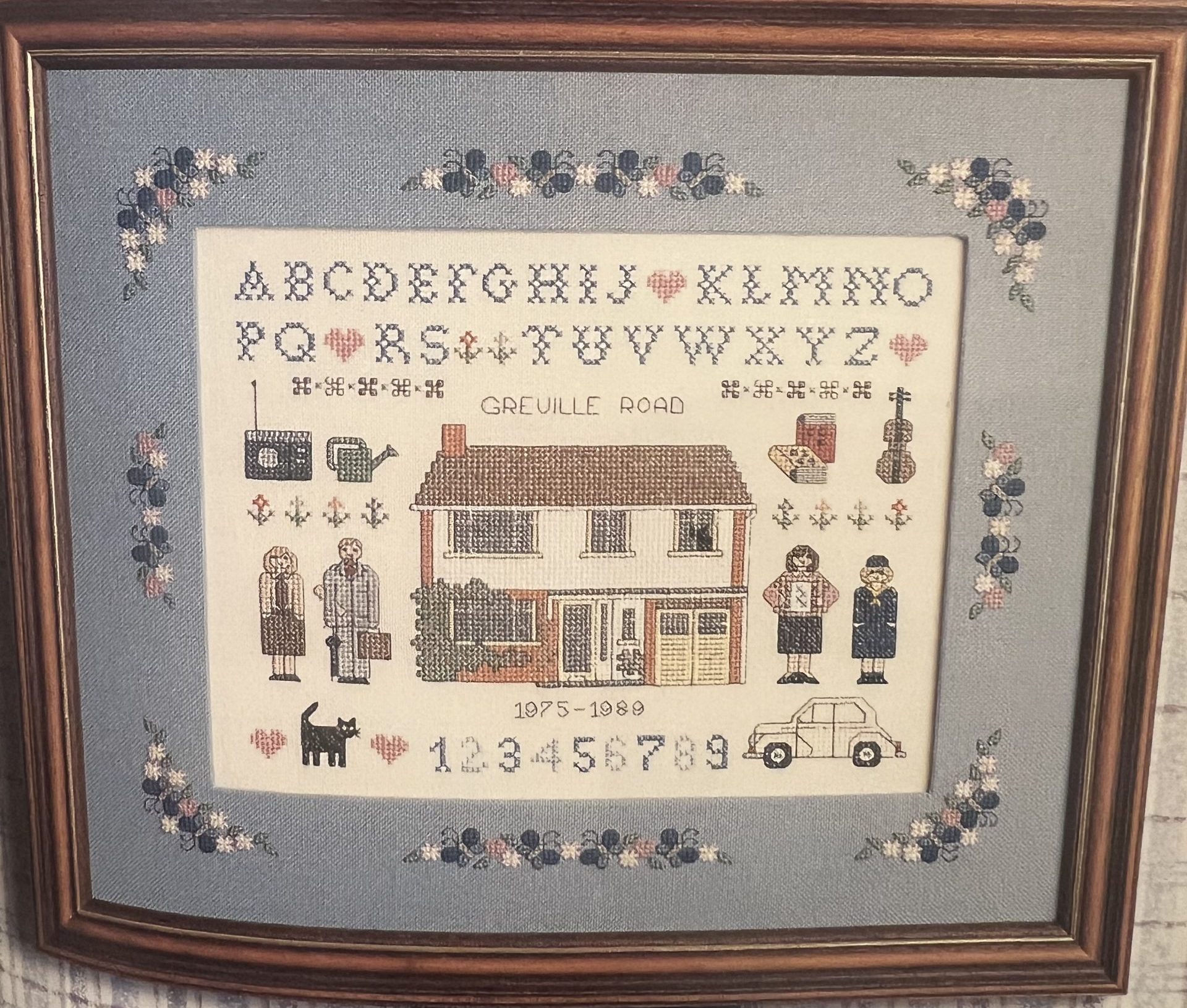
Using the book, you could adapt her characters’ hair, clothes and surround the little cartoon figures with things that meant something to that person, perhaps their pet, their favourite toys, a ball of wool with knitting needles inside, you could go wild and tailor the design precisely to your tastes and needs.
One of my most successful ever cross stitch makes, thanks to Jo Verso, was for my lovely Uncle and Auntie where I proudly stitched my uncle in his Aer Lingus ‘hi viz’ jacket, Auntie in her School cook uniform complete with apron and stirring a mixing bowl, next to my cousin Jo in her Brownie Uniform (memory slightly hazy here – I think?!) but also my cousin Sean in his Spurs football kit. Hamsters in Hamster cages and their black cat Jack either side of the family unit, complete with Union Jack (wouldn’t stitch that now obvs.) and the Tricolour of the Irish Flag and two symmetrical pints of Guinness as a jaunty border motif. I’m proud to say that this work still hangs above the inside of the front door of their family home ❤️.
I’ve eulogised about the importance of standard work often, but taking this trip down memory lane has reminded me, a good standard, like Jo Verso’s book, should actually help to liberate improvement, creativity and connection within the service world. Something that MANY organisations get wrong is that they feel the need to lock ‘difference’ down. John Seddon taught us that the very nature of services is that they are chock FULL of variety. No request for a piece of work to be completed is ever precisely the same because services are often intangible RELATIONSHIPS, which by their very nature are inherently changed, in sometimes microscopic ways, because of the humans that request them and the humans that enact them. True service delight can be achieved through personal connection and meaningful customisation.
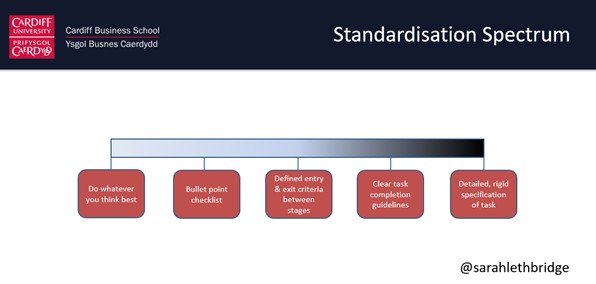
When teaching lean I often talk about the ‘spectrum of standardisation’ where at one end of the spectrum, the worker has complete freedom to respond to the task at hand and at the other end, they need to follow a detailed and rigid script. The point of the spectrum is to illustrate that there are many points on the spectrum that might be right for your particular service. You don’t have to deploy standardisation to the absolute ‘nth degree, something suitable for the manufacture of nuclear submarines (pretty important that you do this really well and to extremely high levels of quality as you can imagine). You just need to work out where you should sit on the spectrum, what’s right for your service and for your customers (plus guess what, this position will likely change over time).
I’ve also recently introduced into my teaching, the spectrum of customisation too.

But reflecting on Jo Verso’s patterns for creativity, maybe I need to rethink the spectrums…. the two spectrums are very entwined really, so maybe there’s another way to think about standardisation in service, the idea of providing a kaleidoscope of possibilities, a set of inspirations, such as Verso’s books, that empower the employee to respond creatively, exactly the way that Jo’s book inspires you to do. AI can probably even help to personalise and delight here. A new type of standard selection that doesn’t suppress and shackle, something that incites innovation.
I’m enjoying thinking about this and what it might mean for Service Design. I’ll keep musing and will report back! In the meantime, I might get out my cross stitch box of tricks again, my ‘refound’ Jo Verso books, and seek to let the creativity flow.
- Working Smarter and Harder to Overcome Friction
- Mesmerising Mnemonics
- Recharging Batteries
- Marketing Magic
- What’s My Job Again?
- The Reports Have Gone to Her Head
- Cross Stitch Standards and Creativity
- Hefin David and the Aeroplane Arms
- Hankering for a Handbook
- Window of Light
- Defensive Organising
- McMullin’s Tandem of Co-Production
- The Joy of John Parry-Jones
- The Perils of Disappointment
- The Shield of Shame
- Customer Care and Organisation Innovation
- Hooray for Humanity!
- Angry Lemons
- Double Meanings
- Ticketing Masterplans
- When will it all end …
- Lifetime Loyalty and Taylor Swift
- Looking at Things Differently
- Networking Noodles
- Addicted to Truth
- Designs on Service Design
- The Multiple Joys of Universal Design
- Hungry Cultures
- Event Lean
- The Traffic Analogy
- Moving on Up
- Rosé Cava Revolution?
- Powerpoint Sneaky Lean
- Writing about Writing
- ChatGPT Response: Exploring the Art of Expression: Unveiling the Magic of Writing in the Style of Sarah Lethbridge
- Help to Grow Coldplay Style
- Caring IS Everything!
- Institutional Flapping
- “Just Do the Next Right Thing”
- Trust Thermoclines
- February 2026 (2)
- December 2025 (1)
- November 2025 (1)
- October 2025 (2)
- September 2025 (1)
- August 2025 (2)
- July 2025 (1)
- June 2025 (1)
- April 2025 (1)
- March 2025 (2)
- February 2025 (1)
- January 2025 (1)
- December 2024 (1)
- November 2024 (1)
- October 2024 (1)
- September 2024 (1)
- July 2024 (2)
- June 2024 (1)
- May 2024 (1)
- March 2024 (1)
- February 2024 (2)
- December 2023 (2)
- October 2023 (2)
- September 2023 (1)
- July 2023 (3)
- June 2023 (1)
- May 2023 (1)
- April 2023 (1)
- March 2023 (1)
- February 2023 (1)
- January 2023 (1)
- November 2022 (1)
- October 2022 (2)
- August 2022 (2)
- July 2022 (1)
- May 2022 (2)
- April 2022 (1)
- February 2022 (1)
- January 2022 (1)
- December 2021 (2)
- November 2021 (1)
- October 2021 (1)
- September 2021 (1)
- August 2021 (1)
- July 2021 (1)
- May 2021 (2)
- April 2021 (1)
- March 2021 (1)
- January 2021 (1)
- December 2020 (1)
- October 2020 (3)
- August 2020 (1)
- June 2020 (2)
- April 2020 (1)
- March 2020 (1)
- February 2020 (1)
- December 2019 (2)
- October 2019 (1)
- September 2019 (1)
- August 2019 (1)
- July 2019 (1)
- June 2019 (1)
- February 2019 (3)
- October 2018 (1)
- September 2018 (1)
- March 2018 (10)
- April 2016 (1)
- January 2015 (3)
- July 2014 (9)
- September 2013 (1)