What’s My Job Again?
22 October 2025

Last month I talked about the “Call for Help” box within my Elements of Improvement model and this month I want to talk about a box which is giving me much food for thought at the moment – that of “Define Clear Roles and Responsibilities”.
I added this box to my wonder web because, when conducting improvement work, often I feel like what’s needed isn’t the advanced introduction of complex operations management concepts, but rather just the ability to talk to people individually, reminding them of what their job is there to achieve whilst empowering them to ‘get on and do’ so that they are delivering for their customers.
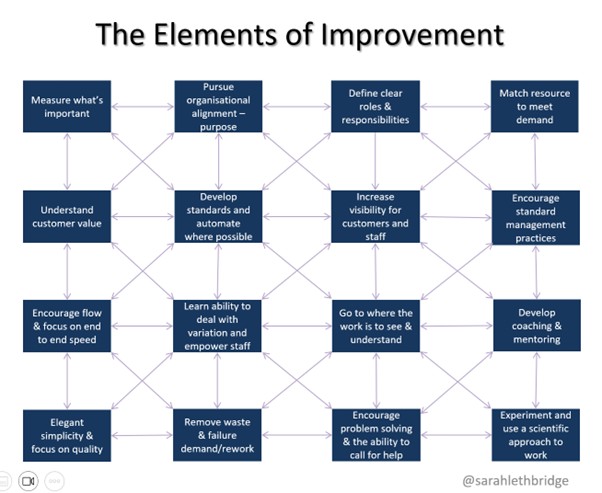
I’ve talked before about how important a sense of ‘helpfulness’ is within organisations and I think when you know what you are there to do, and that you are ‘keen to help’, honestly, so much can be achieved. In my model, the “Define clear roles and responsibilities” box works hand in hand with “Pursue organisational alignment – Purpose” and “Understand customer value” because if you have a good appreciation of what each of these blocks require, you have the foundations of an organisation that knows what it’s there to do, understands what matters to its customers, and has employees who know what their roles are in order to deliver that value and that purpose. (See how genius the model is? Sigh!)
In my role at Cardiff University I’ve been exceptionally fortunate to be able to have the freedom to forge my own career path. I fully appreciate what a luxury this is. Seeing the need for the Business School to develop an engaged Business Community, I’ve been able to create one. This hasn’t been easy at all, but I’ve been exceptionally driven by both a clear sense of purpose and also, an acute sense of who our customers are and what they value. It wasn’t a massive stretch to reach upon the conclusion that a Business School must be exceptionally connected to Business, granted, but yet we just didn’t have the structures and processes there to maximise our proximity to business before we embarked upon the creation of the Executive Education and External Engagement team. I pride myself on being able to spot patterns, spot opportunities, make connections and I had the ability, and well, freedom, to move to meet the opportunities I could see, head on.
But things are changing, and there are suddenly a lot more people around whose job titles are very much aligned to the things that I’ve been working on. The necessary pursuit of efficiency has triggered activities such as standardising academic roles across all Schools and Colleges (will my current role be allowed to exist?), plus central teams are now embarking on major attempts to create many forms of standard operating procedure, no doubt to reduce variation and glean economies of scale.
The “develop standards and automate where possible” box is looking at me wryly as I write this … oh great, it’s just laughed.
Whilst the “define roles and responsibilities box” side of me is hugely supportive and appreciative of the arrival of new positions which finally recognise hugely important University activities such as flexibility and engagement, suddenly, it’s calling into question whether or not I’m ‘stepping out of my lane’ by working on things that are now, featured within someone else’s ‘role and responsibility’ remit?
Whereas there wasn’t anyone previously that I needed to consult before I embarked upon an idea in some area, often, now, there is.
This new state of permission asking is making me question the “Define clear roles and responsibilities” box altogether. If we have too many roles too defined, where is the room for innovation and initiative?
And when I think about it, the team that we’ve built together, whilst everyone has their areas of specialism and strength, from design, writing, building relationships, attention to detail – we work very much flexibly, pitching in when there’s something big happening, covering each other’s roles when people are off and helping each other out. Also, there’s something about having an awareness of what each other does within a multi-disciplinary team, that makes everyone better at their job. I also think it makes teams immensely productive.
What do you do when you find yourself flailing somewhat in the midst of a sea of functionally aligned change? Well, I look to my wonder web for guidance and am comforted by a couple of other boxes on there, both connected to the “develop standards and automate where possible” box and both proudly sitting next to each other, side by side:
“Go to where the work is to see and understand” and “learn ability to deal with variation and empower staff”.
These two boxes are critical. Roles can only really be defined by a genuine understanding of what work is actually required – and that can only happen by truly appreciating what happens on the ground. And this work always works best when staff have been given the sufficient level of autonomy to do what they need to do for their customers. Being able to flex into other roles with fluidity, as and when required, feels quite an important element of how this can be achieved.
So it’s dangerous to just look at the implementation of one box in isolation, in this case, to just deploy “Define clear roles and responsibilities”.
The whole point of the Elements of Improvement web is that the different boxes absolutely have to work together. But perhaps I also need to stress, much more strongly, that people need to be aware of the fact that each of the concepts sitting in their own box, exists on a spectrum – such as the spectrum of standardisation, the spectrum of customisation, and maybe there’s a spectrum of job role autonomy as well.
At one end of this spectrum, you are tightly confined to working specifically to task, at the other end, you are given the freedom to work on whatever you want to work on. That’s the sort of ‘highly aligned, loosely coupled’ Netflix model of work that I’ve discussed previously and, like all of the other spectrums, where you need to sit on that spectrum should be determined through experimentation, plus, where it needs to be will change over time.
So “Define clear roles and responsibilities” absolutely has to be considered as having its own spectrum too AS WELL AS, how it connects to other concepts. More than this, I need to make sure how important small, flexible and agile teams are within successful organisations. Toyota is deeply committed to nested cells of small teams, held together by a leader who helps teams to problem solve through coaching. For more information on team size and structure please read this excellent blog by Christoph Roser – On the Team Structure at Toyota – AllAboutLean.com
So begads guys, I’m changing the box.
Behold! The newly formed “Define Roles and Responsibilities in Flexible Teams” box.

It’s my model and I’ll change it if I want to.
- Turning Sad Times into Happy Times
- Gwybod and Nabod. To Know and TO KNOW.
- You’re Not Doing it Right!
- Systems Leadership
- Working Smarter and Harder to Overcome Friction
- Mesmerising Mnemonics
- Recharging Batteries
- Marketing Magic
- What’s My Job Again?
- The Reports Have Gone to Her Head
- Cross Stitch Standards and Creativity
- Hefin David and the Aeroplane Arms
- Hankering for a Handbook
- Window of Light
- Defensive Organising
- McMullin’s Tandem of Co-Production
- The Joy of John Parry-Jones
- The Perils of Disappointment
- The Shield of Shame
- Customer Care and Organisation Innovation
- Hooray for Humanity!
- Angry Lemons
- Double Meanings
- Ticketing Masterplans
- When will it all end …
- Lifetime Loyalty and Taylor Swift
- Looking at Things Differently
- Networking Noodles
- Addicted to Truth
- Designs on Service Design
- The Multiple Joys of Universal Design
- Hungry Cultures
- Event Lean
- The Traffic Analogy
- Moving on Up
- Rosé Cava Revolution?
- Powerpoint Sneaky Lean
- Writing about Writing
- ChatGPT Response: Exploring the Art of Expression: Unveiling the Magic of Writing in the Style of Sarah Lethbridge
- Help to Grow Coldplay Style
- June 2026 (1)
- May 2026 (1)
- April 2026 (2)
- February 2026 (2)
- December 2025 (1)
- November 2025 (1)
- October 2025 (2)
- September 2025 (1)
- August 2025 (2)
- July 2025 (1)
- June 2025 (1)
- April 2025 (1)
- March 2025 (2)
- February 2025 (1)
- January 2025 (1)
- December 2024 (1)
- November 2024 (1)
- October 2024 (1)
- September 2024 (1)
- July 2024 (2)
- June 2024 (1)
- May 2024 (1)
- March 2024 (1)
- February 2024 (2)
- December 2023 (2)
- October 2023 (2)
- September 2023 (1)
- July 2023 (3)
- June 2023 (1)
- May 2023 (1)
- April 2023 (1)
- March 2023 (1)
- February 2023 (1)
- January 2023 (1)
- November 2022 (1)
- October 2022 (2)
- August 2022 (2)
- July 2022 (1)
- May 2022 (2)
- April 2022 (1)
- February 2022 (1)
- January 2022 (1)
- December 2021 (2)
- November 2021 (1)
- October 2021 (1)
- September 2021 (1)
- August 2021 (1)
- July 2021 (1)
- May 2021 (2)
- April 2021 (1)
- March 2021 (1)
- January 2021 (1)
- December 2020 (1)
- October 2020 (3)
- August 2020 (1)
- June 2020 (2)
- April 2020 (1)
- March 2020 (1)
- February 2020 (1)
- December 2019 (2)
- October 2019 (1)
- September 2019 (1)
- August 2019 (1)
- July 2019 (1)
- June 2019 (1)
- February 2019 (3)
- October 2018 (1)
- September 2018 (1)
- March 2018 (10)
- April 2016 (1)
- January 2015 (3)
- July 2014 (9)
- September 2013 (1)