Uncertainty and Asymmetry: Electoral Understanding in the 2026 Senedd Election
5 May 2026
This is a guest post from William Davies, a PhD student at Cardiff University. You can follow him on Bluesky at @willdv2002.bsky.social
As Thursday’s election draws closer and closer, it’s becoming increasingly clear, according to survey data by Dr Jac Larner (and qualitatively, the public testimony of canvassers) that a decent portion of the Welsh electorate does not hold a sufficient understanding of the electoral system following Senedd reform. This, of course, is not an issue reserved exclusively to the domain of electoral politics, as Cushion et al. have recently demonstrated, this is a fundamental issue of the ecosystem of political communication in Wales, which aims to amplify fury and fervour over public education or policy discussion. Whether it is the responsibility of the media, politicians, educators, academics, or civil society to ensure that democratic processes are understood by the public, it would first help to make clear what patterns of understanding emerge in the data.
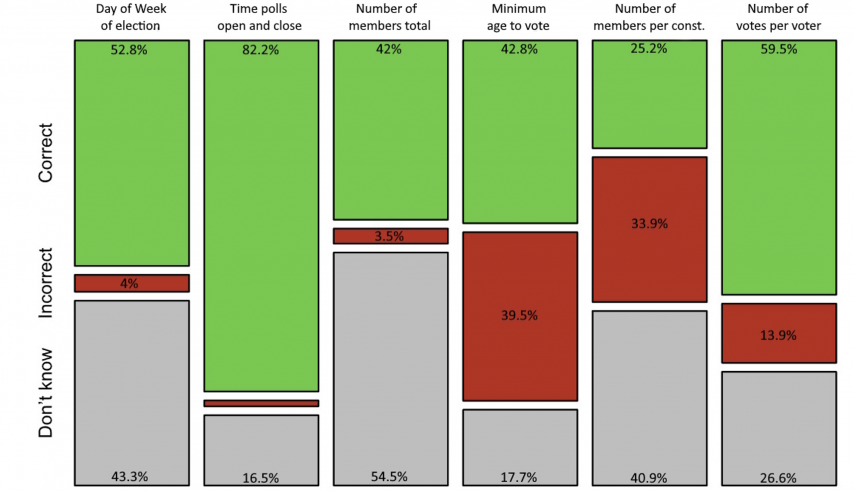
A sample of 1082 potential voters in Wales were presented with 6 statements, representing either a true statement or a false one, and asked which they believe them to be. The statements were as follows:
- Senedd elections are usually on a Wednesday (False, it’s usually on a Thursday)
- Polls open and close at 7am-10pm (True)
- 96 Members will be elected in total (True)
- The minimum age to vote in this election is 18 (False, it’s 16)
- Each constituency has one seat in the Senedd (False, it’s 6 per constituency)
- Voters may vote for more than one party (False, unlike the previous AMS system, they can only vote for 1).
In total (rounded), 50.7% of responses were correct, 16% were incorrect, and 33.2% were unsure. By any measure, this is a worrying finding for the health of Welsh democracy, but it’s important not to take this as a universally applicable fact. For one, as the graph above shows, the base of knowledge is hardly uniform, with some answers well known, while others not so much (more on this later). Secondly, there’s a conceptual difference between those surveyed, and those who will actually turnout to vote. In terms of overall performance, most people get around half the answers correct, with the number of voters getting the maximum or minimum correct answers being much lower. This begs the question: why is there so much variation in knowledge, and what can we do about it as we wake up to a new era for Welsh politics on Friday morning?
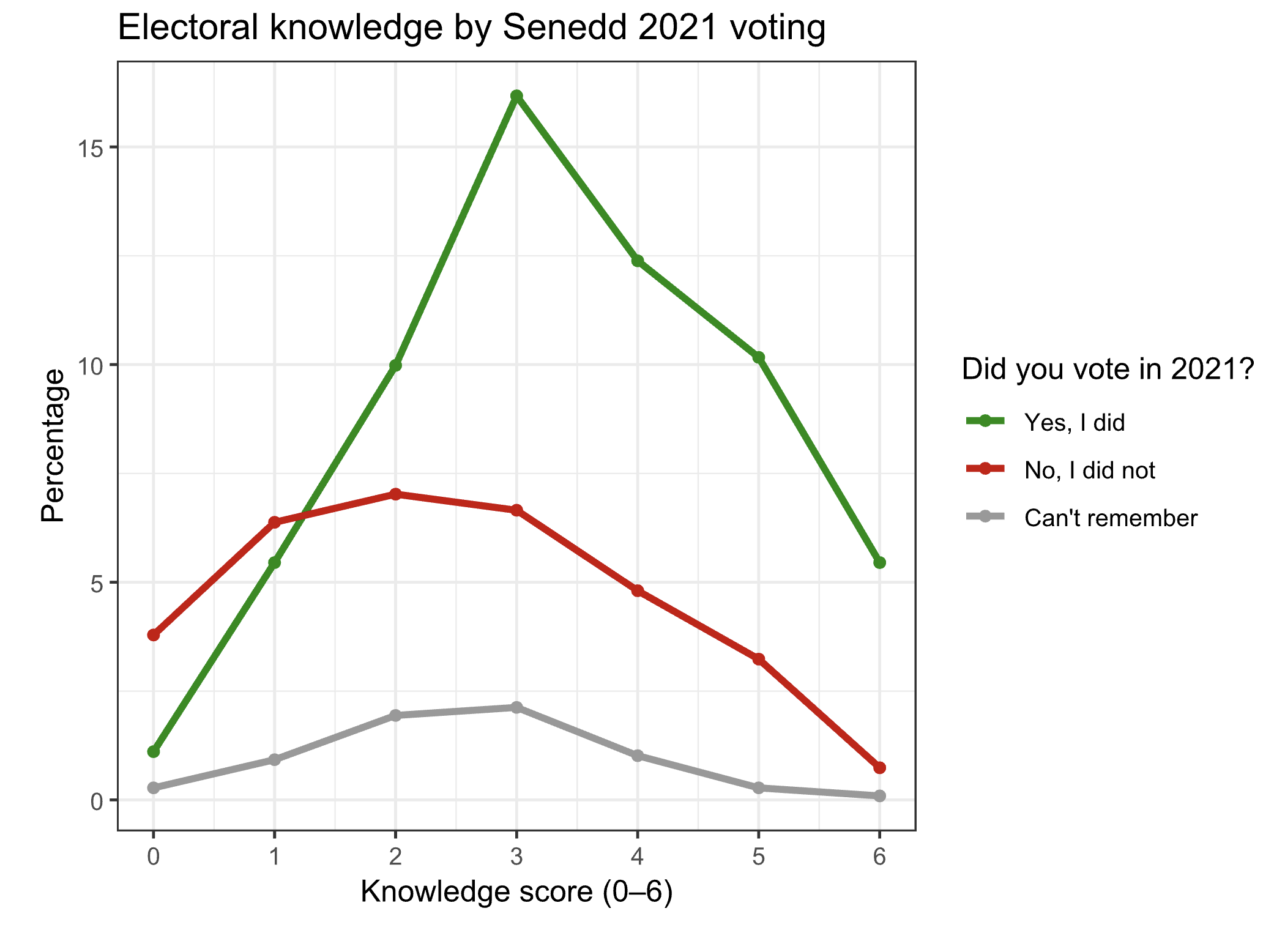
The first place to look to explore this issue would be to see whether a person voted in the previous Senedd election, and therefore may already have experience of a devolved Welsh election that can help understanding (different electoral systems, time and date, etc.). We can see that for people who either can’t remember if they voted, or remember that they did, there’s a roughly bell-shaped distribution around the middle, as you’d expect. However, those who voted are much more likely to score higher than those who did not, with non-voters skewed slightly to the lower end of the scoring. The amplitude of the graph shouldn’t be read into too much, as 60.7% of respondents voted in the last election, 32.6% did not, and 6.7% couldn’t remember – the shape is much more insightful, and shows a strong relationship between having voted in the previous election, and being knowledgeable about the election this Thursday.
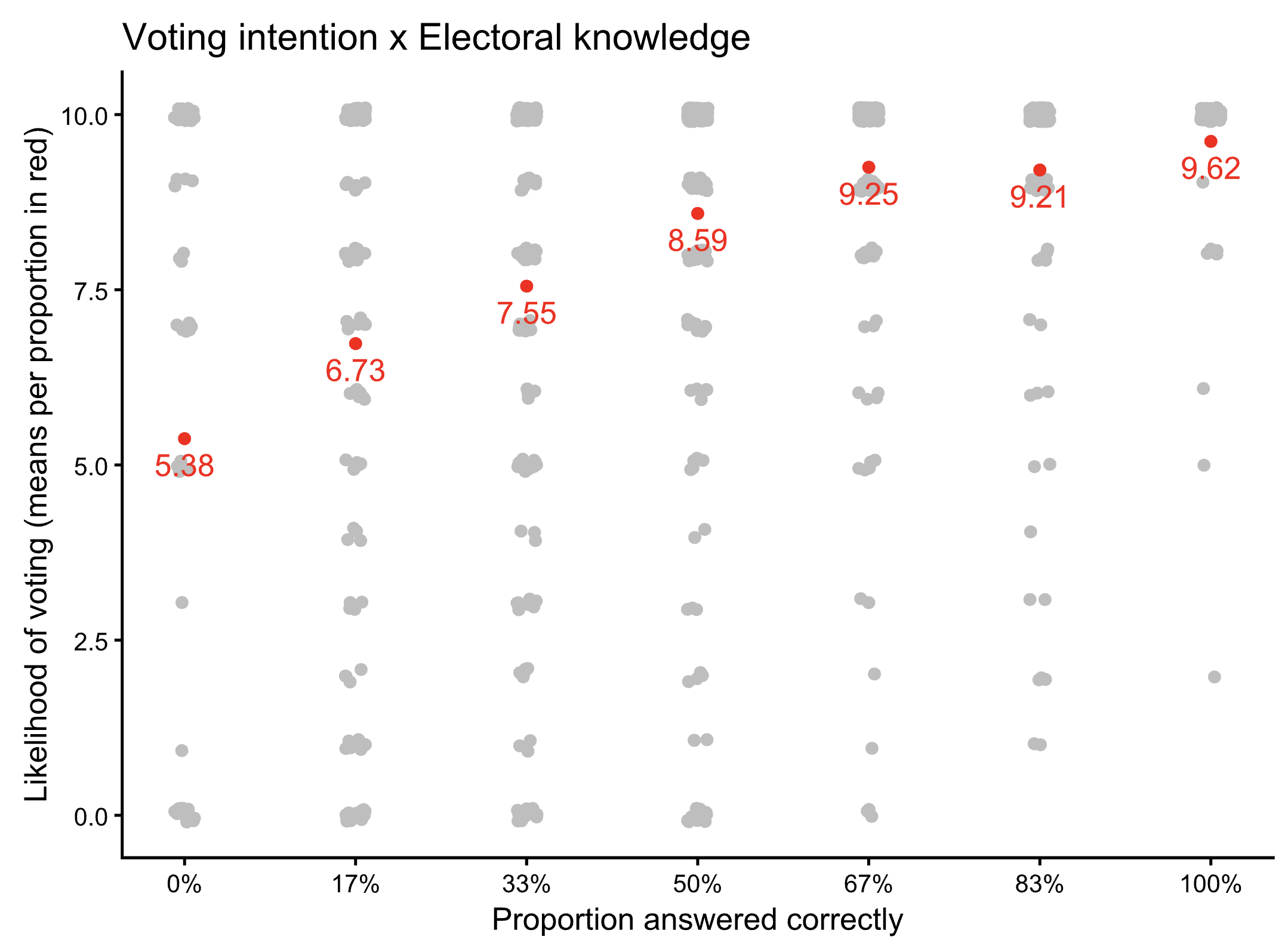
In terms of voting in 2026, when participants were asked to rate how likely they were to vote out of 10, a clear pattern emerged. On average, for every correct answer given, the odds of being in a higher likeliness-to-vote rating increased by 62.2%. Being that there are only 6 questions, and that the scale only goes to 10 in terms of likelihood to vote, this pattern starts to die down towards 4th correct answer – but as we’ve established, most people (61.8%) never reached that, which means that there is reason to suspect that potential turnout is being left on the table. Given the turnout of previous Senedd elections has been shockingly poor for a national legislature, this should not be overlooked.
Asymmetry and Discourse: For Wales, see England?
However, it’s also important to look at the questions themselves and ask why there’s a lack of uniformity across the responses. Some questions, like the one on the opening and closing times of the polls, have barely any incorrect answers (1.38%), while others like the number of seats per constituency have more incorrect answers than correct ones. One could easily argue that this is an issue of timing, that the most recent Senedd reforms are the ones with the most confusion, but that’s simply not the case. The minimum age of Senedd elections has been 16 since 2020, while the number of parties a voter could choose has only changed in the last two years, and yet a majority of participants could identify this correctly.
An unfortunate yet compelling explanation is that while all these questions apply to the Senedd elections, only three of them have the same answer as their counterparts in the Westminster elections – and these are the only ones which received a majority of correct answers. When these are removed from the data, the number of correct responses drops from 50.7% to 36.7 – only 6.4% of joint Westminster-Senedd answers were incorrect compared to 25.6% of Senedd-exclusive ones.
However, it’s important to note that the question on the number of members overall showed no such relationship, actually having a much lower proportion of incorrect answers to correct ones (3.5% to 41.9%) than the other Senedd-exclusive questions. This is where it is important to look at the political context surrounding this reform, where the move from 60 to 96 members of the Senedd has been controversial for voters from its conception. The Welsh Conservative manifesto released in March explicitly called for this decision to be reversed, saving £20 million a year according to them, while Reform UK’s Llyr Powell has stated “Wales doesn’t need more politicians”. Even if voters are unpersuaded by the economical argument (which from seat projections showing the Welsh Conservatives close to a wipeout, may be the case) the persistence of the line that “no one wants more politicians in Cardiff Bay”, much like the insistence on talking about 20mph limits, has shown that the Sixth Senedd’s legacy is continuing to bleed into the discourses around who should lead the Seventh, and it could be argued that this explains this oddity in what would otherwise be a fairly clear Westminster-Wales split.
Uncertainty: The silent challenge facing the Seventh Senedd
The key trend across the data is that voters aren’t especially willing to guess incorrectly (with some exceptions mentioned above), but are very willing to admit they don’t know the answer. As shown in Fig. 2, given “don’t know” makes up a large proportion of non-correct responses, there’s a strong relationship between not knowing and not voting. On one hand, some may see this as a form of self-selection, that those who are aware they don’t know enough are choosing not to vote. On the other, this means participation in our democracy could be stunted, not by misinformation as many fear but a lack of confidence in recalling information.
This uncertainty shapes the way that politics operates, creates gaps in the public debate for untruths to slip through without proper scrutiny. We see this in the vastly alternative views the parties take on the mechanics of the electoral system itself when speaking to voters (is it a “two-horse race”, or does any party really have a chance at the constituency level?). If we truly want a healthy Welsh democracy, which was the justification for Senedd reform in the first place, we should start with explaining to the public how it works. It may be too late for this election, but certainly by the review of these reforms in the Seventh Senedd, the way in which information is disseminated to the public should be a key priority.
- October 2026
- July 2026
- June 2026
- May 2026
- April 2026
- March 2026
- December 2025
- November 2025
- October 2025
- September 2025
- June 2025
- May 2025
- March 2025
- February 2025
- December 2024
- October 2024
- September 2024
- July 2024
- June 2024
- December 2023
- November 2023
- August 2023
- February 2023
- December 2022
- November 2022
- September 2022
- July 2022
- April 2022
- March 2022
- January 2022
- October 2021
- July 2021
- May 2021
- March 2021
- January 2021
- November 2020
- October 2020
- August 2020
- July 2020
- June 2020
- May 2020
- April 2020
- March 2020
- October 2019
- September 2019
- June 2019
- April 2019
- March 2019
- February 2019
- December 2018
- October 2018
- July 2018
- June 2018
- April 2018
- December 2017
- October 2017
- July 2017
- June 2017
- May 2017
- April 2017
- March 2017
- February 2017
- January 2017
- December 2016
- November 2016
- October 2016
- September 2016
- Bevan and Wales
- Big Data
- Brexit
- British Politics
- Constitution
- Covid-19
- Democracy
- Devolution
- Elections
- Equality
- EU
- Finance
- Gender
- History
- Housing
- Introduction
- Justice
- Labour Party
- Law
- Local Government
- Media
- National Assembly
- National identity
- Plaid Cymru
- Prisons
- Reform UK
- Rugby
- Senedd
- Senedd Election 2026
- Theory
- Uncategorized
- Welsh Conservatives
- Welsh Election 2016
- Welsh Elections