The World Cup is coming, but does football influence national identity at home?
9 June 2026
This is a guest post from James Griffiths at the University of Manchester. You can follow him on Bluesky @jamesdgriffiths.bsky.social
“The imagined community of millions seems more real as a team of eleven named people.” (Hobsbawm 1992: 143).
Sport has an exceptional power to make national identity visible. For those living in England or Scotland, the sudden appearance of flags, football shirts, and packed pubs will be a dead giveaway that the World Cup has started. So, what better time to share part of our recent research on how international sport associates with the strength of national identities in Britain?
Researchers have long been interested in the relationship between sport and national identity. Normally, though not always, symbols of nationhood sit in the background of everyday life. Sporting events bring them to the surface, as moments where people are united in support of their nation. People still talk about the feelings prompted by the 2012 Olympics and Wales’s Euro 2016, and the emotions stirred by England’s recent footballing near-successes have even inspired dramatization.
However, quantifying the exact impact of a sporting event on national identity is harder than it sounds, as survey data rarely exists at the right moments. One study found a very small uptick in English national pride after the men’s side lost in the 2018 World Cup semi-finals, but since it compared two different cross-sectional samples, we can’t know whether the shift reflects genuine attitude change or sampling variation.
Fortunately, the 2024 UK General Election’s proximity to men’s UEFA Euro 2024 creates a rare opportunity. The British Election Study Internet Panel ran four waves between 3rd May and 19th July, neatly bracketing both the tournament (14th June–14th July) and the election (4th July), allowing us to track how each event shaped national identity over time. Identity was measured on a 7-point scale across British, English, Scottish, and Welsh dimensions. Since each nation competes under its own flag in football, we expected the tournament to move sub-national identities more than Britishness. We also split the analysis by football club fandom, to account for those with a pre-existing investment in the tournament.
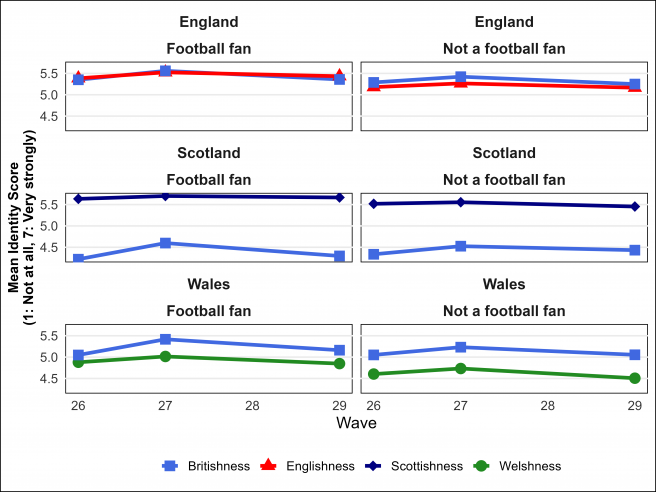
The results, though, were surprising. While football fans generally have higher levels of national identity than non-football fans, it appears that the General Election appears to have had a greater effect on national identity than the Euros (Figure 1). We say this for two reasons. First, changes are concentrated in Britishness in all three nations, despite England and Scotland both qualifying for the tournament. Second, the shift appears between waves 26 and 27 (i.e. immediately before/after the election was called), before fading back to pre-announcement levels in wave 29, the post-election wave. This is striking given that the Euros continued throughout much of wave 29, especially as England played three knockout games – including the final – in that period! Taken together, our patterns point to the election, rather than the football, as the driver of the small, temporary rise in Britishness. One possible explanation is that the election made politics salient, momentarily making British identity feel more immediately relevant when answering a survey with a lot of political questions.
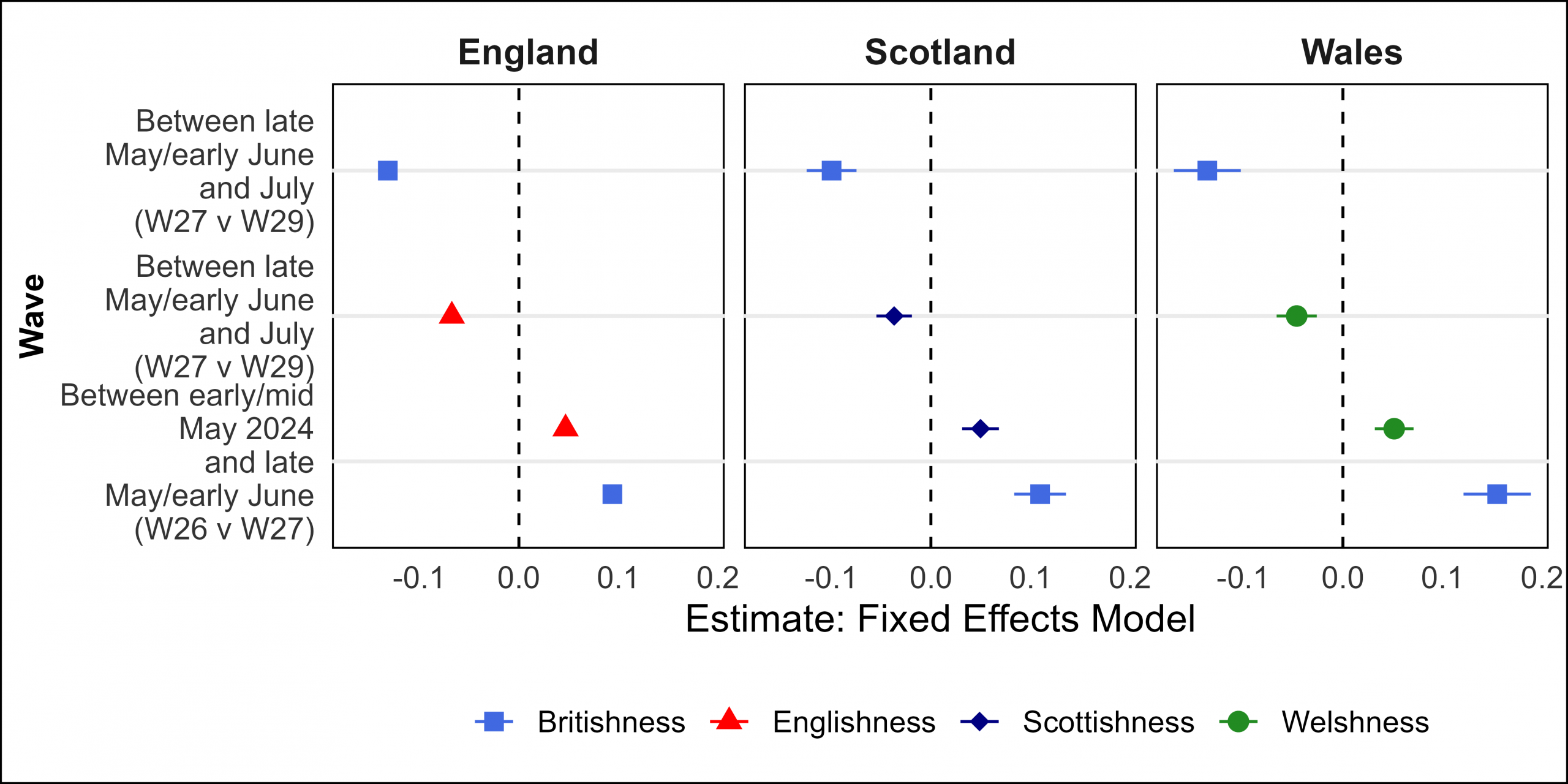
To dig deeper, we ran a model with a fixed effect for individuals, capturing whether people changed their identities between waves rather than just looking at group averages. These results (Figure 2) confirm the same pattern: people felt more strongly British when the election was called, but the effect was temporary, largely reversing after the election concluded — even as the Euros continued.
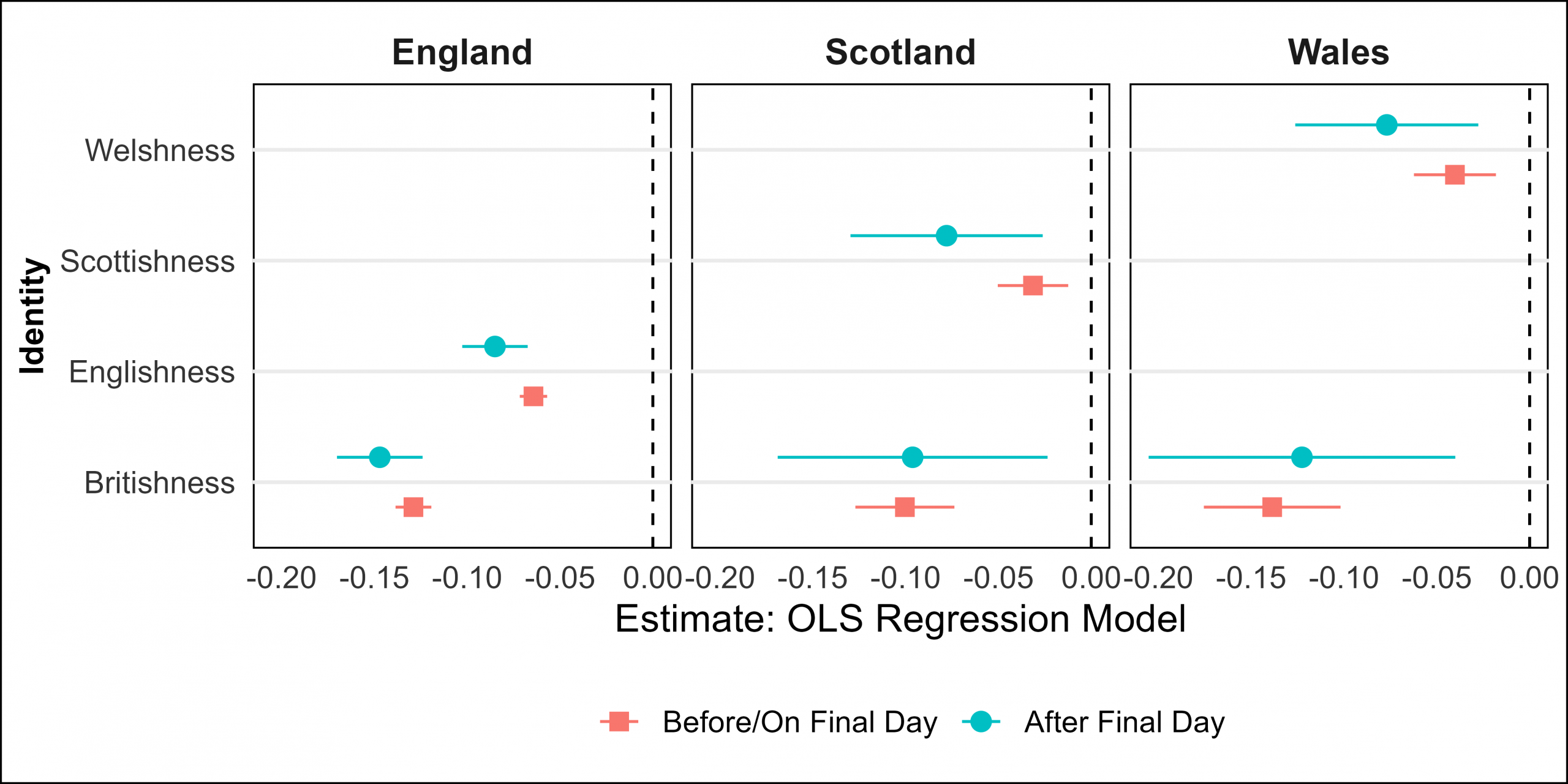
We also tested whether England’s defeat in the Euro 2024 final produced a measurable within-individual change (Figure 3). Comparing identity scores in wave 29 against wave 27, and splitting by whether someone was surveyed before or after the final, we found no statistically significant difference. There is a slightly greater drop in both Britishness and Englishness among those measured after the final, but it falls well short of significance. What the data reiterates, instead, is that national identity dropped for everyone once the election was over.
So, does this mean football has no effect on national identity? No, but it does suggest that its effect is to activate existing identities, rather than intensify them. People already know how they feel about their national identity going into the tournament, but they may just not express it in their daily life. That changes when an international tournament begins, prompting people to dress, drink, and chant in their country’s colours. In this sense, sport may not necessarily forge new national identities so much as it makes existing ones visible and audible. Of course, this might change if a country were to actually win a tournament…
- October 2026
- July 2026
- June 2026
- May 2026
- April 2026
- March 2026
- December 2025
- November 2025
- October 2025
- September 2025
- June 2025
- May 2025
- March 2025
- February 2025
- December 2024
- October 2024
- September 2024
- July 2024
- June 2024
- December 2023
- November 2023
- August 2023
- February 2023
- December 2022
- November 2022
- September 2022
- July 2022
- April 2022
- March 2022
- January 2022
- October 2021
- July 2021
- May 2021
- March 2021
- January 2021
- November 2020
- October 2020
- August 2020
- July 2020
- June 2020
- May 2020
- April 2020
- March 2020
- October 2019
- September 2019
- June 2019
- April 2019
- March 2019
- February 2019
- December 2018
- October 2018
- July 2018
- June 2018
- April 2018
- December 2017
- October 2017
- July 2017
- June 2017
- May 2017
- April 2017
- March 2017
- February 2017
- January 2017
- December 2016
- November 2016
- October 2016
- September 2016
- Bevan and Wales
- Big Data
- Brexit
- British Politics
- Constitution
- Covid-19
- Democracy
- Devolution
- Elections
- Equality
- EU
- Finance
- Gender
- History
- Housing
- Introduction
- Justice
- Labour Party
- Law
- Local Government
- Media
- National Assembly
- National identity
- Plaid Cymru
- Prisons
- Reform UK
- Rugby
- Senedd
- Senedd Election 2026
- Theory
- Uncategorized
- Welsh Conservatives
- Welsh Election 2016
- Welsh Elections