The First Supplementary Budget: what it means and the options ahead
8 July 2026
Owain Cynfab and Ed Gareth Poole
A lot has changed since the outgoing Welsh Labour government set out its Final Budget for 2026–27. Not only has UK government spending crept up – which means extra cash has landed in Cardiff Bay – but a new Welsh First Minister and UK Prime Minister will take office within ten weeks of each other.
The new Welsh Government’s First Supplementary Budget, published at the end of June, sets out how the Plaid Cymru administration proposes to allocate these additional resources, and provides an early indication of its priorities.
Plaid Cymru forms a minority government and will require support from either Reform UK, Welsh Labour or the Welsh Conservatives for the budget to pass in the upcoming vote on 14 July.
This blog post examines the additional spending proposals included in the budget, who might possibly sign up to it, and where the sticking points lie ahead of Tuesday’s vote.
Where did the extra money come from?
Mark Drakeford’s “neutral” approach to the 2026-27 Final Budget left around £40 million of day-to-day spending unallocated. Since then, two ‘consequentials’ have topped up the pot:
- £327 million from the UK Government’s Spring Statement – most of which comes from writing off accumulated Special Educational Needs and Disabilities (SEND)-related deficits held by English local authorities
- £46 million from the UK Government’s Main Estimates.
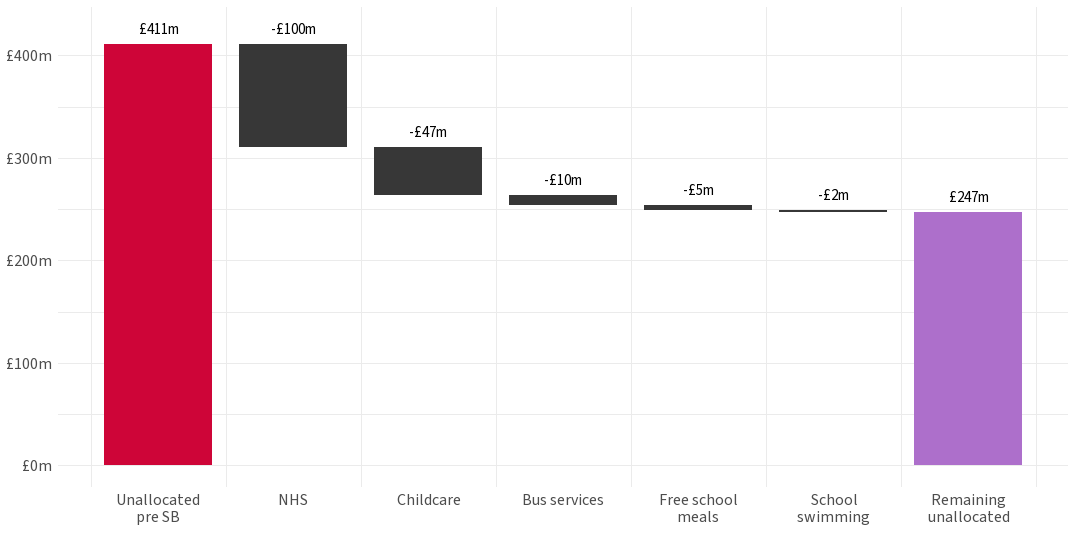
Taken together, these developments increased the amount of day-to-day spending available for 2026-27 by approximately £411 million.
What’s on the table
Of the £411 million available, the Supplementary Budget allocates £164 million to new day-to-day spending priorities:
- £100 million for the NHS aimed at reducing waiting lists
- £47 million for childcare and early years support, of which £24 million supports the expansion of funded childcare to two-year-olds
- £8 million to continue the £1 bus fare scheme for young people
- £5 million to begin extending free school meals to secondary school pupils in households receiving Universal Credit
- £2 million for a new north-south bus service
- £2 million for school swimming provision
This leaves roughly £247 million of day-to-day funding still unallocated – a decent-sized war chest for whatever comes next.
Figure 1: Changes to unallocated Resource Spending
Source: Analysis of Welsh Government budget documents
The budget also includes capital allocation of £130 million, with the lion’s share going to the NHS and public infrastructure:
- £45 million for the NHS (£25m for new surgical and diagnostic hubs and £20m for maintaining the NHS estate)
- £60 million for education (£40m for school maintenance, £10m for childcare settings, and £10m to support the free school meals rollout)
- £20 million is allocated to social housing
- £5 million for community facilities
Caveating the numbers
Before considering the impact of these allocations, some of this year’s headline figures aren’t directly comparable to last year’s because ministerial portfolios have been reshuffled. Childcare has moved from the old Health and Social Care brief into Social Justice, and the new portfolio is now called Health and Care, so like-for-like comparisons need a bit of care.
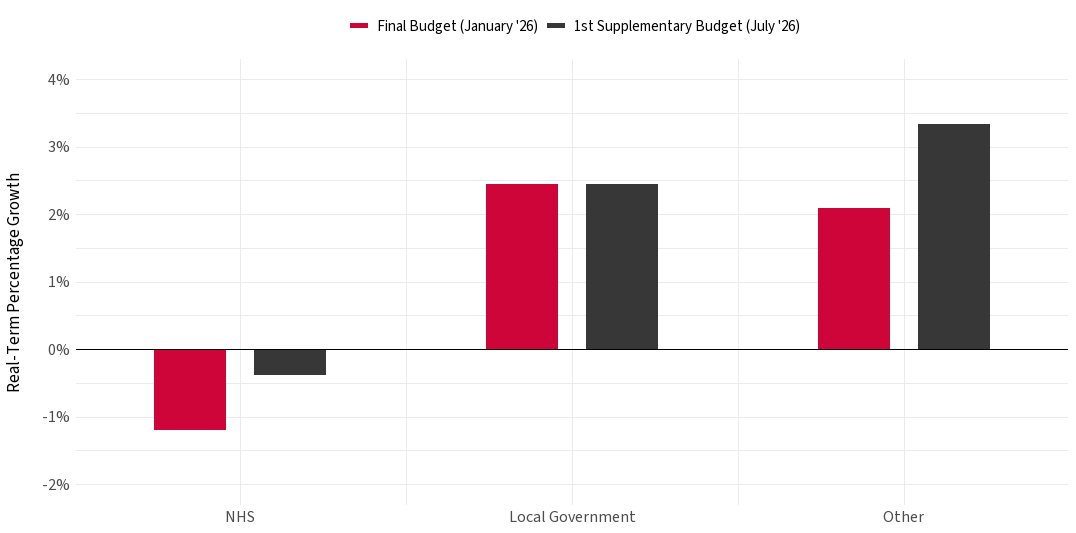
Under the old portfolio structure and prior to the First Supplementary Budget, Health and Social Care was heading for a 1.2% real terms cut in 2026–27. Add in an additional £100 million allocated to the NHS and £47 million for childcare, and spending would have been broadly flat in real terms. But under the new structure, and once childcare costs are removed, the Health and Care budget is set to fall by around 0.42% in real terms.
The NHS: still the elephant in the room
Comparing NHS spending to the rest of the budget is always the simplest way to see where the government’s real budgetary pressures lie – and the picture remains extremely tight. Even after £100 million top-up in the supplementary budget, the NHS still faces a real term cut of 0.38%.
Figure 2: Real Term growth (%) in 2026-27 spending compared to 2025-26
Source: Analysis of Welsh Government budget documents[1]
Why will the NHS face real-terms cuts even with more than a hundred million pounds in top-ups at the supplementary budget? This is happening because of an unusually large £286 million drawdown from the Wales Reserve in 2025–26 – Wales’ piggy bank, which normally faces strict annual limits on how much can be taken out. The previous government secured sign-off from the UK Government for the withdrawal on the basis of “exceptional circumstances”, in an effort to bring down NHS waiting lists. That withdrawal gave 2025–26 spending a boost, but it also raised the baseline that this year’s budget is being measured against. What’s more, it’s not obvious the waiting list pressures behind that drawdown were particularly exceptional or one-off. If they weren’t, that £286 million cushion may have masked rather than resolved the pressure, and the underlying fiscal squeeze remains in place.
Will it pass?
The Senedd will vote on the Supplementary budget on Tuesday 14 July. Given that cutting NHS waiting lists is a manifesto commitment for pretty much every party, you might have expected a budget that funnels most of its new money towards the NHS to have faced a fairly easy ride. It hasn’t quite worked out that way.
Labour and Reform have both criticised the budget for not setting aside additional funding for local government in Wales. They argue that money arising from SEND-related spending in England should be largely passed on to Welsh local authorities to help with rising demand for additional learning needs (ALN) provision.
The Welsh Government isn’t obliged to directly pass on consequentials in this way – after all, that’s the reason that devolved institutions have independent budget-setting powers in the first place. Broadly speaking, previous Welsh government budgets and different rules over ALN eligibility mean that local authorities in Wales are in a different starting position to those in England – although they still face enormous cost pressures relating to ALN and adult social care. Given this different background there’s at least a case to be made that at least some of the additional funding could be allocated to other areas of the budget. Whether that’s a strong enough argument to satisfy Labour and Reform is a different question, and one the vote on Tuesday should help answer.
What might happen with the remaining £247 million?
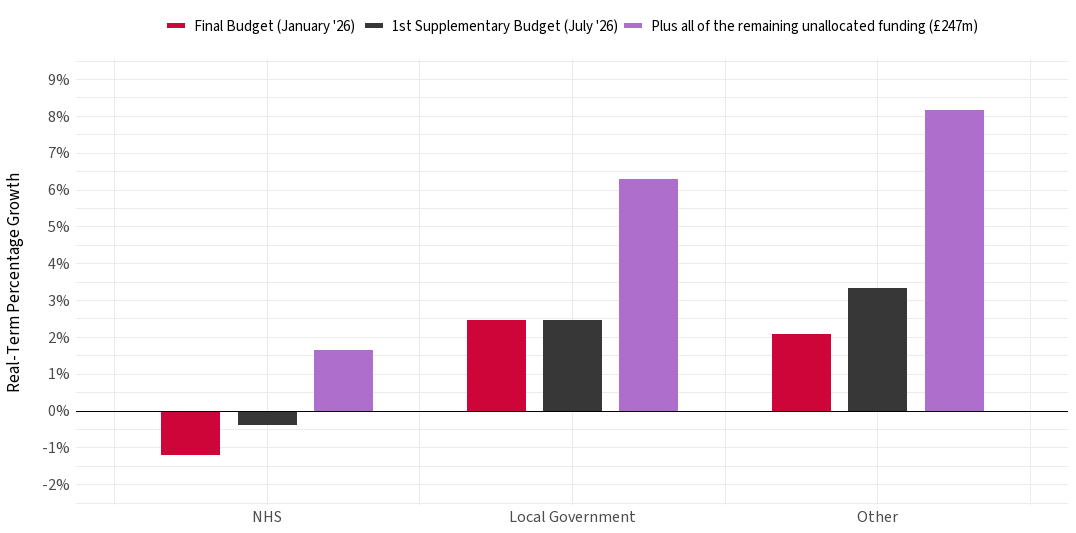
Given the relatively large amount of funding still unallocated and the broadly uncontroversial nature of much of the spending already proposed in the Supplementary Budget, we would expect Plaid Cymru to be able to use the remaining funding to try and secure an agreement with at least one other party.
Figure 3: options for the remaining unallocated resource funding.
Source: Analysis of Welsh Government budget documents
A few ways this could play out:
Go all-in on the NHS. Allocating the full £247 million of resource funding to the NHS would result in real-terms growth of around 1.6% – better than nothing, but still less than half the historic average of 3.6%. Just keeping the NHS budget flat in real terms, meanwhile, would only require about £46 million, leaving it exposed to any inflation shocks that come along.
Split the difference with local government. If NHS spending were held flat, that leaves around £200 million free for local government – a real-terms increase of about 5.6% for 2026–27. That’s a big jump by recent standards, but it still falls short of the £340 million increase Labour is calling for, which would require cutting the NHS budget by at least 0.6% in real terms.
Make a start on childcare. Plaid Cymru might also want to put some of the remaining funding towards its £400 million childcare offer. Labour has a childcare commitment of its own, but with opposition MSs currently laser-focused on local government funding, a childcare-led deal looks like a tough sell right now. Reform UK didn’t include a childcare pledge in its manifesto at all, and while the Conservatives did set out plans to expand provision, it doesn’t seem to be top of their list of priorities. Securing support around childcare in the Supplementary Budget looks like an uphill battle for the new government.
The longer game
It’s also worth looking beyond Tuesday. As we have previously highlighted, the outlook for 2027–28 remains very challenging, with the Welsh Government’s resource budget currently projected to shrink in real terms. That said, there’s genuine uncertainty in both directions – for example, a future UK Government under Andy Burnham could loosen the purse strings in a way that increases funding available for Wales, or rising inflation and new pressures (including recent defence spending commitments) could make things tighter still.
Given this uncertainty, there is a case for holding back some of the £247 million back rather than allocating it all now. The trouble is, a deal with no obvious “win” attached may be a hard sell to opposition parties who’ll want something to show for their support.
The First Test of Minority Government
The First Supplementary Budget is therefore about more than allocating an unexpected £411 million windfall. It is the first real test of how Plaid Cymru intends to govern as a minority administration, and whether it can build the cross-party support needed to do so. Whatever the outcome of next week’s vote, it is unlikely to resolve the underlying fiscal pressures facing Wales. The more difficult spending choices are still to come.
[1] Local Government Aggregate External Finance taken from Final Local Government Settlements.
NHS services line includes Budget Expenditure Lines supporting the NHS in Wales (excludes BELs related to social service and integration, early years, CAFCASS, Food Standards Agency and the inspectorates)
- October 2026
- July 2026
- June 2026
- May 2026
- April 2026
- March 2026
- December 2025
- November 2025
- October 2025
- September 2025
- June 2025
- May 2025
- March 2025
- February 2025
- December 2024
- October 2024
- September 2024
- July 2024
- June 2024
- December 2023
- November 2023
- August 2023
- February 2023
- December 2022
- November 2022
- September 2022
- July 2022
- April 2022
- March 2022
- January 2022
- October 2021
- July 2021
- May 2021
- March 2021
- January 2021
- November 2020
- October 2020
- August 2020
- July 2020
- June 2020
- May 2020
- April 2020
- March 2020
- October 2019
- September 2019
- June 2019
- April 2019
- March 2019
- February 2019
- December 2018
- October 2018
- July 2018
- June 2018
- April 2018
- December 2017
- October 2017
- July 2017
- June 2017
- May 2017
- April 2017
- March 2017
- February 2017
- January 2017
- December 2016
- November 2016
- October 2016
- September 2016
- Bevan and Wales
- Big Data
- Brexit
- British Politics
- Constitution
- Covid-19
- Democracy
- Devolution
- Elections
- Equality
- EU
- Finance
- Gender
- History
- Housing
- Introduction
- Justice
- Labour Party
- Law
- Local Government
- Media
- National Assembly
- National identity
- Plaid Cymru
- Prisons
- Reform UK
- Rugby
- Senedd
- Senedd Election 2026
- Theory
- Uncategorized
- Welsh Conservatives
- Welsh Election 2016
- Welsh Elections