2026 Senedd election analysis: the fiscal outlook
1 April 2026
In our recent report, Setting the Scene: Wales on the eve of the 2026 Senedd Election, we outlined recent trends in Welsh Government funding and spending. In this blog, we outline the fiscal outlook in more detail, highlighting some of the difficult choices and huge uncertainty the next Welsh Government is likely to face.
Summary
- The next Welsh Government will have £356 million of day-to-day spending to allocate at supplementary budgets in 2026-27. The immediate priority will likely be the NHS. Exceptional drawdowns from the Wales Reserve and in-year funding in 2025-26 means NHS spending is now set to fall in real terms in 2026-27 on current plans, for the first time since 2012-13.
- Beyond 2026-27, the budget outlook looks difficult. Overall, projected resource funding is set to grow from £24.3 billion in 2026-27 to £26.9 billion in 2030-31. In real terms, this would be an average increase of just 0.7% per year in real terms. Capital spending could fall by almost 9% in real terms over the course of the Senedd term.
- If NHS spending grows by the long-run historical average of 3.6% per year in real terms (as it has since 2019-20), then non-NHS spending would have to fall by 2.7% per year in real terms to 2030-31. If NHS spending growth slowed to 1.8% per year, non-NHS spending would still fall by 0.6% per year in real terms.
- However, it can be argued that this budget outlook – which takes UK government future spending plans at face value – may prove to be too pessimistic. Successive UK chancellors have pencilled in slower growth in spending for future years, which have invariably been topped up. In the context of a UK general election in 2029, spending on public services may well grow faster than current plans imply, making those trade-offs much less acute.
- Party manifestos should recognise some of the trade-offs the next Welsh Government will potentially face and acknowledge that large-scale new spending commitments or tax cuts will be difficult without a change in the fiscal outlook. And if the UK Chancellor does stick to the very tight spending plans towards the end of this Westminster term, these manifesto commitments will not be possible without significant reprioritising of funding and cuts to services.
- But manifestos are not budget documents and given the electoral system and current polling, negotiations and agreements will be required to form the government and pass budgets. The manifestos may unfortunately be silent on the fiscal trade-offs the next Welsh Government will face but may well indicate what each party would prioritise in those talks.
There is significant funding to allocate for 2026-27, with the NHS the likely priority
The next Welsh Government will have some immediate fiscal choices to make.
The UK government’s Spring Statement in March contained significant additional funding for the Welsh Government, due to the writing-off of accumulated SEND-related debts for English local authorities.
This means there is £356 million of day-to-day spending to allocate at the First Supplementary Budget for 2026-27. On capital spending, the “neutral” approach to the budget means there is £118 million left to allocate for investment in 2026-27.
The immediate priority is likely to be the NHS. At supplementary budgets for 2025-26, the Welsh Government allocated £300 million towards the NHS for in-year pressures and reducing waiting times. This additional spending was largely funded by drawing-down all the available resource funding (£286 million) from the Wales Reserve. Under the Fiscal Framework rules, resource funding drawdowns from the Wales Reserve are capped at £125 million per year, but the UK government waived the drawdown limits for 2025-26.
This exceptional funding means NHS spending increased by 3.9% in 2025-26 (or 3.0% after accounting for funding for increased employer NICs), much faster than originally planned. But this also means that the planned increase in NHS spending for 2026-27 is now much smaller. In fact, spending on the NHS is set to fall by 1.2% in real terms, for the first time since 2012-13.[1] This would be particularly difficult considering proposed pay rises of 3.3% (in cash terms) for NHS staff on Agenda for Change contracts next year.[2]
Even if all currently unallocated funding goes towards the NHS, spending will increase by 1.7% in real terms, below the average growth since 2019-20 (3.7%).
The exceptional waiving of reserve drawdown limits and pre-election year funding for the NHS has created somewhat of a bind for the next Welsh Government.
UK government spending plans imply a difficult budget outlook for day-to-day spending
Beyond 2026-27, the outlook for the Welsh budget looks difficult.
Block Grant funding for day-to-day spending from the UK government is set to fall in real terms in 2027-28 before increasing by 1.5% in 2028-29. Beyond 2028-29, we use the UK government’s pencilled-in plans for total departmental spending to estimate likely consequentials for the next Welsh Government.
The positive net effect of tax devolution – caused by faster growth in revenues compared to corresponding Block Grant Adjustments – is set to continue at its current level of around £500 million. Revenues from Non-Domestic Rates, paid by businesses, are also set to increase as temporary reliefs are removed and the multiplier increases.
Overall, total projected resource funding is set to grow from £24.3 billion in 2026-27 to £26.9 billion in 2030-31. In real terms, this would be an average increase of just 0.7% per year in real terms.
Capital spending is set to fall in real terms over the next Senedd term
The core capital block grant is set to remain at around £3.3 billion in cash terms to 2029-30, and given indicative plans for 2030-31, will fall slightly in the final year of the forecast.
The Welsh Government can borrow £165 million for capital spending in 2026-27 and this will now increase in line with inflation to 2030-31.
Some capital funding from the UK government – some £152 million in 2026-27 – sits outside of the core block grant and is set to fall to £44 million by 2029-30.[3]
Overall, this means that the Welsh Government’s core capital budget (excluding Financial Transactions funding) could fall by 9% in real terms from 2026-27 over the course of the next Senedd term. The unallocated funding available for 2026-27 therefore masks some difficult choices and trade-offs in future years.
In that context, further use of the off-the-books ‘Mutual Investment Model’ to use private sector borrowing could be attractive. However, such projects will have a meaningful impact on day-to-day spending over coming years and will likely entail higher costs than spending funded by devolved borrowing.
This funding outlook implies some very difficult choices for the next Welsh Government
Based on this funding outlook, the next Welsh Government faces some very difficult choices.
As it accounts for over half of day-to-day spending, the key consideration is how quickly NHS spending will grow over coming years.
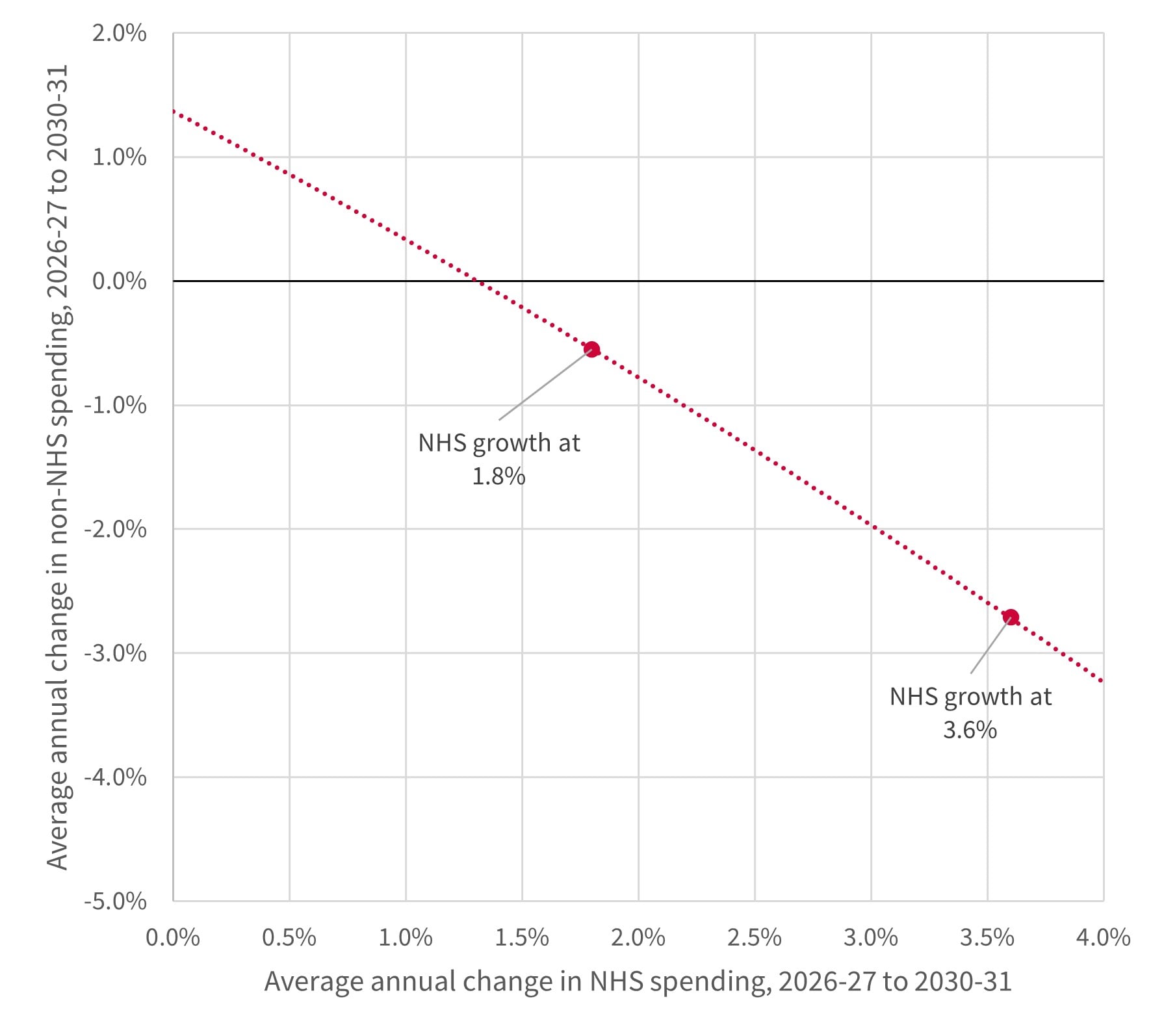
If NHS spending grows by the long-run historical average of 3.6% per year in real terms (as it has done since 2019-20), then non-NHS spending in the Welsh budget would have to fall by 2.7% per year in real terms to 2030-31.
In such a scenario, the Welsh Government may also want to protect core funding for local authorities (£6.5 billion) in real terms each year. Alongside Council Tax increases of 5% per year, this would enable local authority budgets to increase by roughly 1.2% per year in real terms.[4]
The brunt of cuts would subsequently fall on all other areas – worth £5.2 billion in 2026-27 – which would have to fall by almost a quarter by 2030-31. As outlined in our report, this spending – which includes arts and culture, environmental protection, transport, higher education, apprenticeships and rural investment schemes – was cut back significantly in the middle of the previous Senedd term.
It is likely therefore that the next Welsh Government will decide to increase NHS spending at a slower rate. If NHS spending growth was halved to 1.8% per year, non-NHS spending would fall by 0.6% per year in real terms.
As shown in Figure 1, NHS spending growth would need to slow to 1.3% to allow other spending to be protected in real terms over the course of the next Senedd term.
Figure 1: Modelled average annual real terms change in NHS and non-NHS spending, 2026-27 to 2030-31
In this context, an urgent task for the next Welsh Government will be to set a medium-term fiscal strategy, alongside a multi-year Spending Review. This should set targets for productivity growth and efficiencies, plans for the public sector workforce, as well as identifying the funding required to deliver any manifesto commitments and improvements to public service performance.
But the fiscal outlook is massively uncertain and will inevitably change
However, this type of analysis needs to be taken with a pinch of salt – the outlook for the Welsh budget over the course of the forthcoming Senedd term is hugely uncertain.
Perhaps most significant in this regard is the eventual impact of recent events in the Middle East. While the outcome of the war is unknowable, inflation will be significantly higher than implied by the OBR’s Spring forecasts. Another spike in the cost of energy and food will have huge implications for the cost pressures facing public services and the public sector pay bill.
Meanwhile, the constraints on the UK public finances are real and binding. Continued poor economic growth, stagnating living standards, increasing borrowing costs, and an already historically high tax burden, all limit the Chancellor’s room for manoeuvre.
Nonetheless, it can be argued that this budget outlook – which takes UK government future spending plans at face value – may prove to be too pessimistic. Successive UK chancellors have pencilled in slower growth in spending for future years, which have invariably been topped up.
In the context of a UK general election taking place in 2029, how likely is it that spending on public services in England stagnates towards the end of the decade?
Despite the UK government now providing multi-year settlements again, spending plans can change substantially. For example, since the resource block grant for 2026-27 was set last June, it has already been increased by £517 million. As the UK government react to spending pressures and changing forecasts, significant amounts of funding is likely to be allocated in-year and between Spending Reviews.
Amid the huge fiscal turmoil of the last Senedd term, the eventual real terms growth of the Welsh Government’s resource block grant was twice as high as that suggested by the outlook at the time of the 2021 Senedd election.
If spending plans are again topped up, then the trade-offs implied earlier will be much less acute. For example, if the resource block grant grew in line with forecast UK GDP growth from next year, day-to-day spending would grow by approximately 1.5% per year in real terms. This could allow the Welsh Government to increase NHS spending by 3% in real terms per year and avoid real terms cuts to other services.
The future path of devolved taxes and their net effect on the Welsh budget also present another source of uncertainty. On this, the hitherto good news story on devolved taxes may not last.
However, the upside risk here is also arguably more pronounced. Higher inflation and the continued freeze in thresholds will tend to improve the relative performance of Welsh tax revenues, with a more pronounced fiscal drag effect on Wales’ lower incomes.
The implications for party manifestos; or, are you feeling lucky?
As parties publish their manifesto plans, they are facing fundamental uncertainty as to the fiscal outlook. The next Welsh Government will need to respond to likely huge shifts in economic and fiscal sands.
Manifestos should provide some recognition of the potential trade-offs the next Welsh Government will face. Parties should acknowledge that large-scale new spending commitments or tax cuts will be difficult without a change in the fiscal outlook.
And if the UK Chancellor does stick to her very tight spending plans towards the end of this Westminster term, these manifesto commitments will not be possible without significantly reprioritising funding and cutting back on services. This would go well beyond finding efficiency and productivity savings, which, however plausible, will already be required to meet existing spending pressures.
But manifestos are not budget documents. Given Wales’ electoral system and current polling, no one manifesto is likely to be implemented in full. Negotiations and agreements will be required to form the government and pass budgets. The manifestos may unfortunately be silent on the potential fiscal trade-offs the next Welsh Government will face, but they may well indicate what each party would prioritise in those talks.
****
This work is supported by the Nuffield Foundation. The Nuffield Foundation is an independent charitable trust with a mission to advance social well-being. It funds and undertakes rigorous research, encourages innovation and supports the use of sound evidence to inform social and economic policy, and improve people’s lives. The Nuffield Foundation is the founder and co-funder of the Nuffield Council on Bioethics, the Ada Lovelace Institute and the Nuffield Family Justice Observatory. Find out more at: nuffieldfoundation.org.
The views expressed are those of the authors and not necessarily those of the Foundation.
[1] This excludes funding from the Immigration Health Surcharge for 2025-26, which has not yet been allocated to the Welsh Government from the Home Office for 2026-27.
[2] https://www.gov.wales/written-statement-responding-39th-nhs-pay-review-body
[3] This funding relates to border facilities, the Holyhead Breakwater, City and Growth Deals, Coal Tips, and the Core Valley Lines enhancements settlement. We assume this funding is maintained at £44 million in 2030-31 but may well be topped up at future Spending Reviews.
[4] Without accounting for potential cuts in specific grant funding outside of Aggregate External Finance.
- July 2026
- June 2026
- May 2026
- April 2026
- March 2026
- December 2025
- November 2025
- October 2025
- September 2025
- June 2025
- May 2025
- March 2025
- February 2025
- December 2024
- October 2024
- September 2024
- July 2024
- June 2024
- December 2023
- November 2023
- August 2023
- February 2023
- December 2022
- November 2022
- September 2022
- July 2022
- April 2022
- March 2022
- January 2022
- October 2021
- July 2021
- May 2021
- March 2021
- January 2021
- November 2020
- October 2020
- August 2020
- July 2020
- June 2020
- May 2020
- April 2020
- March 2020
- October 2019
- September 2019
- June 2019
- April 2019
- March 2019
- February 2019
- December 2018
- October 2018
- July 2018
- June 2018
- April 2018
- December 2017
- October 2017
- July 2017
- June 2017
- May 2017
- April 2017
- March 2017
- February 2017
- January 2017
- December 2016
- November 2016
- October 2016
- September 2016
- Bevan and Wales
- Big Data
- Brexit
- British Politics
- Constitution
- Covid-19
- Democracy
- Devolution
- Elections
- Equality
- EU
- Finance
- Gender
- History
- Housing
- Introduction
- Justice
- Labour Party
- Law
- Local Government
- Media
- National Assembly
- National identity
- Plaid Cymru
- Prisons
- Reform UK
- Rugby
- Senedd
- Senedd Election 2026
- Theory
- Uncategorized
- Welsh Conservatives
- Welsh Election 2016
- Welsh Elections