Labour’s First Budget Deal with a Plaid Cymru Government: the Supplementary Budget Agreement
13 October 2026
Ed Gareth Poole and Owain Cynfab
Wales Fiscal Analysis, Cardiff University’s Wales Governance Centre
On Tuesday 13 October, the Welsh Government and Welsh Labour reached an agreement on a Second Supplementary Budget for 2026-27. This follows months of negotiations after a first-ever defeat of a Welsh Government Supplementary Budget on 14 July.
This deal confirms all of the prior spending additions proposed in the First Supplementary Budget, while adding an additional £60 million for Additional Learning Needs, a policy area which had been a priority for Labour.
The Origin of the Deal
As is often the case in the mid-year for Welsh budgets, additional monies from UK government spending topped up the pot via two ‘Barnett consequentials’:
- £327 million from the UK Government’s 2026 Spring Statement – most of which came from writing off accumulated Special Educational Needs and Disabilities (SEND)-related deficits held by English local authorities
- £46 million from the UK Government’s Main Estimates.
Along with other smaller allocations, this increased the amount of day-to-day spending available in 2026-27 by approximately £411 million.
Back in July, it was the new government’s intentions to spend these additional monies on the NHS, childcare and public transport – and since that vote was simply about spending additional cash, in many ways it was a low-stakes vote. Because the 2026-27 annual budget approved in January by the previous Labour government remained in force, the supplementary budget vote would not have resulted in spending cuts, a government shutdown, or a new election. What this deal secures is the legal authority to spend these new allocations; it can also be seen perhaps as a trial-run for the 2027-28 Annual Budget that will be voted on this winter, where failure would be far more significant.
Additional Learning Needs: The Crux of the Deal
The original proposal did not include additional spending for ALN, and before the July vote, Labour sought £100 million in 2026-27. The Welsh Government countered with an offer of £40 million per year for two years (£80 million total), an offer which was extended to a third year of funding (£120 million total) in the final offer before the vote.
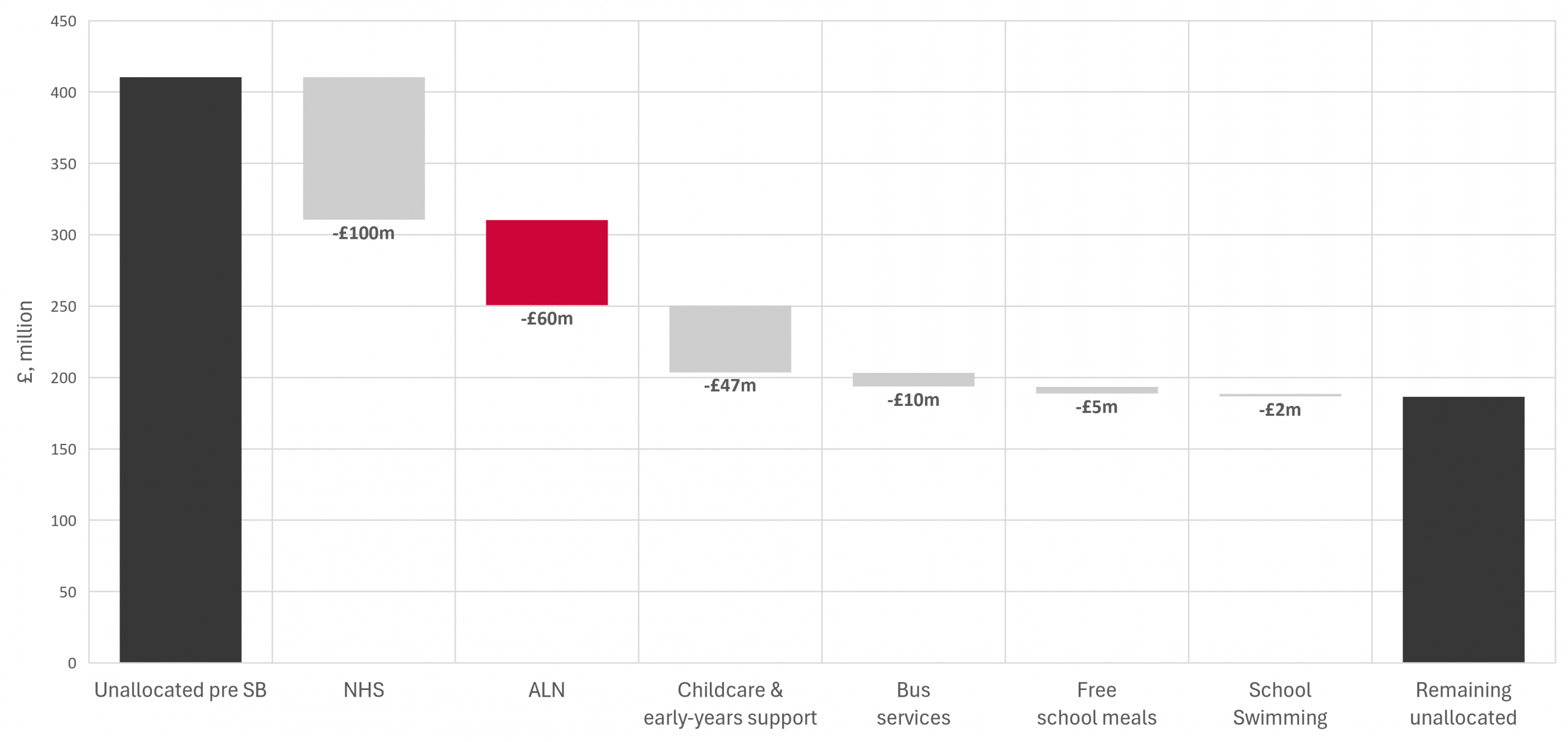
The deal provides £60 million for ALN in 2026-27, of which £44.8 million will go directly to schools, £11.2 million to local authorities, £2.5 million to further education and £1.5 million towards developing a long-term sustainability plan.
Although no figure has been announced for subsequent years, the accompanying ministerial statement notes that “funding allocations for ALN for future years will be considered as part of our preparations for the Draft Budget for 2027-28, in the context of a need to reach cross-party support”.
Although adult and children’s social care remains the most acute pressure facing local authorities, ALN spending is clearly an enormous budgetary challenge. Ministers say ALN spending has grown 2.5 times faster than overall education spending over the last decade and is heading towards £1 billion per year. In that context, in the absence of wider reform or definitive commitments regarding future funding, this can best be seen as a stopgap measure.
The deal also does not appear to have resolved the trade dispute declared by NAHT Cymru and ASCL Cymru in July, which covers pay as well as ALN.
The NHS
Allocations for the NHS from the proposal remain the same: £145 million including £100m in day-to-day spending for waiting times and elective care, £25m for surgical and diagnostic hubs, and £20m capital for maintenance.
The usual caveats from our previous budget analysis apply: Because of significant in-year spending on reducing waiting lists last year, core NHS spending was previously set to fall by 1.2% in real terms this year, and even after this £100 million uplift, it is still set to fall by roughly 0.4% in real terms.
Childcare
The deal confirms £55 million (£45m revenue and £10m capital) to extend 12.5 hours of funded childcare per week to all two-year-olds, completing the Flying Start expansion first announced in the 2021 Co-operation Agreement. The government describes this as a first step towards Plaid’s pledge of 20 hours a week for all children aged nine months to four years, for up to 48 weeks a year.
Together with smaller commitments to bus services, free school meals in secondary schools and school swimming, these allocations total £224 million in day-to-day spending – shown in the accompanying figure. This leaves £187 million of additional resource funding unallocated, which could be used to address other spending pressures later in the financial year.
Changes to Unallocated Day-to-Day (Resource) Spending
What does it mean for 2027-28?
The main significance of this agreement is political. It shows that Plaid and Labour can reach a deal and that ALN is a bridge to wider budget cooperation, albeit after a very extended period of negotiation. The 2027-28 Budget, worth around £27 billion, is the much bigger test. The Plaid Cymru administration will need to show that it can make additional progress on its major childcare commitments in a budget in which calls for funding will be intense in every single department.
Beyond the political calculations, there is one very real indicator that should be flashing red on the Welsh Government’s budget dashboard.
Inflation is once again squeezing public budgets worldwide
Unlike previous rounds of inflation which had multiple causes, the unexpected jump in prices in 2026 has one primary cause: a global energy price shock linked to the conflict in Iran. Before the start of this war, CPI inflation was expected to ease to around 2% from April and stay there for the rest of the year. Because of significantly higher gas, petrol and diesel prices, and because the UK is a net energy importer, inflation reached 3.1% in August, up from 2.9% in July. The Bank of England now expects it to rise to around 3.7% in 2026 Q4 and around 4.2% in 2027 Q1.
The Institute for Fiscal Studies’ Green Budget, published on 12 October, quantifies the effects of that higher inflation for the public sector. The new Chancellor, John Healey, inherited spending plans that already looked incredibly tight before prices began rising faster than expected. The IFS calculates that simply keeping departments whole for higher pay costs could require an additional £3 billion of budget pressure in 2028-29, and if future pay awards follow recent forecasts for average earnings growth, this pressure could reach £7-9 billion. Meanwhile, the effects of higher inflation on the non-pay components of department budgets could reduce the value of non-pay day-to-day budgets by £4-8 billion in 2028-29 and the value of capital budgets by £2-4 billion (IFS Green Budget 2026, p168).
For Wales, while we cannot calculate the impact directly (because the Welsh Government’s block grant follows spending decisions for England under the Barnett formula), how far the Chancellor tops up English departments for inflation later this month will largely determine what reaches Cardiff Bay. This matters, because the previous Welsh Government’s 2026-27 budget promised every department at least the same funding in real terms as the prior year, including an uplift for inflation and pay, and councils and NHS bodies across Wales have warned that their funding isn’t rising enough to cover higher costs. Earlier this year, in our elections analysis work funded by the Nuffield Foundation, we cautioned that a tough spending outlook will make improving services especially difficult for the new Welsh Government.
“Winter is Coming”
The Supplementary Budget agreement is a useful, if modest, milestone. It gives the Welsh Government the legal authority to spend new in-year monies. But a one-time £60 million for ALN is a stopgap rather than a settlement, and the deal leaves the wider budgetary pressures largely unresolved.
The real test is still to come. The 2027-28 Budget will be far larger and far less forgiving, with childcare commitments to fund, pressure in every department, and inflation driving up what pay and services cost. Much will depend on how the Chancellor allocates funding across the UK government departments in his budget later this month, and particularly the extent to which English spending departments will be compensated for higher inflation via budget top ups – if this happens at all.
In retrospect, this agreement may be seen as the easy part; next year’s annual budget will show whether this first deal was a genuine foundation for cooperation or whether it merely postponed hard choices until winter.
- October 2026
- July 2026
- June 2026
- May 2026
- April 2026
- March 2026
- December 2025
- November 2025
- October 2025
- September 2025
- June 2025
- May 2025
- March 2025
- February 2025
- December 2024
- October 2024
- September 2024
- July 2024
- June 2024
- December 2023
- November 2023
- August 2023
- February 2023
- December 2022
- November 2022
- September 2022
- July 2022
- April 2022
- March 2022
- January 2022
- October 2021
- July 2021
- May 2021
- March 2021
- January 2021
- November 2020
- October 2020
- August 2020
- July 2020
- June 2020
- May 2020
- April 2020
- March 2020
- October 2019
- September 2019
- June 2019
- April 2019
- March 2019
- February 2019
- December 2018
- October 2018
- July 2018
- June 2018
- April 2018
- December 2017
- October 2017
- July 2017
- June 2017
- May 2017
- April 2017
- March 2017
- February 2017
- January 2017
- December 2016
- November 2016
- October 2016
- September 2016
- Bevan and Wales
- Big Data
- Brexit
- British Politics
- Constitution
- Covid-19
- Democracy
- Devolution
- Elections
- Equality
- EU
- Finance
- Gender
- History
- Housing
- Introduction
- Justice
- Labour Party
- Law
- Local Government
- Media
- National Assembly
- National identity
- Plaid Cymru
- Prisons
- Reform UK
- Rugby
- Senedd
- Senedd Election 2026
- Theory
- Uncategorized
- Welsh Conservatives
- Welsh Election 2016
- Welsh Elections