The Superior Eight vs the Best Backs: Styles and Traditions in Welsh Rugby
31 July 2026
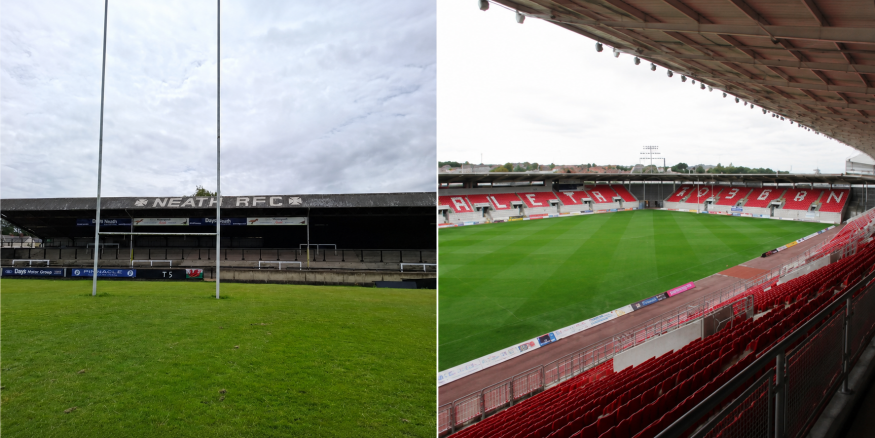
Nye Davies discusses his recent article ‘The Scarlet Runners and the Welsh All Blacks: Traditions and Identities in Welsh Rugby’, published by The International Journal of the History of Sport. The article is available via open access.
When Neath and Merthyr faced off in the Welsh Premiership Cup final in April 2026, the result might have appeared inevitable. Merthyr were on course to win the league, having lost only one game up to that point all season, and it was less than a year since they had trounced Neath 104-0. It was the Ironmen’s to lose.
But there was hope for the Welsh All Blacks. That team Merthyr had lost to was Neath. After Merthyr won the opening game of the season at the Gnoll through a last-minute penalty, Neath pulled off a fantastic 28-40 victory away at the Wern.
When the cup final came about, Neath once again proved to be Merthyr’s bogey team, winning 32-21 in a great cup upset. The Neath fans were jubilant, the team producing its most gutsy and resilient performance of the season, coming back from what looked like a potential drubbing at 21-7 down to take control of the game.
While it was a special day for the Neath faithful, the contrast between this final and those of Neath’s pre-professionalisation heyday couldn’t be starker. Only a few thousand were present for this match, while in 1989, Neath and Llanelli faced each other in front of what was then a world record crowd for a club game: 58,000 at the National Stadium in Cardiff. In what is considered Neath’s greatest season, breaking the world record for the number of points and tries scored, Kevin Phillips lifted the Welsh Cup, exacting revenge for defeat against the Scarlets the previous year.
As Welsh rugby fans, we tend to reminisce about the past, particularly today, when Welsh rugby appears to be moving from one crisis to another. But when sports fans look back, it goes beyond simple nostalgia; the past plays a major role in shaping how fans, commentators, coaches and players recognise clubs today. The past informs the present.
In a new article published in The International Journal of the History of Sport, I explore how such history informs the way we think about clubs and their identities. Adopting the concept of tradition, I compare the histories of Neath and the Scarlets to show how myths, symbols and narratives shape perceptions of clubs. Through a reading of newspaper reports surrounding cup finals between the two sides, I show that even in a completely changed sporting landscape, traditions persist and are still treated as inherent truths.
The Welsh All Blacks vs the Scarlet Runners
While the mythology surrounding the Welsh national team often invokes a singular narrative of Welsh wizardry, with the likes of Gareth Edwards, Barry John and Gerald Davies held up as purveyors of running Welsh rugby, the clashes between Neath and Llanelli demonstrate how this style has been shaped by contrasting traditions. Neath have historically been known for their tough, uncompromising forwards, while the tradition of the ‘Scarlet Runners’ reflects a style of play more akin to that of the ‘Welsh way’, with the team known throughout its history for running rugby, flair and exciting backs.
Exploring cup finals over the years between the two sides, we can see how these narratives have been established and maintained over time.
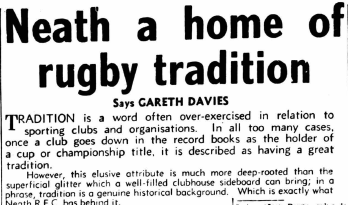
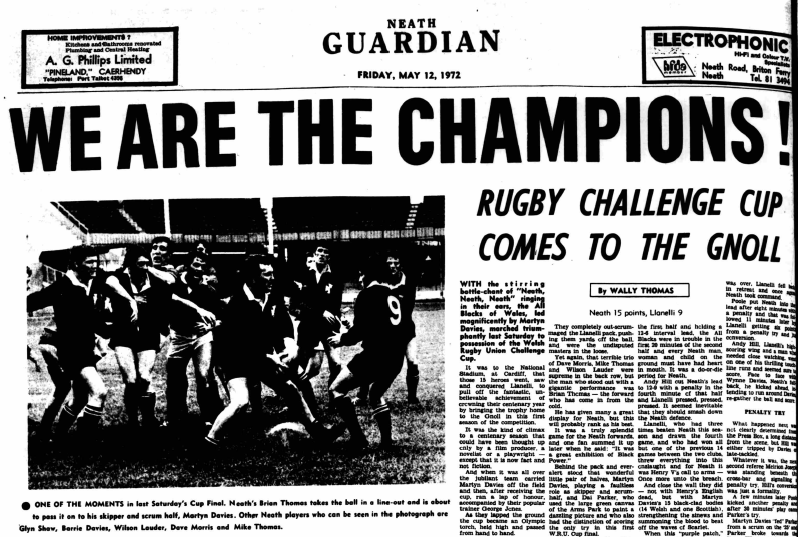
Right from the very beginning, when the two sides faced each other in the inaugural Welsh Cup in 1972, Neath’s forward power was contrasted with the running rugby of the Scarlets, despite the irony that it was Dai Parker, the smallest man on the pitch, who scored the winning try for Neath that day. Whether it was the “tremendous, relentless power play of the Neath pack”, or the argument that the Scarlets “did not have the hardness at forward that Neath could muster”, the familiar contrast between the two sides was clear.
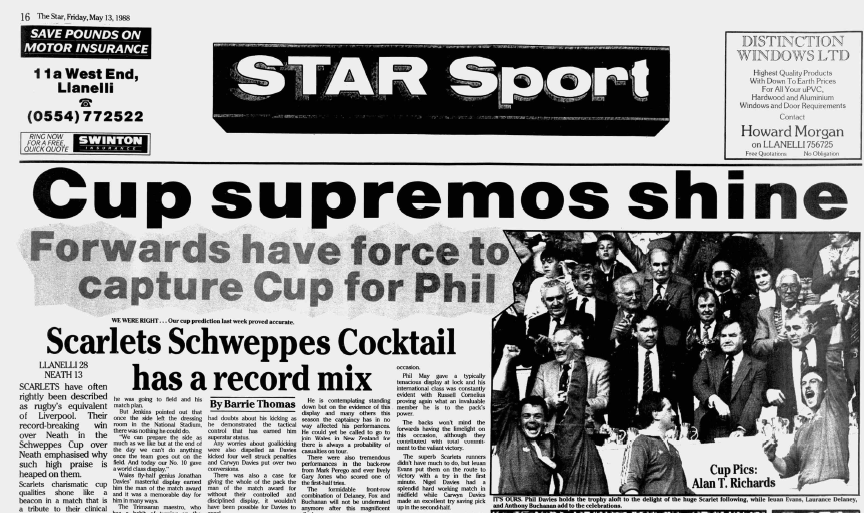
These narratives persisted into the 1980s, despite Neath’s style adapting to become much more dynamic, while the Scarlets became more pragmatic, boasting strong forwards such as Phil Davies, Phil May and Anthony Buchanan. Llanelli’s “magic” and “bit of genius behind”, as Phil Bennett described it, was too much for Neath in 1988, but the Welsh All Blacks’ “big, strong and mobile set of forwards”, featuring the likes of Phillips, Brian Williams and Mark Jones, were able to come out on top in a tight contest in 1989. Throughout match reports stretching to the 2009 final, the only final played between the two sides in the semi-pro era, these contrasting traditions were consistently emphasised.
The establishment of such traditions can often be traced back to key individuals. For Neath, Brian Thomas was seen as the driver of the club’s identity, first as a physical and uncompromising player and then as Neath’s team manager in the 1980s. Alongside coaches Ron Waldron and Glen Ball, he helped to revolutionise Neath’s play. Meanwhile, Scarlets coach John Maclean is credited with putting the team’s attacking identity into writing for the first time, formally defining a style of play that had previously existed largely as an unwritten tradition. Coaches, officials and supporters from both clubs have regularly looked back to these individuals and the traditions they helped to establish.
That these narratives persist, despite evidence that they might not always be accurate, shows their power. Commentators often reproduce clichés and myths, solidifying the traditions for decades to come.
The Superior Eight vs the Best Backs
Of course, it isn’t just commentators who sustain narratives and traditions. Supporters play a crucial role in reinforcing a club’s identity. Unfortunately, the article doesn’t explore the voices of supporters in much detail, but a look through newspaper reports and TV coverage around the cup matches demonstrates their importance.
The best example comes from BBC Wales’s preview of the 1989 cup final between the two sides. In the clip linked below, we can see these traditions being articulated. For example, a Neath fan claimed that the Neath pack wearing down the opposition would be key to success in the 1989 final. Another praised the Llanelli three-quarters but concluded that “the Neath 8 are a little bit superior”.
Scarlets supporters felt the opposite. A young Llanelli fan said that the Scarlets “have the best backs” and would therefore win comfortably. When the reporter pointed to Neath’s backline, featuring the likes of Chris Bridges, Paul Williams and Colin Laity, one of the group replied, “Colin Laity can’t pass”: a damning indictment of one of Neath’s greatest centres, but perhaps reflective of his renown as a powerful rather than footballing centre, fitting neatly into the mould expected of a Neath player.
Further comments emphasised something similar, with another supporter suggesting that if Neath kept it in the forwards and denied the ball to Llanelli’s backs, then Neath would triumph. However, one Scarlets fan claimed that Neath “weren’t up to the standard of Llanelli”, this in a season where, as we have seen, Neath broke the world record for points and tries scored in a single campaign. Still not enough for the Stradey Park faithful!
Of course, that such a view could be expounded speaks to the biased nature of sports fans. Richard Williams, writing in the South Wales Echo ahead of the 1993 final, where the Scarlets triumphed after a definitely illegal controversial drop goal by Emyr Lewis, described the Scarlets fans and their “one-eyed, dyed-Scarlet-in-the-wool devotion”. With tongue firmly in cheek, and, in my eyes, with some admiration, Williams described the pride that Scarlets fans have in their team:
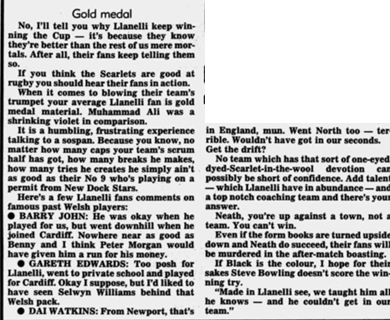
Some things never change of course! And before Scarlets fans berate me, I am perfectly aware that here I am, as a biased, one-eyed diehard fan of both Neath and the Ospreys, using this space to cast aspersions on the Scarlets (I even managed to get towards the end of this without mentioning 1972, 9-3 and the All Bl…damn it).
The ‘good old days’
Whether it be fans, journalists, coaches or players, the narratives that exist behind sports clubs continuously shape and maintain traditions.
Despite significant changes to rugby since the very first cup final between these two sides in 1972, the traditions that underpin Neath and the Scarlets continue to persist. When Neath beat Merthyr in the Welsh Premiership Cup final, the Neath website’s match report drew parallels with the winning side of 1972. The performance could certainly be used as evidence of a sustained tradition in playing style, with the Neath pack scoring two tries from driving mauls and the team being led by the carrying power of the likes of captain Ben Williams and giant lock Jon Barley, in his last, and I would argue finest, performance in a Neath shirt.
After the Ospreys beat the Scarlets at the Brewery Field this year to complete the double, I was of course gracious in victory and didn’t gloat, instead commenting to my Scarlet-supporting friends how exciting their backline was. Nigel Davies has clearly tried to instil the philosophy of the ‘Scarlet Runners’ back into the playing identity of the club. The likes of Blair Murray and Macs Page look set to try to continue that tradition.
Identity and tradition are very important in a country like Wales. However, with rugby being in a perilous state and football vying for the status of ‘national game’ (as if such a debate is useful or necessary), many turn to the ‘good old days’ of Welsh rugby in order to reflect on what has gone wrong, and how something tangible might be salvaged to get Wales back to the top as a rugby nation.
Things change, and we need to move with the times. But reflecting on the narratives and rivalries that have sustained interest for decades should be a lesson to those at the top: tradition matters, and it should not be compromised.
- October 2026
- July 2026
- June 2026
- May 2026
- April 2026
- March 2026
- December 2025
- November 2025
- October 2025
- September 2025
- June 2025
- May 2025
- March 2025
- February 2025
- December 2024
- October 2024
- September 2024
- July 2024
- June 2024
- December 2023
- November 2023
- August 2023
- February 2023
- December 2022
- November 2022
- September 2022
- July 2022
- April 2022
- March 2022
- January 2022
- October 2021
- July 2021
- May 2021
- March 2021
- January 2021
- November 2020
- October 2020
- August 2020
- July 2020
- June 2020
- May 2020
- April 2020
- March 2020
- October 2019
- September 2019
- June 2019
- April 2019
- March 2019
- February 2019
- December 2018
- October 2018
- July 2018
- June 2018
- April 2018
- December 2017
- October 2017
- July 2017
- June 2017
- May 2017
- April 2017
- March 2017
- February 2017
- January 2017
- December 2016
- November 2016
- October 2016
- September 2016
- Bevan and Wales
- Big Data
- Brexit
- British Politics
- Constitution
- Covid-19
- Democracy
- Devolution
- Elections
- Equality
- EU
- Finance
- Gender
- History
- Housing
- Introduction
- Justice
- Labour Party
- Law
- Local Government
- Media
- National Assembly
- National identity
- Plaid Cymru
- Prisons
- Reform UK
- Rugby
- Senedd
- Senedd Election 2026
- Theory
- Uncategorized
- Welsh Conservatives
- Welsh Election 2016
- Welsh Elections