2026 Senedd manifesto analysis: Capital spending and investment
23 April 2026
By Guto Ifan, Ed Gareth Poole and Owain Cynfab
This blogpost – the fourth in a series of manifesto analyses as part of the 2026 Scottish and Welsh Elections Project, conducted in partnership with the Fraser of Allander Institute and supported by the Nuffield Foundation – looks at some of the key manifesto plans for capital spending and infrastructure projects, in the context of a difficult outlook for the capital budget.
Capital spending is set to fall in real terms over the next Senedd term
Finance Secretary Mark Drakeford’s “neutral” approach to the 2026-27 Draft Budget – where each spending area was only uprated to reflect forecast inflation – means there is £118 million in capital spending (i.e. not day-to-day spending) left to allocate for the next Welsh Government in 2026-27. However, this immediate headroom masks some difficult choices and trade-offs for the next government to make over the course of the seventh Senedd term.
The core capital block grant is set to remain at around £3.3 billion in cash terms to 2029-30, and given indicative plans for 2030-31, this will likely fall slightly in the final year of the forecast. This stagnation partly reflects UK government spending more on defence, which as a reserved area, does not draw consequentials for the Welsh Government.
If it chooses to, the Welsh Government can borrow £165 million for capital spending in 2026-27 and this will now increase in line with inflation. Some capital funding from the UK government – £152 million in 2026-27 – sits outside the core block grant and is set to fall to £44 million by 2029-30.[1]
Overall, this means that the Welsh Government’s core capital budget (excluding Financial Transactions funding) could fall by 9% in real terms from 2026-27 over the course of the next Senedd term.
Capital spending for healthcare
As in the case of day-to-day spending, all parties make significant pledges on NHS capital spending.
Most immediately, Plaid Cymru, the Welsh Conservatives and Reform UK promise new surgical hubs to tackle waiting lists.
Plaid Cymru propose creating a new Sustainable Health and Care Facilities investment programme to address the current maintenance backlog. Welsh Liberal Democrats propose a capital investment programme to repair, replace and upgrade hospital buildings. Reform UK promise estates modernisation and renewal with a multi-year capital programme.
Other specific commitments on the number of beds (Plaid Cymru, Green Party) will also require capital spending.
In terms of building new hospitals, the Welsh Conservatives call for a ‘21st Century Hospitals Fund’ to modernise and build new hospitals, including four new Community Hospitals with Minor Injuries Units, though without specific cost estimates.
Welsh Labour’s manifesto contains a specific headline pledge of investing £4 billion through a Hospitals of the Future Fund, including replacing Wrexham Maelor Hospital and University Hospital Wales, and a major hospital development in West Wales. Previous announcements suggested this spending would be over 10 years, though no information has been publicly published on the estimated costs of the specified projects, how it would be funded or the profile of spending across years.
Capital spending on health is set to be around £566 million in 2026-27.[2] Removing funding for maintenance backlogs, digital transformation, diagnostic equipment, vehicles, health and social care community hubs, and smaller programmes and policy schemes, this leaves £250 million to be spent this year on approved and non-approved capital projects and the Targeted Estates Fund.[3] This means that £4 billion on new hospitals over 10 years – or £400 million a year on average – would be sizeable increase in capital spending levels.
Welsh Labour’s plans will reportedly be funded through the existing block grant funding, capital borrowing and the ‘Mutual Investment Model’ (MIM). In the context of a capital budget set to fall in real terms, this last option gets around some immediate trade-offs with other areas of capital spending, through using private sector borrowing to fund the up-front costs of the investment.
However, this option is ultimately more expensive, with the Welsh Government eventually repaying costs from its day-to-day spending. These costs could become significant by the end of the Senedd term and beyond, in the context of a tight budgetary outlook for day-to-day spending. As an example, the New Velindre Cancer Centre currently being built using the MIM has a capital value of £312 million; on completion of the project, the Welsh Government will make annual service payments of £34 million (with a portion indexed to inflation) over the next 25 years.
Transport spending
Welsh Labour, the Welsh Liberal Democrats, the Green Party and Plaid Cymru all commit to expanding rail infrastructure, including building new stations and upgrading existing lines. Meanwhile, Reform UK and the Welsh Conservatives say they would increase rail capacity.
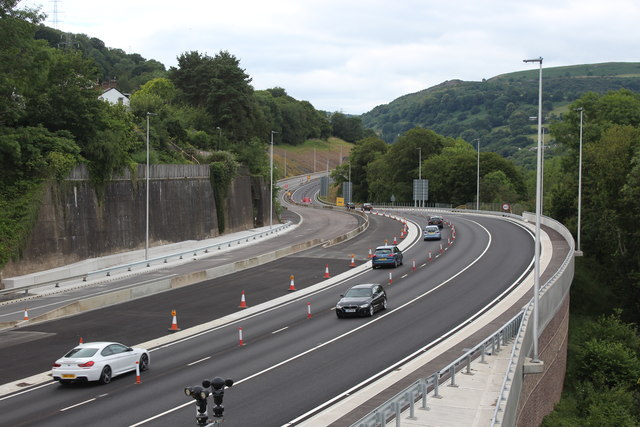
Reform UK and the Welsh Conservatives promise to build the M4 relief road – a proposal for a six-lane road south of Newport, previously scrapped by the Welsh Government – alongside other road projects such as upgrading the A55. Plaid Cymru leader Rhun ap Iorwerth has also suggested he backed alternative routes to improve traffic on the M4, referencing the ‘Blue Route’ (i.e. upgrades to the A48 Newport Southern Distributor Road) in leader debates.
When the decision was made to cancel the M4 relief road in 2019, the reported cost of the scheme was £1.6 billion. Since then, estimates of construction costs for new infrastructure projects have increased by approximately 29%.
Reform UK’s manifesto refers to funding the M4 relief road via a “Reform instituted British Sovereign Wealth Fund” – presumably requiring a Reform-led UK government – or seeking private funding. As in the case of using private finance for hospital building, this would have significant implications for the Welsh Government’s day-to-day spending at a later stage.
For example, private funding was used to complete the dualling of the A465, with an estimated capital value of £590 million. This is now reflected in an annual service payment of £38 million in the Welsh Government’s Transport day-to-day spending budget for the next 30 years.
In interviews, Reform UK leader Dan Thomas has also talked about “revisiting” the £14 billion announced for investment in Wales’ railways and devoting £2.5 billion to roads instead. This relates to the rail investment prospectus published by Transport for Wales back in February, which contained a list of rail projects which could amount to £14 billion by the 2040s.
Unfortunately, however, this £14 billion announcement was not accompanied by actual spending commitments, beyond the inadequate amounts – just £350 million over four years – confirmed at the 2025 Spending Review. Since it did not trigger any additional funding, the rail announcement should instead be best viewed as a political signal that Welsh rail projects might potentially be awarded more funding at future spending rounds over the next two decades. But not only is rail infrastructure a reserved area of spending – in other words, it would be the Westminster government and not the Cardiff government who would determine how it is spent – but since there are no additional funds it cannot be reallocated for devolved roads spending in the 2026-2030 Senedd term.
Social housing and decarbonisation
Building social housing represents a significant share of the Welsh Government’s capital budget, with the budget for Social Housing Grants reaching £446 million in 2026-27.
Some manifestos make significant commitments in this area: Welsh Labour commit to building at least 40,000 social homes over the next decade; Plaid Cymru promise 20,000 new social homes by 2030; the Green Party promise 60,000 over ten years; while the Welsh Liberal Democrats promise to build 30,000 (presumably over the next Senedd term).
In scale and timing, the Welsh Labour and Plaid Cymru commitments are broadly similar to the previous Welsh Government target of delivering 20,000 additional social homes over the last Senedd term. The latest data suggested the target will be narrowly missed despite an uptick in delivery, though these figures include non-social housing and some existing social homes.
Welsh Labour, Plaid Cymru and the Green Party also make commitments on expanding energy efficiency upgrades and retrofitting, alongside commitments to decarbonise the public sector.
In contrast, the Reform UK manifesto says they would “scrap net zero in devolved policy” and “remove ideology from Welsh Government energy subsidies”. In interviews and debates, leader Dan Thomas has claimed they would cut £145 million in “green subsidies and levies”. This would free up capital spending for other areas, but as we’ve previously outlined, will not help fund the promised tax cuts as claimed.
Conclusion
Taken together, as in the case of tax and day-to-day spending, there are significant differences in promises and emphasis between party manifestos, particularly on transport, housing and decarbonisation. The manifesto commitments across all parties paint an ambitious picture for capital investment in Wales — from new hospitals and social housing to new trunk roads and railway stations. Yet ambition and affordability are difficult to reconcile against a capital budget that could shrink by around 9% in real terms over the next Senedd term. Whichever party or coalition forms the next Welsh Government will face hard choices about prioritisation, and the scale of pledges made — particularly on hospitals and housing — will inevitably test the limits of what the block grant, borrowing powers, and private finance mechanisms can collectively deliver.
The reliance on instruments like the Mutual Investment Model, or private funding for road building, may ease immediate pressures on the capital budget, but they do not make spending disappear — they defer it, at greater long-run cost, into future day-to-day budgets that are themselves under strain. Voters and policymakers alike would benefit from greater transparency about how parties intend to fund their commitments over the full Senedd term, not just in year one. As this analysis has shown, headline figures can mask significant uncertainty about timing, funding sources, and trade-offs — and it is precisely that detail which will determine whether these ambitions translate into bricks, mortar, and meaningful public services.
****
This work is supported by the Nuffield Foundation. The Nuffield Foundation is an independent charitable trust with a mission to advance social well-being. It funds and undertakes rigorous research, encourages innovation and supports the use of sound evidence to inform social and economic policy, and improve people’s lives. The Nuffield Foundation is the founder and co-funder of the Nuffield Council on Bioethics, the Ada Lovelace Institute and the Nuffield Family Justice Observatory. Find out more at: nuffieldfoundation.org.
The views expressed are those of the authors and not necessarily those of the Foundation.
[1] This funding relates to border facilities, the Holyhead Breakwater, City and Growth Deals, Coal Tips, and the Core Valley Lines enhancements settlement. We assume this funding is maintained at £44 million in 2030-31 but may well be topped up at future Spending Reviews.
[2] This excludes IFRS16 spending, reflecting recent accounting changes.
[3] See written evidence provided to the Health and Social Care Committee in November 2025: https://www.gov.wales/sites/default/files/publications/2025-11/health-and-social-care-committee-cabinet-secretary-for-health-and-social-care-november-2025.pdf
- July 2026
- June 2026
- May 2026
- April 2026
- March 2026
- December 2025
- November 2025
- October 2025
- September 2025
- June 2025
- May 2025
- March 2025
- February 2025
- December 2024
- October 2024
- September 2024
- July 2024
- June 2024
- December 2023
- November 2023
- August 2023
- February 2023
- December 2022
- November 2022
- September 2022
- July 2022
- April 2022
- March 2022
- January 2022
- October 2021
- July 2021
- May 2021
- March 2021
- January 2021
- November 2020
- October 2020
- August 2020
- July 2020
- June 2020
- May 2020
- April 2020
- March 2020
- October 2019
- September 2019
- June 2019
- April 2019
- March 2019
- February 2019
- December 2018
- October 2018
- July 2018
- June 2018
- April 2018
- December 2017
- October 2017
- July 2017
- June 2017
- May 2017
- April 2017
- March 2017
- February 2017
- January 2017
- December 2016
- November 2016
- October 2016
- September 2016
- Bevan and Wales
- Big Data
- Brexit
- British Politics
- Constitution
- Covid-19
- Democracy
- Devolution
- Elections
- Equality
- EU
- Finance
- Gender
- History
- Housing
- Introduction
- Justice
- Labour Party
- Law
- Local Government
- Media
- National Assembly
- National identity
- Plaid Cymru
- Prisons
- Reform UK
- Rugby
- Senedd
- Senedd Election 2026
- Theory
- Uncategorized
- Welsh Conservatives
- Welsh Election 2016
- Welsh Elections