Play in the Academy: What if we took play seriously at work?
29 June 2026
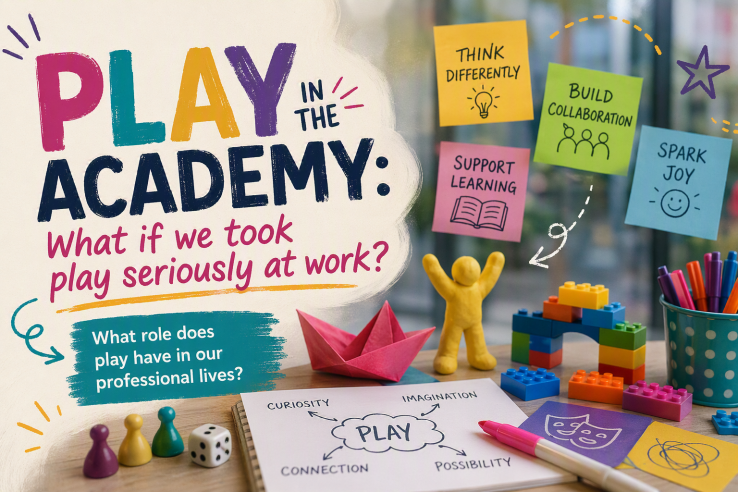
What role does play have in our professional lives?
Play can help us to think differently, support learning, build collaboration, and spark joy. And yet, in many university settings – often shaped by complex hierarchies and risk-averse cultures – play can feel out of place, undervalued, or even invisible.
Exploring play in universities
Researchers based in SPARK – Enrique Uribe Jongbloed (Centre for the Creative Economy) and Hayley Trowbridge (SPARK Hub Team) have been collaborating with colleagues from Bristol and Exeter universities to explore how play already operates (or could operate) within universities. Having met on the GW4 Crucible 2025 programme and secured seedcorn funding, the team has been asking: how do people bring playfulness into their roles—whether visibly, subtly, or even subversively? What does play make possible in environments that can sometimes feel constrained by structure, process, or pressure?
In this scoping study, we’ve been working with university staff across disciplines and roles to begin answering these questions. Using participatory, creative methods, the project aimed to build an emerging evidence base and prototype ways of talking about—and practising—play at work.
Playshops in practice
One of the core methods we’ve been using is the playshop: a hands-on, participatory workshop that blends “play” and “workshop”. In early 2026, we held playshops at the Universities of Exeter, Cardiff, and Bristol. At Cardiff University, the playshop took place in the Visualisation Lab in sbarc|spark. This interactive session was co-delivered by Enrique and Hayley, and brought together 10 members of Cardiff University’s staff who had an interest in play.
Using methods such as metaphor-making, serious play and forum theatre the playshops enable attendees to explore how play shows up in their work and teams, and have deep discussions about its potential usages and purposes within universities. These playful techniques helped to surface forms of understanding that might not emerge through conventional discussion alone… And we also had fun!
Specific discussion prompts included – What does play mean to you? Do you play in your professional life – why or why not? Who gets to play in universities?
From playshops to practical outputs
Using the insights from the different playshops and a survey (open to anyone) that gathers further examples of play, we been busy making some initial outputs that are designed to make play more visible and usable in professional contexts.
So far, these include:
- A Playshop guide and slides (open access – so you can run your own!)
- A “play personality” quiz, inspired by purposes of play identified in the research and set of accompanying play missions and prompts to try in everyday work
- Examples of play in universities
- Welsh language outputs
What’s next?
At a time when many organisations are grappling with questions around culture, wellbeing, and innovation, play can offer a different way of answering. The team are using this scoping work to build an initial shared vocabulary and framework for thinking about play in professional life more broadly. To keep up-dated on this work, visit here.
Here at SPARK the ideas and play missions will be used in our own research culture work – contributing to sessions for the Creative and Innovative Research Methods Community of Practice and the forthcoming Playing with Research programme.
- Play in the Academy: What if we took play seriously at work?
- From Evidence to Action: SPARK’s Public Sector Partnerships
- From Research to Action: Why Social Science Needs Design
- Reimagining Alcohol Free, Night-Time Economy Social Activities in Cathays
- Doing Research Differently: Principles for equity in creative and participatory research settings