An inflation wave heading for Cardiff Bay: the stark choices awaiting next month’s Welsh Government Draft Budget
29 October 2026
Owain Cynfab and Ed Gareth Poole
Wales Fiscal Analysis, Cardiff University
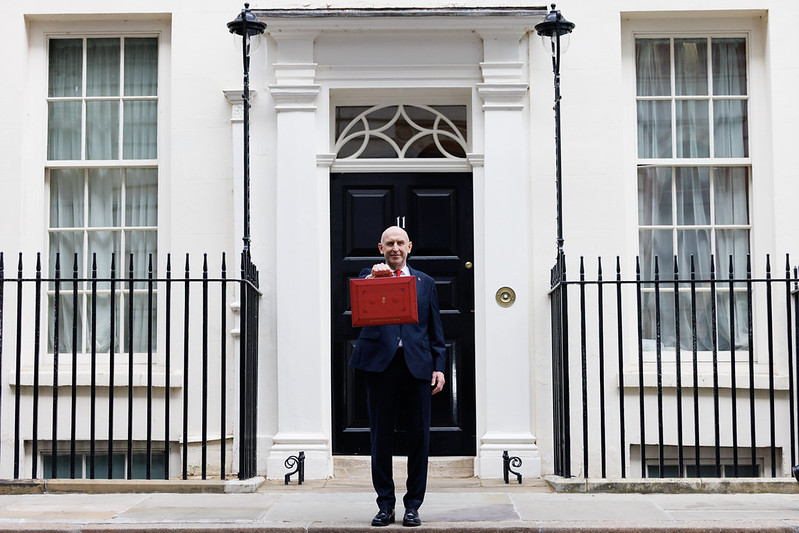
© HM Treasury Flicker
A UK Government Budget should do more than just try to ride out the next few months. Its core job is to set a credible course for tax, spending and borrowing, and to leave the public finances able to withstand shocks.
On that test, the 2026 UK budget looks like a missed opportunity, with an emphasis on short-term winter support for households over stabilising the public finances over the long term or protecting public services from rising inflation.
The consequences of this will crash onto Wales’s shores within weeks, when the Welsh Government publishes its Draft Budget for 2027-28.
Healey’s Headline Measures
The main policy measures announced by the Chancellor were cost-of-living interventions. These were numerous and useful, but of relatively small value and aimed mainly at this winter’s energy costs. The headline measure was a £100 payment to households in council tax bands A-D in England to offset higher energy costs.
Other measures included plans to abolish gas standing charges by the end of 2027, extending the temporary VAT cut on electricity bills, maintaining the fuel duty freeze until July 2027, and raising the tax-free allowance for pensioners who rely solely on the state pension.
These interventions, which will be welcomed, were funded from a much weaker fiscal position than the Chancellor inherited just three months ago. Since the OBR’s previous forecasts in March, higher interest rates and inflation have increased the cost of borrowing by an average of £11bn a year before any policy decisions had been made, and cut the margin against the fiscal rules to £15bn, down from £24bn in March.
The Budget also included some targeted investments in Wales, including £30m to progress Cardiff Parkway railway station, £20m “to support UK reindustrialisation and high-value jobs in AI hardware, building on existing strengths in semiconductor clusters including South Wales”, £11m towards replacing Aberavon Bridge in Port Talbot, and £2.5m to expand the M-SParc science park on Anglesey. These relatively modest investments, again while useful, fall well short of the Welsh Government’s objectives, particularly the announcement’s extremely limited ambitions with respect to rail infrastructure.
Why the headline interventions miss the bigger picture
Beyond these cost-of-living and Wales-specific measures, the much bigger story for Wales is how little the Budget did to compensate public services for higher inflation.
The global energy price shock linked to the war in Iran has pushed inflation back up, with direct consequences for public sector pay awards and therefore for public budgets. In March, the OBR expected CPI inflation to fall to 2% from 2027 onwards. It now expects inflation to average 3.4% in 2027.
For households, this means higher energy, fuel and grocery costs. But the other victim of higher inflation is public services, as higher-than-expected pay and non-pay costs erode departmental budgets.
The scale of the problem was well known before the Budget. The OBR estimates that, compared with its March forecast, departmental spending in cash terms would need to be on average £2bn higher every year across the Spending Review period to maintain its real value, and around £7bn per year higher compared with the inflation forecast on which the original spending plans were set. Yet the Chancellor did little to reinforce public sector budgets against these higher costs.
Policy decisions do add an average of £3bn a year to UK departmental resource spending in 2027-28 and 2028-29 (excluding an accounting adjustment for pensions), but this is primarily higher defence funding, a reserved area of spending which is not subject to Barnett.
What this means for Wales
All of this matters in Wales because the block grant – which makes up 80% of the Welsh budget – follows UK Government spending decisions for England under the Barnett formula.
The Chancellor’s limited compensation for inflation is now a major problem for Elin Jones as she prepares her Draft Budget, due on 17 November.
Table 1 shows the consequentials for day-to-day and capital spending for the Welsh Government resulting from the UK budget.
Table 1: Changes to Welsh Government funding resulting from the UK budget (£ millions)
| £ millions | 2026-27 | 2027-28 | 2028-29 | 2029-30 |
| Day-to-Day (Resource) | 199 | 165 | 146 | – |
| Capital | -27 | -19 | 2 | -18 |
| Total | 172 | 146 | 148 | -18 |
Source: Welsh Government
The Chancellor’s announcements added £199m to the Welsh Government’s day-to-day funding for the current year. Elin Jones has already pledged to pass on the £100 payment to households in bands A-D, which we estimate, using a rough population share, would cost around £120m. This would leave around £80m of additional funding available for other priorities.
Adding this new £80m to the £187m that remains unallocated for 2026–27, and after accounting for other smaller changes to the Welsh Government’s funding outlook, leaves an estimated £280m of resource funding to be allocated for this financial year.[1]
As a working assumption, suppose that every penny of this £280m goes to the NHS. That would move the NHS from a real-terms cut of around 1% this year to a real-terms increase of around 1.3%.[2] This would be a clear improvement, but even with an ‘all-in’ payment such as this, growth would be little more than a third of its historical average of 3.6% a year.
This starting point also shows how much inflation is eroding public budgets. When we analysed the Supplementary Budget agreement between the Welsh Government and Welsh Labour just two weeks ago, core NHS spending was set to fall by roughly 0.4% in real terms, even after its £100m uplift. The OBR’s new inflation forecast has now deepened that projected cut to around 1.0%. The additional funding remains in place, but higher inflation means it will not go as far as anticipated when the agreement was reached.
An even harder test: the 2027-28 Welsh budget
Even more important than in-year allocations is what this all means for the budget for 2027-28, which will be proposed next month. And here the outlook is bleak.
Despite the additional funding announced by the Chancellor, the Welsh Government’s total resource financing (including non-domestic rates revenues) is projected to remain broadly flat in real terms in 2027–28.[3] This makes the draft budget next month essentially a zero-sum game, where any real-terms increase in spending necessitates cuts elsewhere.
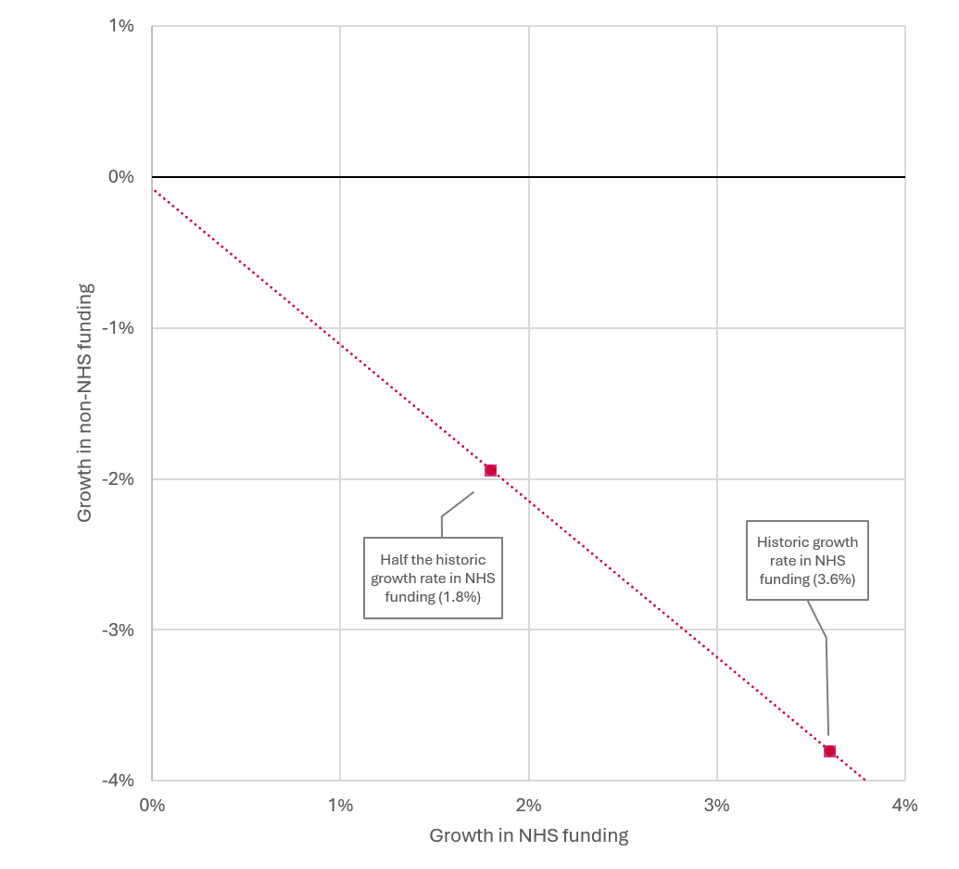
To illustrate the scale of these trade-offs, Figure 1 shows the choices to come. In one scenario, if NHS spending were to match its historical average real-terms growth of 3.6%, the rest of the budget would need to be cut by around 3.8%.
A second scenario, which sets the NHS budget at just half of its historical growth rate at 1.8%, would require average cuts of around 1.9% across the rest of the budget.
Figure 1: Trade-offs between NHS and non-NHS real-terms growth for the 2027-28 budget
Source: Authors’ calculations [4]
These are difficult choices. The first scenario would mean significant cuts to local government, education, transport and other services. The second would leave the NHS with growth far below its long-run trend, despite continued pressures from waiting lists and upcoming pay rounds.
Elin Jones will therefore face a much harder task in repeating Mark Drakeford’s 2026–27 ‘neutral’ budget, which promised every department at least last year’s funding in real terms. And this comes at a time when councils and NHS bodies are already warning that their funding is insufficient to cover rising costs.
In effect, the UK budget has deferred its hard choices. The Chancellor has prioritised immediate support for households, with the measures to pay for it concentrated in later years.
Tax devolution cushions the blow
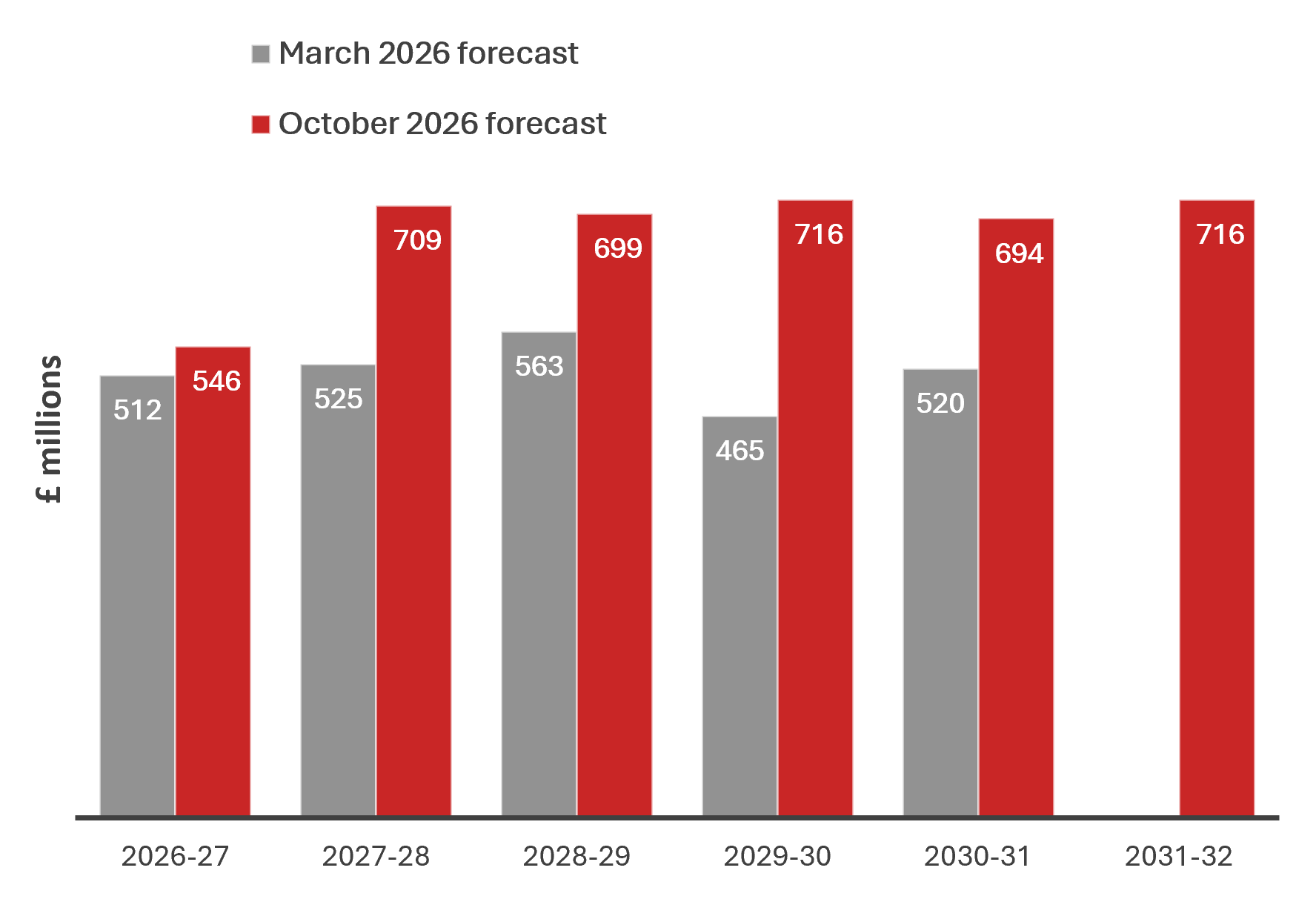
One bright spot in the forecasts is the continued positive contribution from tax devolution. After accounting for their associated block grant adjustments and reconciliations relating to previous years, devolved taxes are forecast to make a net contribution of £546m to the Welsh Government’s budget in 2026–27 and £709m in 2027–28.
Figure 2: Net contribution of devolved taxes to the Welsh Government budget
Source: Authors’ calculations based on Office for Budget Responsibility forecasts
The latest forecasts represent a significant improvement on those published in March, with the net contribution revised upwards by £184m in 2027-28. That upgrade is larger than the £165m of additional resource consequentials from the UK budget in the same year. Without tax devolution, the budget-cutting scenarios presented above would be even more difficult.
Beyond 2027-28: no easing in sight
Unfortunately, the outlook offers little relief in 2028–29, when Welsh Government resource financing is projected to grow by just 1.3% in real terms. That leaves limited room to meet rising demands on the NHS and other public services without squeezing spending elsewhere.[5]
Beyond 2028-29, the precise outlook is uncertain, as future UK departmental spending allocations have yet to be determined. However, indicative UK spending plans suggest that growth in funding is likely to remain constrained through to 2031–32, leaving little prospect of significant relief for Welsh public services under current plans.
The outlook for capital funding is even more difficult. Total general capital financing is projected to fall by around 1.5% in real terms in 2027-28, followed by a further 4.7% reduction in 2028-29.[6] By 2029-30, funding is projected to be around 8% lower in real terms than in 2026-27, further constraining investment in housing, transport and public services.
The winter test
Earlier this month we described the Supplementary Budget deal as the easy part and the winter as the real test. The UK budget has not eased that test. By leaving departments to absorb the cost of inflation, it has handed the difficult decisions to Cardiff Bay.
****
[1] All figures exclude forthcoming adjustments relating to employer pension contribution savings. Other changes reflect updated forecasts for devolved tax and non-domestic rates revenues, revisions to associated block grant adjustments (including reconciliations relating to previous years), and a small technical difference in the treatment of budget cover transfers.
[2] NHS funding is defined as “core NHS” in Welsh Government BELS. We exclude budget cover transfers.
[3] Total Resource includes block grant (after BGA), devolved taxes, non-domestic rates (excluding budget cover transfers).
[4] Scenarios are illustrative and include non-domestic rates funding, but exclude sponsored bodies, other direct charges and adjustments relating to public service pensions. The 2026–27 baseline excludes budget cover transfers and assumes all remaining unallocated funding is allocated to the NHS, while including the estimated £120m one-off household payment in non-NHS spending. All available funding is assumed to be allocated in 2027–28. Real-terms changes are calculated using the OBR’s October 2026 GDP deflator.
[5] Total resource financing (including non-domestic rates), accounting for budget cover transfers and excluding adjustments arising from changes to public service pension contributions.
[6] Total General capital financing (excluding financial transactions).
- October 2026
- July 2026
- June 2026
- May 2026
- April 2026
- March 2026
- December 2025
- November 2025
- October 2025
- September 2025
- June 2025
- May 2025
- March 2025
- February 2025
- December 2024
- October 2024
- September 2024
- July 2024
- June 2024
- December 2023
- November 2023
- August 2023
- February 2023
- December 2022
- November 2022
- September 2022
- July 2022
- April 2022
- March 2022
- January 2022
- October 2021
- July 2021
- May 2021
- March 2021
- January 2021
- November 2020
- October 2020
- August 2020
- July 2020
- June 2020
- May 2020
- April 2020
- March 2020
- October 2019
- September 2019
- June 2019
- April 2019
- March 2019
- February 2019
- December 2018
- October 2018
- July 2018
- June 2018
- April 2018
- December 2017
- October 2017
- July 2017
- June 2017
- May 2017
- April 2017
- March 2017
- February 2017
- January 2017
- December 2016
- November 2016
- October 2016
- September 2016
- Bevan and Wales
- Big Data
- Brexit
- British Politics
- Constitution
- Covid-19
- Democracy
- Devolution
- Elections
- Equality
- EU
- Finance
- Gender
- History
- Housing
- Introduction
- Justice
- Labour Party
- Law
- Local Government
- Media
- National Assembly
- National identity
- Plaid Cymru
- Prisons
- Reform UK
- Rugby
- Senedd
- Senedd Election 2026
- Theory
- Uncategorized
- Welsh Conservatives
- Welsh Election 2016
- Welsh Elections