Rats, Fleas… and Phylogenetic Trees: Teacing the Black Death with Videogames
14 August 2025
In his blog, Stefan Visnjevac, lecturer in Medieval history, explains how we can use video games to help our students get a better understanding of the Black Death and the debates surrounding the pandemic.
The Black Death, a devastating pandemic of plague that ravaged Europe, Asia, and Africa in the mid-1300s, is very much a ‘live’ subject in medieval history. A new finding is regularly reported which causes us to reconsider what we thought we knew. In terms of History teaching, the ‘problem’ is that nowadays such breakthroughs are very rarely down to historical scholarship. Many of the major recent contributions have instead come from scientists and archaeologists. This has been the case since 2011, when the closing of one big historiographical debate led to the opening of a whole host of new ones. In that year, genetic tests conducted on the dental pulp of Black Death victims found at East Smithfield cemetery in London revealed the presence of the Yersinia pestis bacterium which causes plague, definitively proving what historians by themselves could not: that the Black Death was indeed this disease, and not anthrax, Ebola, tuberculosis, a cocktail of diseases, or a possibly extraterrestrial agent (all of which had been proposed as alternatives).
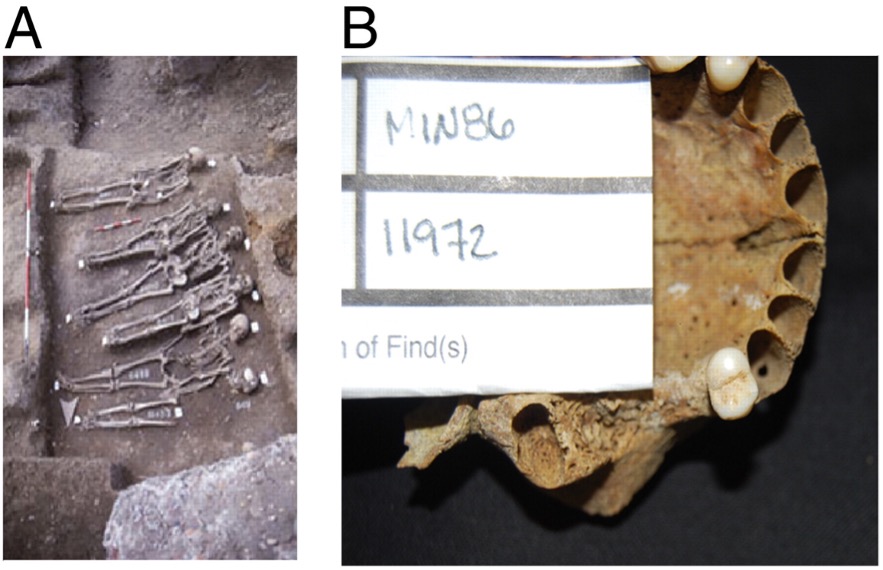
Remains of Black Death victims at East Smithfield, London
This discovery initiated a ‘scientific turn,’ as researchers focused on trying to answer, “how could it have been plague?” – as modern plague is not very infectious, and is only sometimes lethal. The diversity and complexity of these more recent approaches to explain fourteenth-century plague’s speed of travel, its infectivity, and its lethality from scientific investigations (rather than historical study) is exciting. However, this shift can be overwhelming for History students: the subject has moved on from rats, fleas, and buboes to instead consider a far more complex plague epidemiology, involving unfamiliar concepts and terminology like aDNA, biovars, pathogenesis, epizootics, vectors, antigens, phagocytosis, phylogenetic trees, and the accompanying scientific literature.

A version of the Y. pestis phylogenetic tree. From Eaton et al., ‘Emergence, continuity, and evolution of Yersinia pestis throughout medieval and early modern Denmark,’ Current Biology, v. 33, issue 6 (2023), pp. 1147-1152
An interactive learning approach can help to address these challenges through play, reflection, and direct application of knowledge. The enormously successful commercial videogame, Plague, Inc., and specifically its ‘Black Death’ scenario, can help introduce students to plague epidemiology, facilitate understanding of meanings and functions of some medico-scientific terms, and above all motivate greater engagement with the sources and interdisciplinary aspects of Black Death studies.

Title screen from Plague, Inc.: Evolved (2016), developed and published by Ndemic Creations
In Plague, Inc., you play as a pathogen (like a virus, bacterium, fungus, etc.), with the goal of wiping out humanity. After selecting a starting region, you gradually change the pathogen’s infectivity, severity, and lethality levels. The design is minimalist, essentially taking place across two screens: a world map where you watch your pathogen spread and work out what kinds of environmental, demographic, socio-economic and political barriers are being encountered; and an evolution screen, where you spend points to evolve your pathogen’s modes of transmission, symptoms, and resistances in order to surmount those barriers. This sparse interface means it is simple to pick up and play, with a full game typically taking less than ten minutes. Through engaging with the game’s systems players learn about the meaning, effects, and significance of particular symptoms and modes of transmission – its concise and precise descriptions distil the scientific language of specialist literature, while the changing map shows something of the impact of decisions.
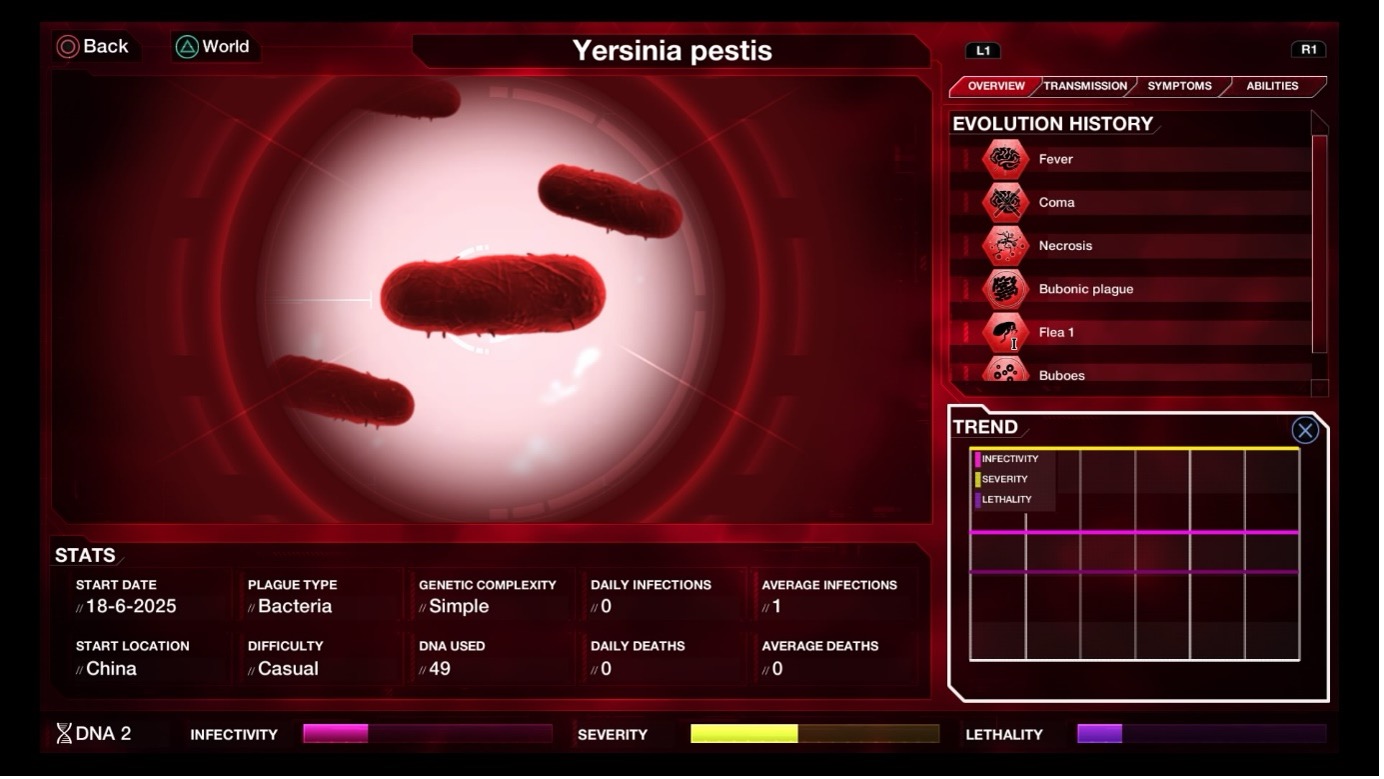
A screenshot from the game’s ‘Black Death’ scenario from Plague, Inc.: Evolved (2016),
The game’s ‘Black Death’ scenario casts the player as the bacterium Yersinia pestis, initially manifesting as bubonic plague, though you can later develop pneumonic and septicaemic variants. Starting symptoms are reminiscent of actual plague, such as buboes, fever, and necrosis, and transmission occurs through flea bites, much like the classic (though not necessarily current!) model of plague epidemiology. The game’s plague (again, much like modern plague) starts off as a serious illness, but one with moderate lethality and low infectivity. And because the symptoms are highly visible, the game is more likely to notice it quickly and to enact containment measures, such as shutting ports. This, then, does not make a promising starting point for a pandemic, either today or in the Middle Ages.
How then can we use Plague, Inc. in teaching?
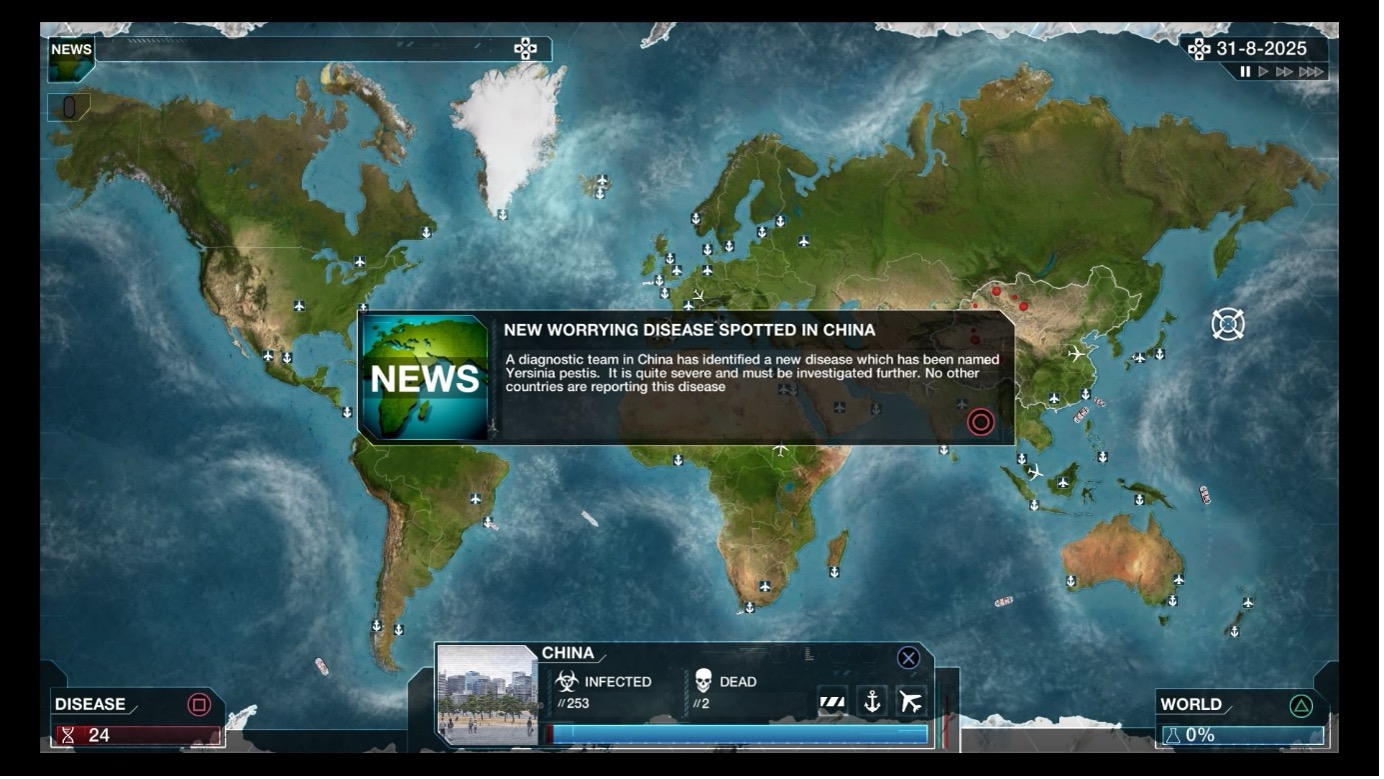
I’ve been spotted after infecting just 250 people, not a good start. Screenshot from Plague, Inc.: Evolved (2016),
After an initial playthrough to acquaint students with the mechanics, primary source extracts and secondary articles (with content summaries), provided to students prior to the seminar, can be integrated into play: the class is divided into smaller groups, which are encouraged to share out the sources/literature amongst themselves. Groups can evolve only those abilities for which they can cite evidence (the game can be paused anytime, which allows for research and discussion), whether that’s from fourteenth-century sources describing the vomiting of blood as a symptom, or a scientific study suggesting that Y. pestis can survive for long periods in soil or water, or an archaeological article arguing for the origin of the Black Death in Mongol territory, thus requiring application of their own reading, knowledge, and analysis. The different evolutionary routes down which groups can go depends on what evidence they find to justify their choices vividly illustrates the significance of one of the trickiest concepts in current debates about the Black Death: the phylogenetic tree of evolutionary relationships. Limiting factors, such as the point of origin (based around debates on geographical origins of the Black Death), or modes of transmission (for instance, only by land and ships), in turn prompts discussion of environmental conditions and disease vectors, which are some of the most active points in current historiographical debate. Students quickly found, for instance, that fleas and rats are poor vectors for ensuring widespread or rapid infection.
Plague, Inc. lends itself to stimulating discussion of current debates and pertinent questions about medieval transmission, mutation, and lethality, how we might explain these discrepancies, and importantly gets students to, in their words, “feel like” they’re directly participating in a hotly-contested scholarly argument – which is exactly what they’re doing. The game’s presentation and mechanics simply make this “feel” more within their reach. Moreover, giving students a way to see the results of their arguments and a clear goal to work towards (being more successful than other groups) stimulated engagement and noticeably improved both motivation to delve into historical sources and comprehension of those sources. Ultimately, the restrictions placed upon gameplay through external sources means that it is nearly impossible to win – though this is where it has to be surprisingly frequently pointed out to students that the real Black Death also did not wipe out everyone.
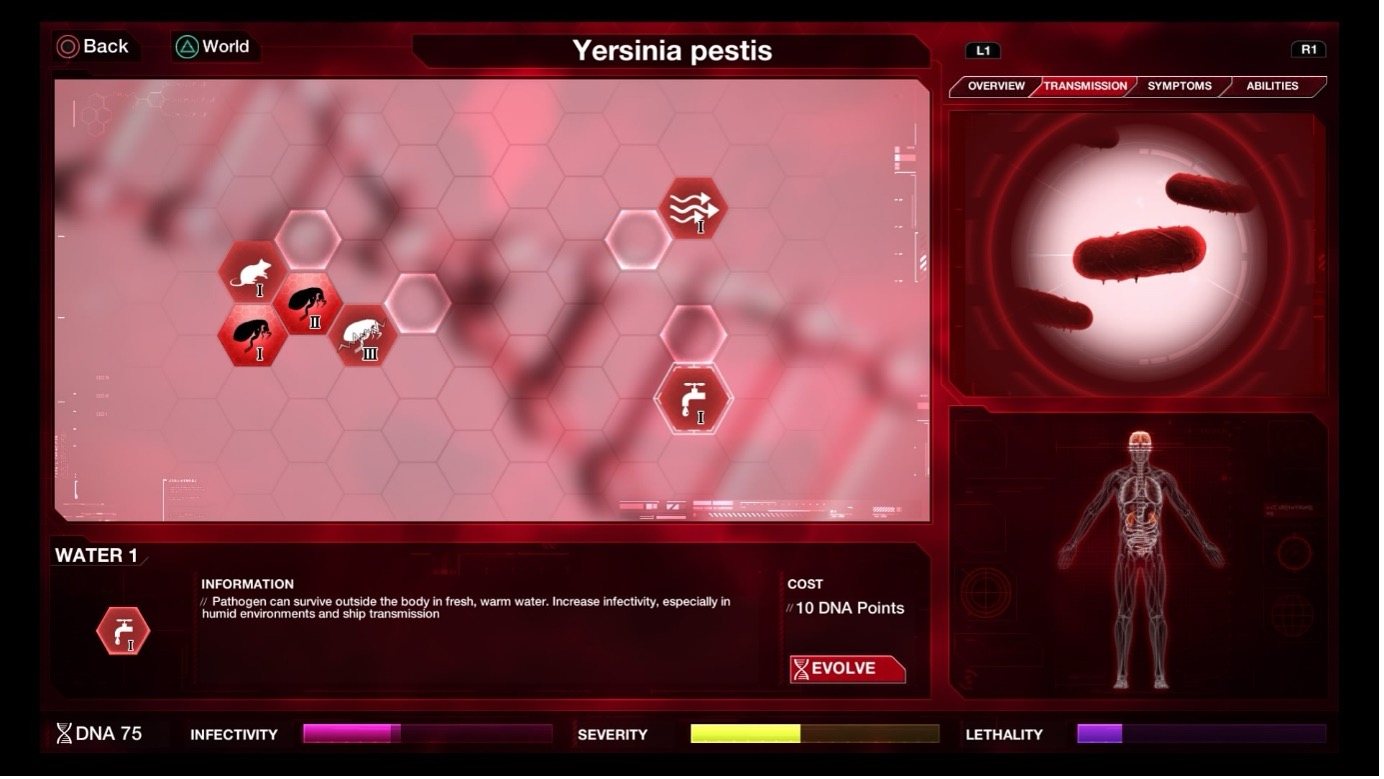
Can you find evidence to argue for developing this trait? Screenshot from Plague, Inc.: Evolved (2016)
Plague, Inc. is not without problems, however. Despite its marketing (which claims that it is a rigorously scientifically-modelled ‘outbreak simulator’), it was designed for entertainment over education. We can certainly question how well, or perhaps how accurately, the game teaches how plague (or any disease) works or is responded to. The Black Death scenario takes place in the modern world; the game allows you to evolve symptoms and abilities which real plague has never exhibited; the very premise endows the pathogen with conscious decision-making, and through the map screen makes the pandemic seem akin to a military conquest. This is actually not dissimilar from how many historians of the Black Death have also written, quite problematically, about it. Self-restriction through integration of sources into play mitigates some issues, while highlighting others. But ultimately, it is a puzzle game which blends fictional elements with science rather than a deep strategy simulator. It is a catalyst for learning and source engagement, but sources remain the main focus.
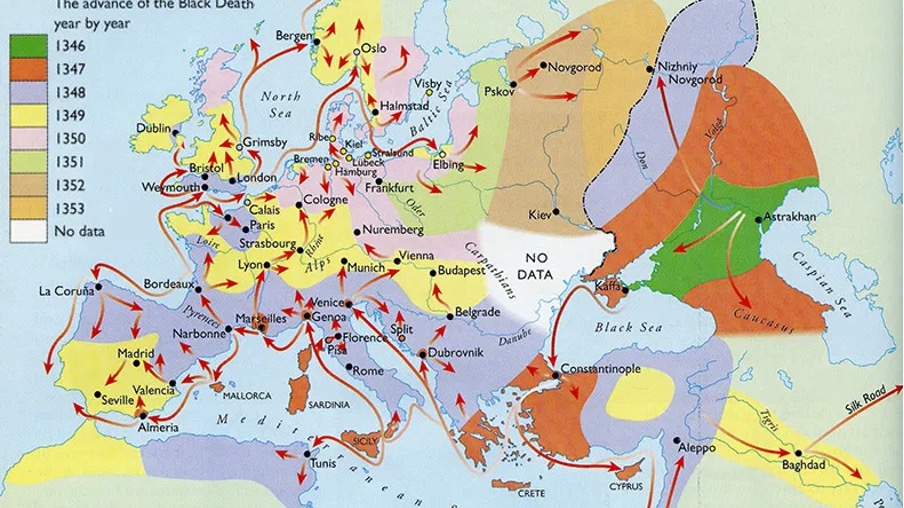
The Black Death is often problematically discussed as if it was a military campaign. Notice the similarity to troop movement maps. Taken from Ole J. Benedictow, The Black Death, 1346-1353: The Complete History (2004)
The Black Death is a subject in flux. Its enormous range and array of invested disciplines both inspires and requires more novel approaches to teaching: videogames are one way through which to promote accessibility into sources and literature, critical thinking, and hopefully inspire future developments. As a final thought, the existence of games like Plague, Inc. also serves to connect the past to the present and how we continue to think about the pandemic. By showing how videogames construct and contribute to cultural pandemic narratives today, students might better relate to how, say, late medieval art fulfilled similar functions in the past. We might not carry memento mori around with us anymore, but we might have Plague, Inc. on our phones.
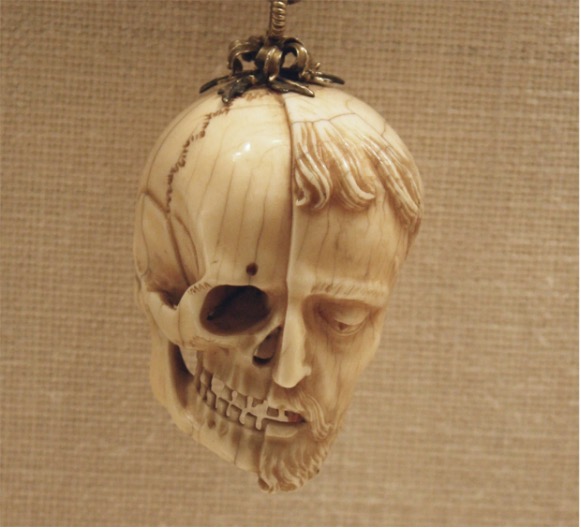
16th century ivory memento mori, now at the Metropolitan Museum of Art, New York
- American history
- Central and East European
- Current Projects
- Digital History
- Early modern history
- East Asian History
- Enlightenment
- Enviromental history
- European history
- Events
- History@Cardiff Blog
- Intellectual History
- Medieval history
- Middle East
- Modern history
- New publications
- News
- North Africa
- Politics and diplomacy
- Research Ethics
- Russian History
- Seminar
- Social history of medicine
- Teaching
- The Crusades
- Uncategorised
- Welsh History
- Visions of the Future from Central and Eastern Europe
- History is delicious at Cardiff!
- Making Ely Memory Lane: Perspectives from Some of the Project’s “Golden Oldies”
- Happily Together: Gardens for the Children at Penrice Castle
- How Troubled Was My Valley? 1941’s How Green Was My Valley and Contemporary America