History is delicious at Cardiff!
13 August 2026
In the History First Year core module ‘Global Histories’, one of the weekly seminars covers histories of potatoes. As a collective spin-off, this blog post offers three vignettes by Cardiff historians on how food features in their research as a way of accessing cross-cultural encounters and cross-cultural identities. Through potatoes, beef, hickory nuts, honey, and pork, as well as practices of eating and fasting, we find evidence of foodstuffs as elevated and humble, and as food and not food. Ultimately, our encounters with food histories show how people have broken social divisions through sharing food, how cuisines have emerged from human encounters, and how food gifts exchanged between different peoples have had significant symbolic meanings that shape relationships and power dynamics.
By Eleanor Barnett, Rachel Herrmann, and Helena Lopes
Eleanor:
In November 1631, a 19-year-old named Domenico de Gorgi appeared before the Venetian Holy Office. He told the inquisitors how he’d been captured by ‘the Turks’ in Venice and taken to Tunisia to be sold as a slave. Like other Christians who had been taken to Muslim lands, Domenico converted (probably by force) to Islam. After four years he was able to flee, and he returned to Venice recanting to the religious authorities.
As part of my Leverhulme Early Career Fellowship, I’ve been searching the Venetian archives for cases like this, not just for what they might tell us about early modern religion, but – perhaps surprisingly – what they tell us about food. The inquisitors were interested in what it meant to live as a Muslim, and food played an important part in Domenico’s response: to him, it meant attending mosque, being circumcised, and eating meat on Fridays and Saturdays ‘like the Turks did’. Catholics were expected instead to fast from meat on these days every week, and doing so had come to act as a visible expression of religious affiliation.
While Domenico, like many other slaves in Inquisition trials, downplayed his disobedience to the Church by claiming that he remained a Catholic ‘in his heart’, actions clearly mattered. To support his case to the Inquisition, he disclosed that he would secretly eat pork with Christians in Tunisia, this time in contravention of Islamic dietary laws.
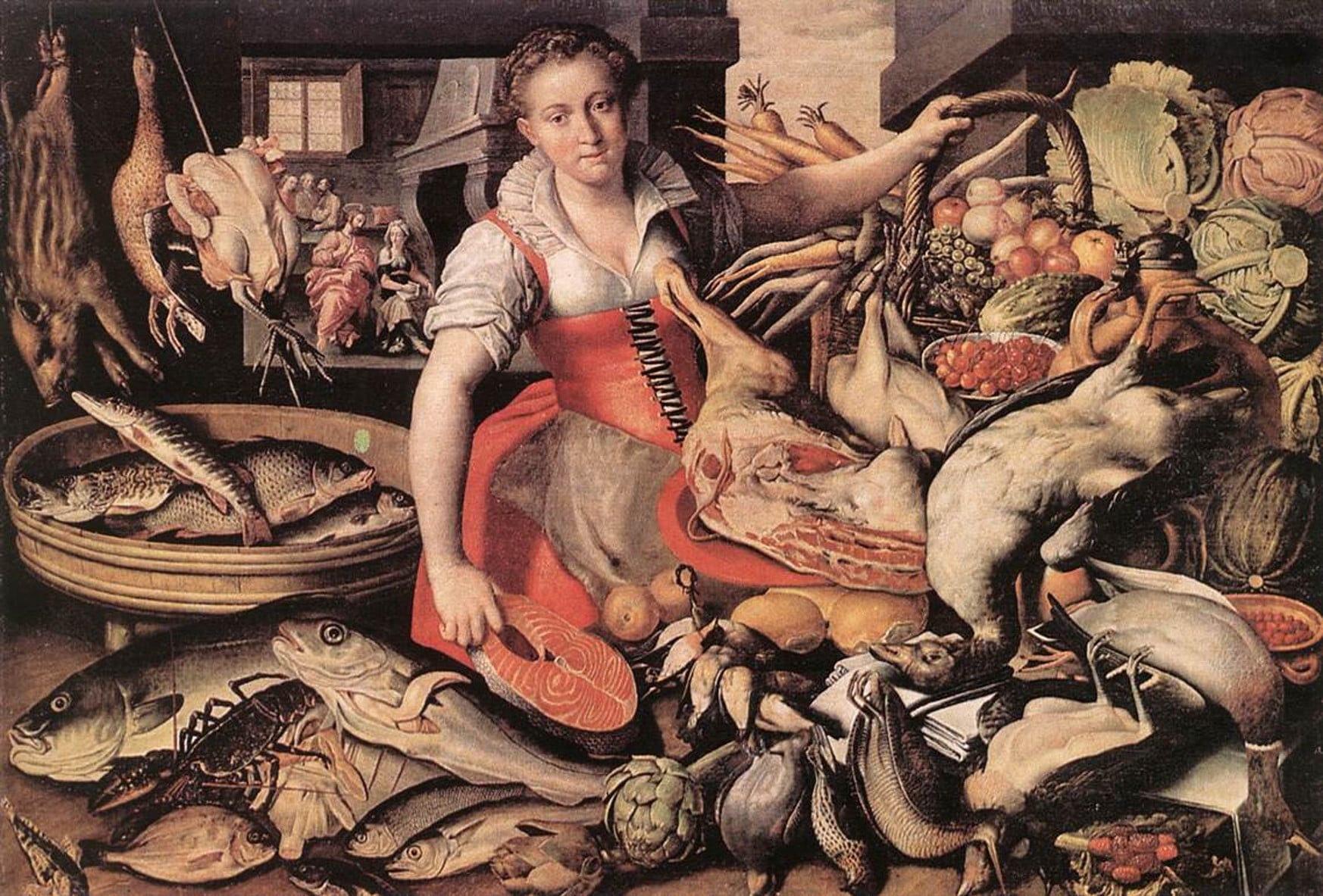
Christ in the House of Mary and Martha (attributed to 16th-century Italian artist Vincenzo Campi), housed in the Galleria Estense in Modena, Italy. Wikimedia Commons https://commons.wikimedia.org/wiki/File:Vincenzo_Campi_-_Christ_in_the_House_of_Mary_and_Martha_-_WGA03831.jpg

We begin to see, then, how diet was a point of difference in the early modern world, something that could define distinct religious identities. But, as my research into Inquisition records shows, the lives of those of different faiths were far more entangled than we might expect. Individuals moved across countries whether as slaves, travellers, or merchants; neighbours, friends, and even family might come from different religious and ethnic backgrounds. Adapting their ways of eating helped people navigate these complex identities and relationships across boundaries.
Rachel:
In my Year 3 module on Native American history, we look at a lot of maps of the places that became the colonies of Georgia and Florida to sharpen our historical abilities to interpret depictions of borders, people, and movement. Maps are often missing the presence of Indigenous people and contain claims about empty geographic space. These omissions can raise puzzling questions about how early colonists survived.
One of these maps, which was published in the 1733 edition of Benjamin Martyn’s Reasons for Establishing the Colony of Georgia and which Martyn co-authored with James Oglethorpe, famously moved the Spanish colony of San Agustín (in what is currently Florida) much further south than it was in reality to enhance England’s claims to the newly-envisioned colony of Georgia, to the north. This map borrowed knowledge from the trader Thomas Nairne to identify at least two Creek (or Muscogee) polities – called ‘Okesee nation’ and ‘Talavoosee’ on the map – but failed to record the Yamacraws, the Georgia colony’s nearest neighbours.[1] Yet those Yamacraw neighbours would be the ones to give the Georgia colonists permission to settle, the ones to supply them with fresh beef and venison, and the ones to mediate between other Creeks and James Oglethorpe to allow the English colony the land colonists needed to stay.
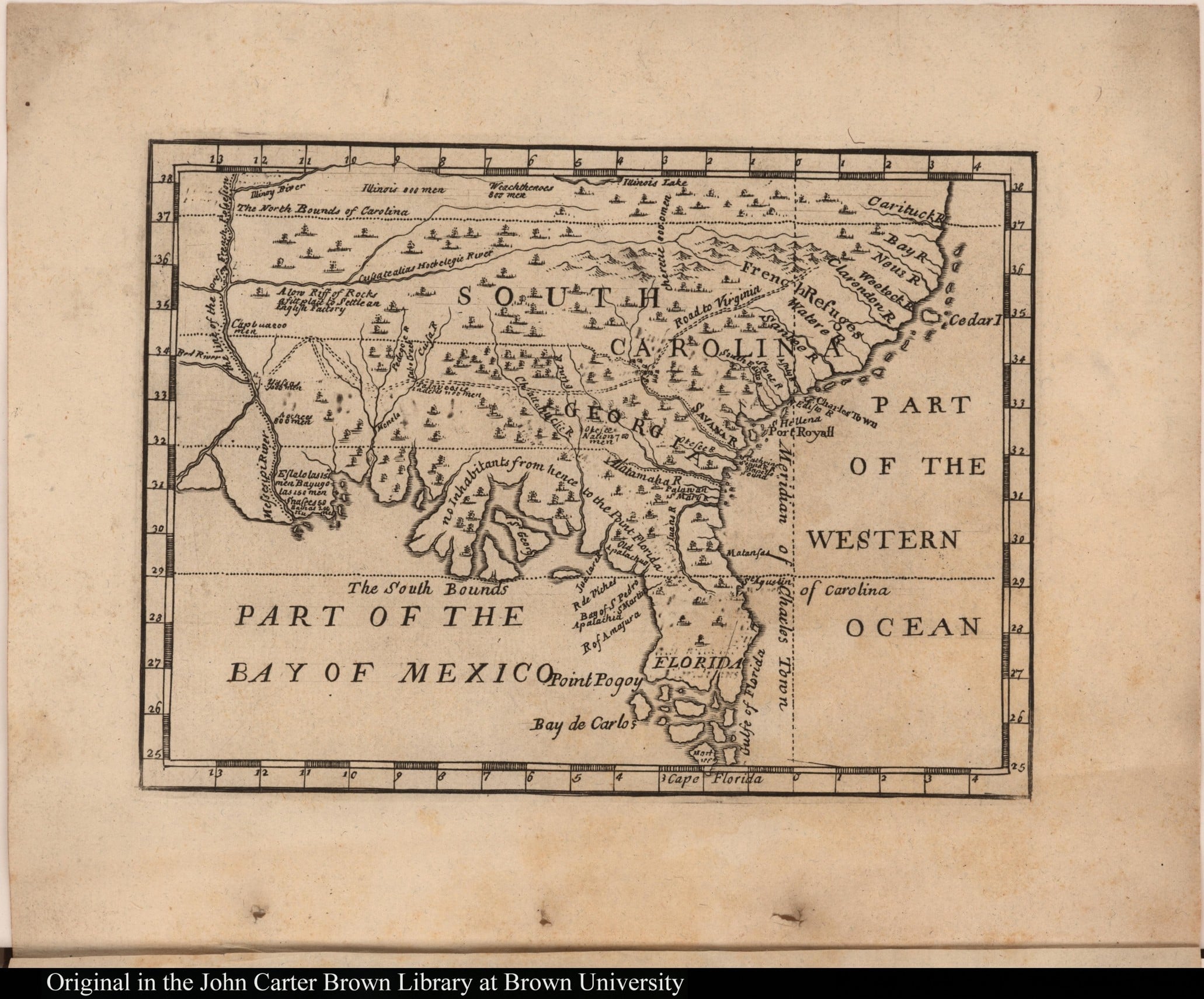
Benjamin Martyn [and James Oglethorpe], [Map of southeastern North America], in Reasons for Establishing the Colony of Georgia, 2nd edition (1733). Courtesy of the John Carter Brown Library.
That the land was Indigenous land became evident to the English – probably not for the first time – during a shipboard meeting in 1736.
I’ve written about this meeting, called the ‘milk and honey meeting’ for a new chapter that’s just come out in Food Production and Gender Across the Early Modern World. At this meeting Yamacraw leaders Tomochichi, his wife Senauki, the translator Mary Musgrove, and several other unidentified Native American women and children descended the bluff of the Savannah River to board a ship carrying James Oglethorpe and Methodist missionary John Wesley. Aboard, Tomochichi gave a gift of venison, and Senauki gave another gift of two jars, one containing honey and the other hickory nut milk. Musgrove then translated a complaint from the party’s Yuchi relations upriver: colonists’ wandering, unfenced cattle were eating Yuchi cornfields. Gifts of food produced from other animals and plants, rather than beef, helped to underscore the anti-cattle message that these Native American representatives delivered.
The Oglethorpe-Martyn map isn’t good at identifying people, plants, or animals at the local level. Other primary source evidence, fortunately, helps me (and my students) to offer counter-readings of these maps, and to use these sources and our historiography workshops to interpret maps for evidence of foodstuffs and people on the move.
[1] Louis de Vorsey, Jr, ‘Maps in colonial promotion: James Edward Oglethorpe’s use of maps in “selling” the Georgia scheme’, Imago Mundi, 38 (1986), pp. 35–45; Benjamin Martyn [and James Oglethorpe], [Map of south-eastern North America], in Reasons for establishing the colony of Georgia (2nd edn, 1733), The John Carter Brown Library, https://jcb.lunaimaging.com/luna/servlet/detail/JCBMAPS~1~1~1808~104390005:-Map-of-southeastern-North-America-?qvq=q:martyn%2C%20reasons;lc:JCBMAPS~1~1,JCBMAPS~2~2,JCB~1~1,JCBBOOKS~1~1,JCB~3~3,JCBMAPS~3~3&mi=0&trs=2#
Helena:
Chips might not be the first thing that springs to mind when one thinks of Chinese food, yet writing a history of Chinese restaurants in Wales and how they have been experienced locally will inevitably contain some ‘chippy’ stories. An atypical (outrageous?) ‘primary source’ attesting to this might well be a TikTok video by Welsh comedian Rhys Doing Things (https://www.tiktok.com/@rhysdoingthings/video/7601251676430798102).
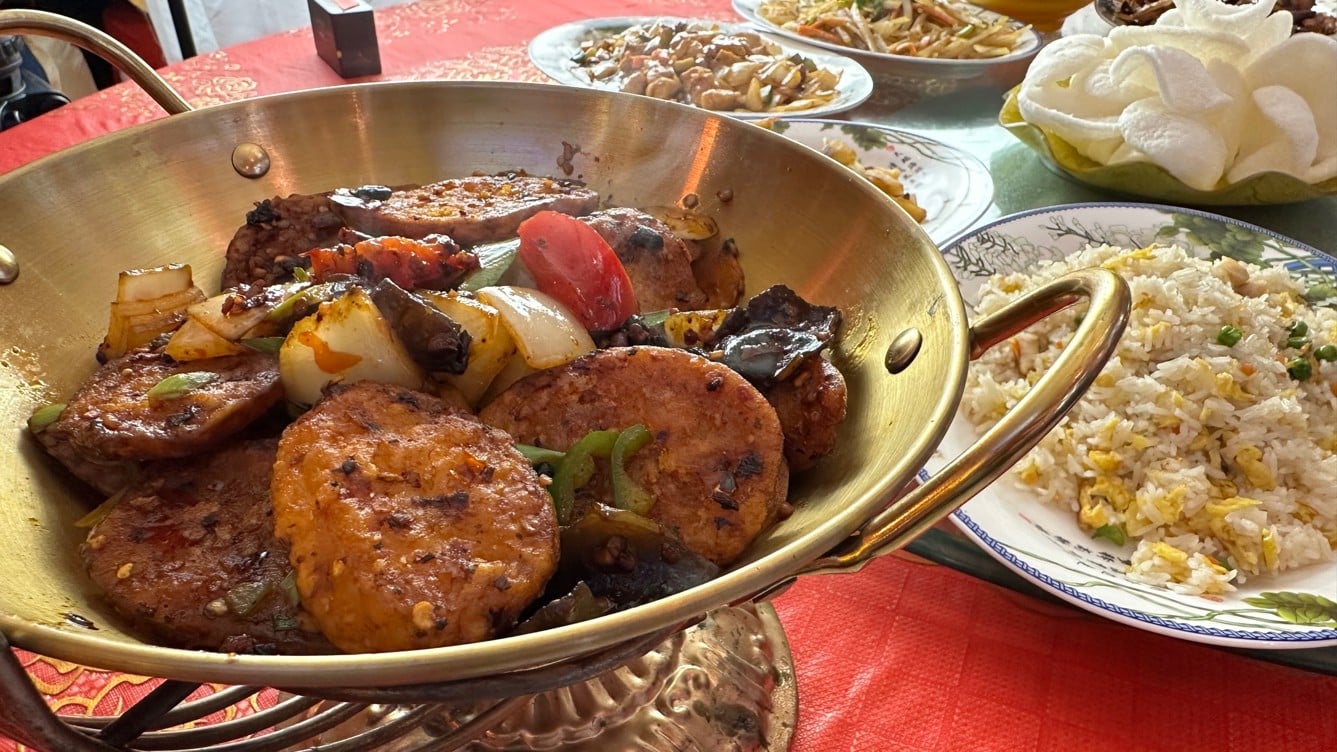
Griddled potatoes and other dishes at ‘Gigi Gao’s Favourite Authentic Chinese’ in Swansea (2026). Photograph by Helena Lopes.
British love for potatoes was certainly a factor in Gigi Gao’s conceptualisation of her restaurant’s menu. The profusely decorated ‘Gigi Gao’s Favourite Authentic Chinese’ in Swansea features an extensive list of options, but perhaps the most popular signature dish is griddled potatoes (干锅土豆 gan guo tudou). It is a culinary delicacy originally from Sichuan province, but it now has its renowned Welsh base: food critic Jay Rayner considered Gigi’s griddled potatoes ‘thrilling’, and online accolades deem it ‘the best potato dish in the world’. It is certainly one of the most delicious memories I have of fieldwork research!
In the last nine months, I have been developing the Welsh Crucible-funded collaborative research project ‘Savouring the Many Flavours of China in Wales’. Together with Dr Lui Tam (Welsh School of Architecture), Dr Aled Singleton (School of Geography and Planning), and BAFTA Cymru-winning cinematographer Keefa Chan, we are finalising a short film on the histories, spaces, and people involved in Chinese restaurants (past and present) in different south Wales locations: Abergavenny, Cwmbran, Llandaff – Cardiff, and Swansea.
Like histories of potatoes, pork, and hickory nut milk, histories of Chinese restaurants intersect with larger themes of global migration, cultural exchange, and material circulations. They also testify to forms of taste formation and adaptation: both Gigi’s exquisitely presented griddled potatoes – served on a mini wok suspended over a burning candle – and a humble take-away box of comforting chips ‘British Chinese style’ are features and symbols of these connections still unfolding today.
- American history
- Central and East European
- Current Projects
- Digital History
- Early modern history
- East Asian History
- Enlightenment
- Enviromental history
- European history
- Events
- History@Cardiff Blog
- Intellectual History
- Medieval history
- Middle East
- Modern history
- New publications
- News
- North Africa
- Politics and diplomacy
- Research Ethics
- Russian History
- Seminar
- Social history of medicine
- Teaching
- The Crusades
- Uncategorised
- Welsh History
- Visions of the Future from Central and Eastern Europe
- History is delicious at Cardiff!
- Making Ely Memory Lane: Perspectives from Some of the Project’s “Golden Oldies”
- Happily Together: Gardens for the Children at Penrice Castle
- How Troubled Was My Valley? 1941’s How Green Was My Valley and Contemporary America