Making Ely Memory Lane: Perspectives from Some of the Project’s “Golden Oldies”
5 August 2026
In her blog, Cardiff PhD student Rhianedd Collins and participants in her project Ely Memory Lane and using games to explore inter-generational experiences, childhood, and Ely’s history.
What is the value of play for connecting older and younger people in a community to their local history? Cultural historian Johan Huizinga argued that play is one of the core universal experiences of humans – people of all ages and all cultures have played in some form at some point during their lives.[i] Play can therefore be a powerful way to connect people of different generations. We explored this in our co-production project Ely Memory Lane, which is about the history of childhood play in Caerau and Ely during the 1930-50s.
Caerau and Ely are suburbs of west Cardiff with rich history and heritage that fosters keen local interest and pride. Several existing initiatives, such as the community archaeology project CAER Heritage, work with residents to research and conserve this heritage with a focus on Ancient and pre-History. Less research has been done on the area during the twentieth century, although there is much to explore considering the significant housing and industry development and decline experienced in the inter and post war period.[ii] Childhood play is an aspect of this history that can reveal some of the influence these changes to the local landscape had for people’s lived experiences then and now.
This inspired Ely Memory Lane, a project that has been developed by older and younger residents from Cardiff in partnership with students from Cardiff University. The project was developed around values of co-production, where research is created ‘with, by, and for communities.’[iii] It is affiliated with Rhianedd Collins’ PhD research, which is about playing in the past and playing in the present and how digital technology, specifically video games, can capture these experiences. The main objective of the project was to create a video game about local, personal histories of childhood play. It took place over six months.[iv]
To develop the game, eight older adults from a local club called Endeavourers and eight pupils from Cardiff West Community High School worked together on Ely Memory Lane. They used historical methods, including oral history, to research the types of games and toys that were popular in Ely in the 30s, 40s, and 50s and the places where children played. Using this research, they then co-created a video game called Back in My Day: Ely Memory Lane. The video game is freely available to play online.
This blog has been co-written and co-edited with three of the older project members. What follows are their words and experiences. The project members’ identities are protected with pseudonyms of their choosing. In this post, they reflect on the earlier phases of the project and discuss how the project was both an opportunity to share their knowledge about their local history and to connect with younger people from their community.
Finding Ely Memory Lane
Our connection to Rhianedd started quite a few months ago when she came to our little group in the Gospel Hall. She is doing a PhD project on the history and heritage of childhood toys, games and playing in and around the Ely/Caerau area of Cardiff. She asked us for details of toys and games we played when we were children and about trips and visits with playmates in the area. This caused us all to think and reminisce on our childhood, which was very pleasant. We described games we played and brought in a couple that we had kept. She seemed to be delighted by the effort we had made [Mary & Trees]
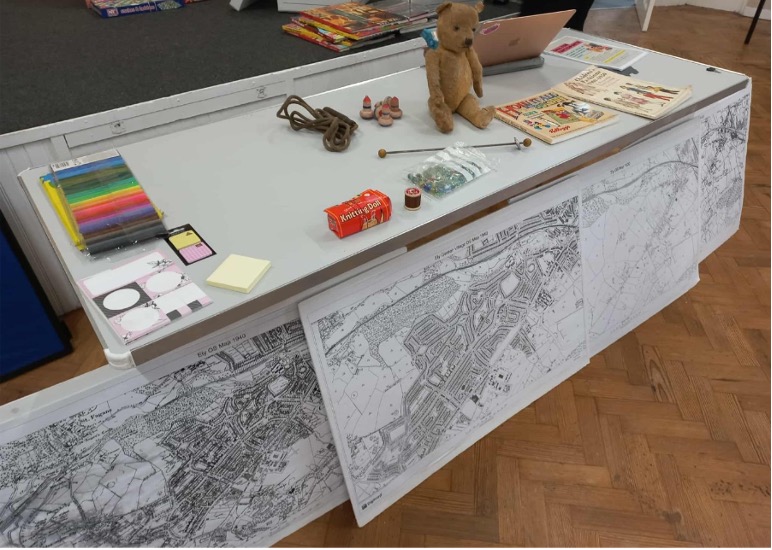
Image from the childhood reminiscence coffee morning delivered by Rhianedd Collins and hosted at Endeavourers, Reflect Church Hall, Grand Avenue, Ely. 26 November 2025.
Rhianedd gave us a pack of details/information about our memories of childhood to fill in before the project all started – this was also very interesting. Next, she came to our homes to interview us about our childhood and early lives, which she recorded digitally. We spoke about memories of special days out and trips [Mary & Trees]
Project member Roses shares as example of the type of childhood reminiscence discussed in the oral history interviews:
My mother was given a house in Snowden Road, Ely, because her house in Canton was bombed. I was born there in 1941 and lived there until 1944 when we moved to a house in Manor Street, Heath, just off Whitchurch Road. I had 5 brothers and one sister. The house was cold. No central heating in those days. No TV, so we played darts or cards or monopoly or listened to the radio. My brothers had a football game called Subbuteo. You had to flick the players to kick the ball into the net. If it was fine, we played outside swinging on the lampposts or playing hopscotch. I also used to nick stones from the graves to play a game called “gobs”. Money was tight. Most of my clothes were hand-me-downs. My parents made sure we had a good education, and we all ended up with good jobs when we left school.
Meeting on Ely Memory Lane
Next, we visited a local school and met a group of young school students who were also taking part in the project from their younger age perspective. The pupils are devising and making a type of video game that will be put on the internet featuring us oldies and some of the stories we told them. During our visit they asked us questions (and we could ask them questions back). It was a delight to meet these young people, aged about 12, in their school. There were 8 or 9 of them; very polite, well spoken, and seemingly interested in what we were talking about [Mary & Trees]
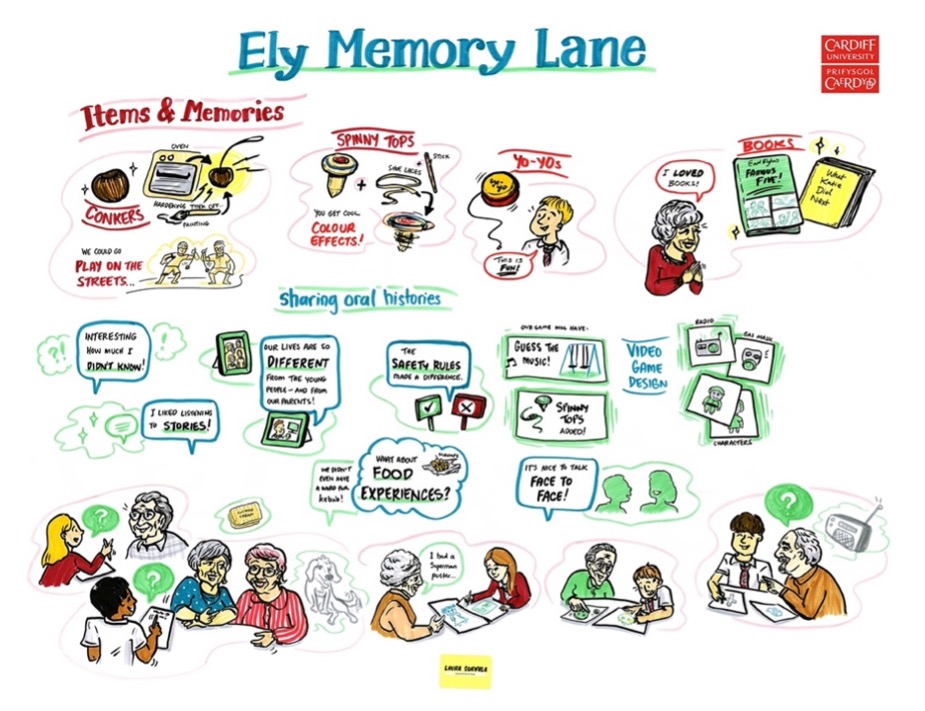
Live illustrated image of the workshop hosted at Cardiff West Community High School, 28 April 2026. Image copyright Laura Sorvala Illustrations.
The chat got off to a great start with introductions between us all. Before we met up, the young people had listened to our recordings of our days out with our pals and based some of their questions on these recordings. They asked questions about various things from our childhood and were surprised at some of our answers compared with what young people play and do today. We were then paired off, with one pupil to each “golden oldie.” They asked questions about how we looked when we were children, and as they listened, they were making a type of pixelated image based on our answers. This looked very difficult to do; it was beyond me!! [Trees]
The pupil who I was paired with was very nice and seemed shocked that as children we had no mobile phones (indeed no phones at home), no computers and no TV. They could not imagine life without these “necessities.” While we talked, they produced a pixilated computer picture of me and the toys and games that we used to play with as children. I was so impressed with what they were doing [Mary]
Reaching the End of Ely Memory Lane
I enjoyed spending time with the pupils from Cardiff West High School and helping Rhianedd with her PHD. It was a truly enjoyable day. These young people were lovely, and the video game will be terrific when completed. Eventually, everything goes into a display about this project, which will be going to the Museum of Cardiff for all to see. I look forward to seeing the finished article [Mary, Trees, and Roses]
It has been a privilege to work with the older and younger project members on Ely Memory Lane. Working together, designing together, and playing together has shown how valuable intergenerational connection is for learning from one another. We have uncovered lots about the history of play in Caerau and Ely and I have personally learnt so much from them all. The game is currently on display alongside examples of their broader project research in a co-curated, free museum exhibition at the Museum of Cardiff, between 11 July 2026 and 31 October 2026. I am thankful to the Museum for the opportunity to proudly share the work achieved on Ely Memory Lane with the wider Cardiff community [Rhianedd].
References:
[i] Johan Huizinga, Homo Ludens: A Study of the Play Element in Culture, 1st edn (London: Routledge, 1949), pp. 3, 4.
[ii] Oliver Davis, Dave Horton, Helen McCarthy, and Dave Wyatt, ‘The Caerau and Ely Rediscovering Heritage Project: Legacies of Co-Produced Research’, in Heritage as Community Research: Legacies of Co-production, ed. by Helen Graham and Jo Vergunst (Bristol: Policy Press, 2019), pp. 129-147 (pp. 130-140).
[iii] Sarah Lloyd and Julie Moore, ‘Sedimented Histories: Connections, Collaborations and Co-production in Regional History’, History Workshop Journal, 80 (2015), 234-248 (p. 235).
[iv] Initial community outreach for the Ely Memory Lane project began in October 2025. The project officially started in December 2025 and ran until the end of June 2026.
- American history
- Central and East European
- Current Projects
- Digital History
- Early modern history
- East Asian History
- Enlightenment
- Enviromental history
- European history
- Events
- History@Cardiff Blog
- Intellectual History
- Medieval history
- Middle East
- Modern history
- New publications
- News
- North Africa
- Politics and diplomacy
- Research Ethics
- Russian History
- Seminar
- Social history of medicine
- Teaching
- The Crusades
- Uncategorised
- Welsh History
- Visions of the Future from Central and Eastern Europe
- History is delicious at Cardiff!
- Making Ely Memory Lane: Perspectives from Some of the Project’s “Golden Oldies”
- Happily Together: Gardens for the Children at Penrice Castle
- How Troubled Was My Valley? 1941’s How Green Was My Valley and Contemporary America