Happily Together: Gardens for the Children at Penrice Castle
27 July 2026
In her blog post, Esther Jones (PhD student in History) talks about the nature of the garden and its role in children’s education in eighteenth-century Wales
“We have never yet mentioned a garden; we have never mentioned those great delights to children, a spade, a rake, a wheelbarrow.”
So says Maria Edgeworth in Practical Education (1798), which advised parents on the improvement of their children. For Lady Mary Talbot (1776–1855),
The garden at Penrice was first developed in the 1770s, alongside construction of the manor house by Mary’s future husband, Thomas Talbot (1747–1813). It was only ‘finished’ in the early 1790s in anticipation of their engagement. Of course, a garden is never really ‘finished’ – not only changing organically across seasons but forever developing according to a family’s needs.
By the late eighteenth century, botany was an essential part of fashionable education. The translation of Carl Linnaeus’ taxonomy into English in the 1760s made botanical classification accessible to the educated lay person, while his anthropomorphising of botanical processes encouraged people to project the plant world onto human society and vice versa. We may now call someone a ‘late bloomer’ with no thought of its garden metaphor, but in the late eighteenth century ‘bloom’ would have been an obvious alignment of floral and human maturity.
Plants were central to domestic life at Penrice Castle, reflecting the vitality of garden culture to a section of society defined by their leisure and country homes.Talbots’ extensive family archive reveals a household embedded in eighteenth-century gentry garden culture. As early as five and six years old, Mary Talbot’s two eldest daughters, Mary Theresa and Jane, wrote to their mother under their governess’ instruction in 1801, showing how quickly they were taught to pay attention to the garden:
Little Mary to her dear Mama:
The yellow roses are in blow round the basket near the rock work. There are two little red rose trees full of blossoms. The renunculuses in the kitchen garden have been very beautiful since you went away, and the pinks are coming out in blow.
Little Jane to her dear Mama:
Mama, the cucumbers are come, but Mary says they are melons. The strawberries are come. The cherries are coming. The gooseberries are come ripish, but not much.
‘Do you not long for the happy day when we shall all be gardening happily together?’ Mary asked the nine-year-old Charlotte while on holiday in Dorset in 1810.
Redevelopment of the Penrice garden over the next two years set out plots for each of the children, which they could tend and curate to their own tastes. Charlotte, for instance, used mustard and cress to spell out ‘CT’ (Charlotte Talbot) in her own plot. As well as entertaining them, the children’s gardens gave them a stake in the landscape their family had owned for generations.
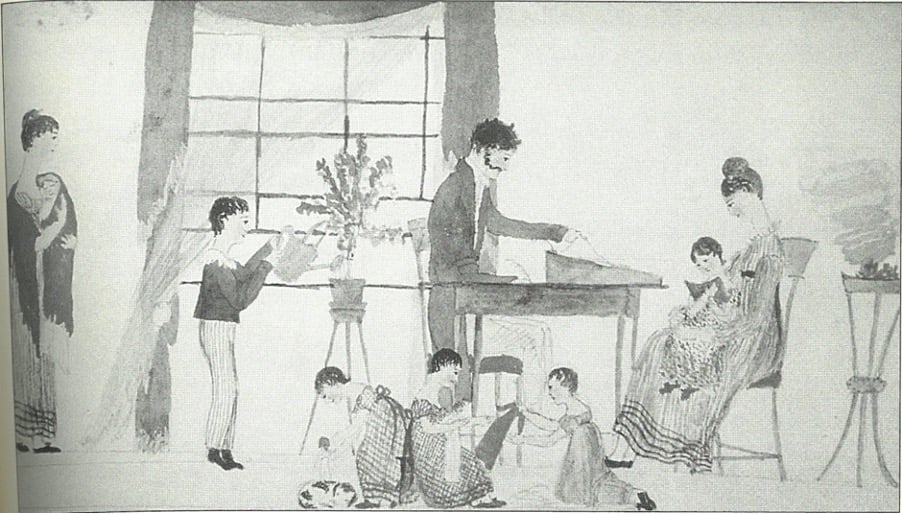
Watercolour of the Talbot family at leisure. Circa 1815, presumably by one of the Talbot daughters. Private collection
The children also expressed their love of gardening through another ‘fashionable’ skill: drawing and painting. A watercolour by one of the children made around 1815 shows an idyllic scene of the family at leisure. In the centre, a young Christopher Talbot waters a potted plant.
Yet eighteenth-century garden education was gendered. The Talbots’ only son, Christopher, ‘graduated’ from the garden when he was sent to boarding school at eight years old. For his five surviving sisters, the garden remained central to daily life and provided a topic of interest in their letters to their distant brother. In 1813, Jane complained that ‘Mama takes so much pains with your garden […] I wish I was at school, that I might have someone to take so much pains with my garden for me.’ Attention to his garden may have been an emotional outlet for Mary, who missed her son while he was away. A year earlier, she wrote to him: ‘I shall put some more things into [your garden] tomorrow as I like to go and think of my dear boy in the spot that I hope will prove so much amusement to him.’
My research is partly a public history project, bringing me into contact with present-day garden afficionados. At a recent outreach event, one attendee told me that he still tends to his late wife’s garden fifteen years after her passing. For him, as for Mary Talbot, the garden was a place to remember the ‘happily together’ and a way to care for our loved ones even in their absence.
Selected Sources
Coutu, Joan, with Jon Stobart, Peter N. Lindfield, and Joan Coutu, ‘Burke’s Exemplum: The “Natural Family Mansion” and Wentworth Woodhouse’, in Politics and the English Country House, 1688–1800 (McGill-Queen’s University Press, 2023), pp. 151–69, doi:10.1515/9780228014973-012
Edgeworth, Maria, and Richard Lovell Edgeworth, with University of California Libraries, Practical Education; (London : J. Johnson, 1798) [http://archive.org/details/practicaleducati00edge](http://archive.org/details/practicaleducati00edge) [accessed 29 July 2026]
King, Amy M., Bloom: The Botanical Vernacular in the English Novel, 1st ed. (Oxford University Press, 2003)
LaBouff, Nicole, ‘Public Science in the Private Garden: Noblewomen Horticulturalists and the Making of British Botany c. 1785–1810’, History of Science, 59.3 (2021), pp. 223–55, doi:10.1177/0073275320961908
Martin, Joanna, Wives and Daughters: Women and Children in the Georgian Country House (A&C Black, 2004)
Further Reading
Sobe, Noah W., ‘Concentration and Civilisation: Producing the Attentive Child in the Age of Enlightenment’, Paedagogica Historica, 46.1–2 (2010), pp. 149–60, doi:10.1080/00309230903528520
Porter, Agnes, with Joanna Martin, A Governess in the Age of Jane Austen: The Journals and Letters of Agnes Porter (Hambledon Press, 1998
- American history
- Central and East European
- Current Projects
- Digital History
- Early modern history
- East Asian History
- Enlightenment
- Enviromental history
- European history
- Events
- History@Cardiff Blog
- Intellectual History
- Medieval history
- Middle East
- Modern history
- New publications
- News
- North Africa
- Politics and diplomacy
- Research Ethics
- Russian History
- Seminar
- Social history of medicine
- Teaching
- The Crusades
- Uncategorised
- Welsh History