Multilateralism, Ocean Governance and International Law: Highlights from Guest Lecture
17 May 2026
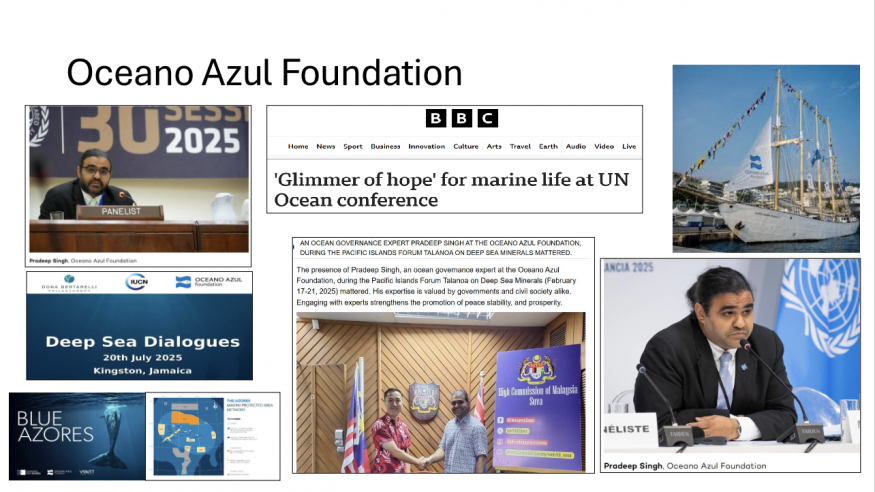
The Centre for International Law and Multilateralism recently welcomed Pradeep Singh, Senior Project Manager at Oceano Azul Foundation, for a guest seminar exploring the relationship between multilateralism, ocean governance, and international law. Drawing on his expertise in the law of the sea, environmental law, climate policy, and public international law, Singh examined the complex network of actors involved in governing the world’s oceans and highlighted the increasingly important role played by international organisations and non-governmental organisations (NGOs).
The seminar began by mapping the ‘who’s who’ of ocean governance. While states remain central actors in international law through treaty-making and enforcement, Singh emphasised that contemporary ocean governance depends on cooperation between a much wider range of stakeholders. International institutions, NGOs, scientific bodies, philanthropic foundations, and private sector actors all contribute to shaping policy and influencing global marine governance frameworks.
A key theme throughout the seminar was the scope of influence exercised by these actors at different stages of international law-making. Singh demonstrated how NGOs and scientific organisations frequently play a major role in raising awareness of emerging issues and setting international agendas which support implementation and compliance efforts once agreements are adopted. Furthermore, he outlined the structure and importance of these groups in contributing expertise during treaty negotiations. This reflects broader developments in multilateral governance, where soft law instruments and voluntary commitments increasingly complement traditional treaty regimes.
The seminar also explored why ocean governance presents unique legal and political challenges. Unlike many areas of international law, ocean governance is highly science-driven and institutionally fragmented. Different issues, including shipping, biodiversity conservation, fisheries management and deep-sea mining, are often governed through separate legal frameworks and organisations. Singh discussed how this fragmentation can create gaps in coordination and enforcement, particularly in areas beyond national jurisdiction.

In the latter part of the seminar, Singh discussed the work of the Oceano Azul Foundation and broader debates surrounding deep ocean stewardship. Particular attention was given to the growing international concern over biodiversity loss and the governance challenges posed by emerging activities such as deep-sea mining. Here, Singh emphasised the importance of precaution, scientific knowledge, and long-term stewardship within future ocean governance frameworks.
Overall, the seminar provided valuable insight into how multilateralism operates in practice within the context of ocean governance. It highlighted both the opportunities and limitations of contemporary international law in responding to global environmental challenges, while demonstrating the increasingly important role played by non-state actors in shaping the future of international cooperation. For the students of international relations in attendance, the seminar offered a timely reminder that effective global governance depends not only on states and treaties, but also on collaboration between experts, civil society, and wider transnational networks