Behind Every Data Point: Understanding the Patient Behind the Data
28 September 2026
By Snehal Akkaladevi a Cancer Clinical Trials Data Manager in Haematology
When we think about clinical trials, our attention often turns to the professionals who are most visible in the research environment: the haematologist assessing a participant, the research nurse coordinating study visits, or the laboratory scientist analysing blood, bone marrow, or tissue samples. Yet, underpinning each clinical assessment, laboratory result, treatment decision and outcome measure is another essential component of research: Data.
Behind this data is a professional whose contribution may be less visible but is fundamental to the quality and integrity of clinical research—the Clinical Trial Data Manager.
In Haematology Clinical Trials, NHS, the role of the data manager extends considerably beyond entering information into an electronic database. Data managers contribute to the processes that ensure research data are accurate, complete, consistent, timely and fit for purpose. They coordinate information from multiple sources, identify discrepancies, facilitate data clarification, support database cleaning and work collaboratively with clinical teams, research nurses, laboratories, sponsors and statisticians.
Ultimately, their work helps ensure that the evidence generated from a clinical trial accurately reflects the experiences and outcomes of its participants.
Managing complexity in Haematology Clinical Trials
Haematology clinical trials can generate large volumes of highly specialised and clinically complex information. Depending on the disease and study design, data may include haematological parameters, bone marrow aspirate and biopsy findings, cytogenetics, flow cytometry, molecular results, treatment information, response assessments, progression data, adverse events and long-term follow-up.
For conditions such as Acute Myeloid Leukaemia (AML), Lymphoma, Multiple Myeloma and Myelodysplastic syndromes (MDS), this complexity can be compounded by rapidly changing clinical circumstances. A laboratory result obtained today may influence treatment decisions tomorrow, while a molecular result reported several weeks later may become an important component of a study endpoint.
The challenge, therefore, is not simply to collect information. It is to ensure that the right information is collected at the right time, from the appropriate source, according to the protocol, and in a form that can subsequently be interpreted and trusted.
Translating the protocol into meaningful data
The data manager can play an important role from the early stages of a clinical trial by helping translate a complex study protocol into practical and structured data requirements.
This involves considering fundamental questions such as:
- Pre-screening requirements
- Screening requirements
- Eligibility Checklist
- Schedule of Events as per protocol, etc.
- Abiding to Protocol & Avoiding Deviations
The data manager therefore helps transform the protocol from a document describing what the study intends to investigate into a structured framework that enables the required information to be captured, reviewed and ultimately analysed.
Why haematology requires a particular understanding of data
Haematology presents distinctive challenges for clinical trial data management.
Participants may experience substantial changes in laboratory parameters over relatively short periods. Treatment pathways can involve multiple phases, combinations of therapies and complex dosing schedules. Disease classifications and diagnostic criteria may also evolve, while advances in molecular and genetic testing continue to expand the range and complexity of information collected within trials.
A single study may require data from diagnosis and baseline assessment through induction treatment, response assessment, consolidation, maintenance and subsequent disease progression or relapse. Long-term follow-up may introduce an additional layer of complexity.
Understanding how these data relate to one another is therefore essential.
Technical knowledge of databases and data management systems is important, but it is not sufficient on its own. Effective data management also benefits from clinical awareness, attention to detail, curiosity and an understanding of the context in which the data were generated.
A data manager does not need to be a haematologist to contribute effectively to a haematology trial. However, an understanding of the clinical pathway can make it easier to recognise when information appears unusual.
The purpose of this process is not to find fault with the clinical or research team. Rather, it is to establish the most accurate possible account of the participant’s experience within the study.
The data manager as a bridge between clinical care and research
Clinical trials in the NHS take place alongside normal patient care. Patients attend appointments, have blood tests and other investigations, receive treatment, and may have samples processed by different departments or laboratories. Research nurses, doctors, laboratory staff, and other healthcare professionals all contribute to the trial. Results may also come from external or central laboratories and need to be added to the trial database.
The data manager helps bring all this information together.
For example, a data manager may notice that a blood test result expected at a particular study visit is missing, that a treatment date does not match the expected visit date, or that a disease assessment does not appear to match information recorded elsewhere in the patient’s medical records.
These issues are not always simply database errors. They may indicate that something needs to be checked or clarified in the patient’s records. By raising appropriate queries and working with the clinical and research teams, the data manager helps make sure that the trial database accurately reflects what happened to patient.
Data quality, governance and research integrity
The importance of high-quality data extends beyond the requirements of an individual clinical trial. Research data must be managed within appropriate governance frameworks, with due consideration given to confidentiality, data protection, scientific integrity, accuracy and traceability.
The UK Policy Framework for Health and Social Care Research emphasise the importance of appropriate arrangements for research data, including the handling, storage and management of information so that research can be accurately reported, interpreted and verified while protecting participant confidentiality.
Within this framework, data managers contribute to practical processes such as data validation, discrepancy management, query resolution, completeness checks and database cleaning. Their work supports the broader research team’s ability to maintain reliable and traceable study data.
Importantly, data quality is not the responsibility of one individual or one profession. It is a collaborative process involving investigators, research nurses, laboratory teams, data managers, trial management teams, statisticians, sponsors and other stakeholders.
To build quality infrastructure that supports the credibility of the research.
Protecting the value of the participant’s contribution
Every clinical trial depends on the willingness of participants to contribute their time, information, biological samples and experiences to research.
This contribution has value beyond the individual study visit. Participants contribute to a process through which clinical observations are transformed into evidence that may support future research and healthcare.
For this reason, data quality has a distinctly human dimension.
An inaccurate record is more than just a technical problem. If information is not recorded correctly, clarified, and managed properly, important details about a participant’s clinical experience may be missed or not accurately reflected in the study’s results.
Data management can therefore be viewed as part of the responsibility owed to research participants: ensuring, as far as possible, that their contribution is accurately represented within the research record.
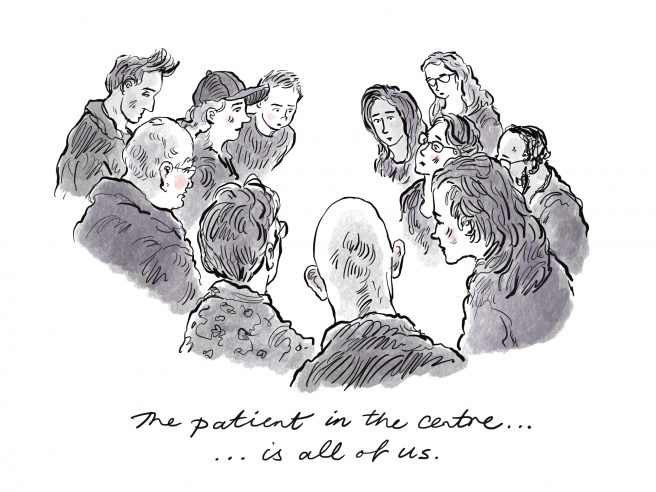
The patient behind every data point
Perhaps the most important perspective is also the simplest: clinical trial data are not merely numbers on a screen.
Behind every participant identification number is a person.
That person may have contributed their time, personal information, biological samples and experiences because they wanted to support research, improve understanding of their condition or contribute to better healthcare for future patients.
Each represents part of an individual’s clinical journey.
For me, this perspective has changed the way I view clinical trial databases. Data management is not solely about maintaining accurate records; it is about ensuring that the participant’s contribution is represented as faithfully as possible within the evidence generated by research.
Looking beyond the database
As clinical trials become increasingly complex and data sources continue to expand, the role of the clinical trial data manager is also evolving. The profession sits at an important intersection between clinical practice, research governance, information management and scientific evidence.
They are an important component of the quality infrastructure of a clinical trial, helping transform individual clinical experiences into structured evidence that can be analysed, interpreted and communicated.
Good clinical research needs good data. Good data require robust processes, collaboration and skilled professionals. And behind every data point, there is a patient whose contribution deserves to be accurately represented.