Behind Every Data Point: A Trial Nurses Story
28 September 2026
By Katie Gilmour a Research Nurse at Velindre Cancer Centre
What does it feel like to be a research nurse whose work is constantly translated into data?
Summertime is the best for sport, after work yesterday I flit between watching Wimbledon and the Tour de France.
Wimbledon won out last night, Djokovic taken to a fifth set and like every good Brit I was hoping and cheering for the underdog. But those statistics won out, unforced errors. Break point conversions. Playing within the rules won Djokovic the game. Moments translated into numbers, attention to data has made a massive difference in sport, in training, in preparation and play…
The spreadsheet says “1”.
One patient recruited at last to our clinical trial!
A single number in a quarterly report.
To someone glancing at the figures, it might not look like much. Perhaps another clinical trial team recruited ten. Another twenty.
But behind that solitary “1” is a story, a patient, an opportunity and hundreds of professional conversations.
Delivering complex and novel therapies to patients
I started working as an oncology early phase research nurse not really knowing the difference between early and late phase nursing roles and knowing very little about novel and advanced therapies. I learned that our standalone cancer centre had been mandated to offer a clinical trial service that worked in partnership with two NHS trusts and the University. The scope is to offer opportunities and equity to patients in Wales to be able to participate in more early phase, complex and novel therapies. I have since realised what an ambitious clinical trial portfolio this is to establish! But that’s another story, let’s stick with one of our clinical trials and a triumph when the stars aligned and that one patient entered our clinical research facility!
Let’s talk about this “1” study, we were so excited to run as a team. The great momentum for this clinical trial came from the fact that it’s a bench to bedside study. I had met the scientist who had developed the drug! I was super pleased to be the lead nurse in setting up the trial when this treatment would be given to a human. We had an outside chance of having the very first patient to have the drug in all the world. Suddenly there was a quiet race against time. We wanted to be ready. We were excited to open the study. If everything aligned, if approvals came through, if screening went well, if logistics worked the science developed in Cardiff might be first given to a patient in Cardiff. The race was on.
So, what of data and nursing?
When I think about a nurse at work do I think about data? As a nurse, No, I think about people, patients, health narratives, clinical skills, good communication and attention to relationships, and attending to people’s needs. But in research, all nursing activities become numbers and details in a database. And research nurses create the conditions for data to be gathered and collected.
Nurses form trusting relationships with patients and help them have confidence to consent to clinical trials. Research Nurses have a fundamental relationship with data collection and a huge responsibility to contribute to the integrity of data.
As research nurses we live in two worlds. We care for people. We also care for data. One without the other doesn’t work. Poor care leads to poor experiences and poor data equals poor science and poor science doesn’t help anyone.
If I think about day one of a new clinical trial every value provided as part of the data collection is generated by me and my colleagues noticing something, asking additional questions, collating accurate and careful information about adverse events, repeating blood tests, exploring ‘what’s that herbal remedy they have taken? Will it impact on the drug!’
The decisions to give or not to give the ‘new’ drug are dependent on clinical judgements and all these individual decisions are collected for researchers to understand how the drug works in the human body. So yes, some nursing tasks are measurable- vital signs, bloods, scans, clinic attendance and follow up are all measurable activities. And all-important activities! But arguably much nursing activity is not measurable, or the measures only tell part of a story, not all activities to make something happen are measured.
The scale of effort behind each data point
That spreadsheet saying “1”, let me talk about those hundreds of professional conversations that make that one thing happen. Yeah, before that “1” patient could even be approached, two NHS Organisations had to agree on how an entirely new treatment pathway would work. Relationships had to be built. Governance agreed. Pharmacy prepared. Imaging teams informed. Laboratory processes validated. Emergency pathways discussed. Consultants, ward teams and specialist nurses all needed confidence that this new therapy could be delivered safely. It took many conversations to work on the infrastructure to deliver a clinical trial in a new place. In opening this trial some professional conversations were missed too and thought of late in the day eek…
One communication that was not missed was the communication to all the support teams letting them know that the patient is coming in tomorrow, the overzealous emails maybe didn’t need to get to the ears of the CEO…
As well as the professional conversations with colleagues and within health systems establishing a process there were all the conversations with the patient and family. For me the essence of nursing in oncology and clinical trials space. Our patient might not be frightened but his partner certainly was, our patient longed for another treatment option, he was a husband, father, grandfather and wanted to live. Patient and caregiver had extended family commitments and responsibilities; they lived a few hours away and had to stay in hotels to support the clinical trial treatment days. The patient worried about side effects, and the impact of clinical trial procedures on his advancing disease. These were the conversations navigated between nurse and them. How was that work measured? Questions about every eventuality, mortality, a limitation to the assurance that can be given, a lack of data that can be provided on what the drug has done in the body before because it hasn’t been in a human body before. Because yes, we did give this drug to someone for the very first time, created by a scientist I’d met and that doesn’t happen or align very often.
Months later the quarterly report still simply says “1”.
One patient recruited
One data point.
But when I see that number, I don’t see a spreadsheet.
I see a courageous and determined patient.
I see a wonderfully capable, nurturing, questioning and dedicated wife.
I see pharmacists checking calculations, navigating transport and timings.
I see scientists who’ve spent years trying to turn an idea into a medicine.
I see one scientist who has spent years developing the drug and still waits to discover whether it will do what everyone hopes.
I see nurses working extra hours, supporting one another, giving good care, asking questions, providing comfort, checking results.
Behind every data point is a story.
And sometimes that story begins long before a drug ever reaches a patient.
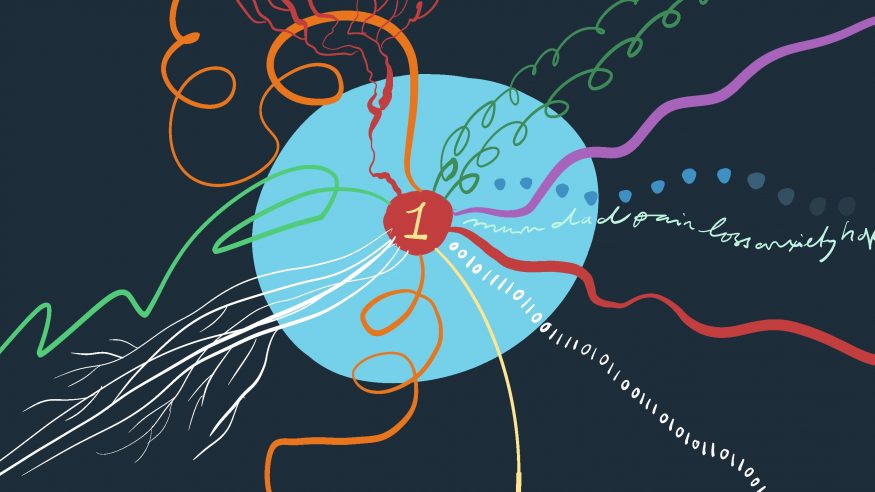
Note: Header image imagined from the text by artist Chris Glynn