Trust Before Data: What Community Engagement Has Taught Me
28 September 2026
By Josh Rodden from the Wales Gene Park Education and Engagement Team
I’ve been talking to people about science for the past 12 years, and one of the key issues faced when we do community engagement isn’t explaining complex ideas; it’s building, and then keeping, the trust of the communities we support.
I’ve covered topics across the gamut of science, from astrophysics to plant science, and more recently I’ve been focused on genomics, genetics, health data and rare disease research through my role at Wales Gene Park. Across all areas of science, it’s clear that trust isn’t something automatic; it is something we should earn, protect and work to reinforce.
Where Trust Begins
A substantial body of research has explored how patients and the public feel about their health data being used. The findings vary slightly depending on the country and cross-section of society, but in general the public supports the use of their health data for research.
Exploring Public Attitudes to Health Data Research Across the UK (2025) by Health Data Research UK synthesises a wide range of this research and gives a clear overview. The report highlights a clear hierarchy of trust when it comes to patient data, with local NHS services being trusted by 72% of respondents. In marked contrast, pharmaceutical companies, on the other hand, were only trusted by 40% of respondents.
This hasn’t always been the case, a Wellcome-commissioned Ipsos report found that in 2016 over half of respondents (54%) trusted their data to be used by commercial organisations for health research. From a purely anecdotal perspective, people are nervous about how their data is used. They worry about how secure it is, how anonymised it is, what the wider research community wants out of it, where it is going and, most frequently, who can access it.
In a recent community consultation, patient representatives were asked about health data usage, with some of the shared comments staying with me.
“It just makes me nervous, reading news stories about my data being given to companies like Palantir.”
“I think the majority of people would like to be able to see how their data is being used and what is happening with it now.”
“You hear about data breaches all the time. How is my data being protected?”
“Feels like there is a lack of accountability in how my data is being used and who is responsible for deciding.”
These weren’t people unfamiliar with research. Many of them had participated in multiple genomics studies and were proud to be a part of them, but they still had concerns.
Public trust is a finite resource, and reporting about NHS data partnerships, particularly those involving companies such as Palantir, could undermine public trust in health research. Every engagement either strengthens it or weakens it.
Remember whose data it is
A recent article by Bowden et al. (2026) explored why, despite the strong support for health research in the UK, there is a wider lack of trust when it comes to actually storing and using that data. The main outcome was that the databanks didn’t treat the data as if it were still the patients’ data.
It’s a small distinction, but it clearly matters.
There is a strong sense of ownership over everything they have given; it is theirs and loaned out to the wider research community. This sense of ownership is made stronger when the patient doesn’t know how their data is used, where it is going and what happens next.
When a dataset is made, it can be easy to think of it as data rather than people, and the recent CACNA1C Global Network Conference at Cardiff University was a brilliant example of how we can manage this.
The first day was a more traditional scientific research conference, albeit with a lot of patient families in attendance. The second day was focused on the patients and families and included an informal speed-dating activity where families could ask researchers questions. There was also a Dragon’s Den-style pitching activity where researchers pitched some of their ideas for future research to patients.
What struck me was how engaged all the attendees were. It allowed a barrier to fall naturally and encouraged communication between the researchers and the patients. The whole conference was about remembering that the data being used has come from people and that, without their contribution, there is no research.
Sometimes the most important thing you can do is stay quiet
One of the hardest lessons I have learnt is when to stop talking.
Very early on in my career, I was delivering an engagement activity at a school in North Wales, running some activities around the Apollo Moon landings. Towards the end of the session, a young person said, “I’ve seen a video about how the moon landing was faked. They said that the light looks wrong.”
I was passionate about the topic, and I wanted to be Ben Goldacre. What came out of my mouth was an overly technical answer that I thought made me sound smart. Looking back, I was trying to win an argument. Instead of building trust, I’d shown him that asking me a difficult question would earn a lecture rather than a conversation.
Years later, I still see this. I’ve seen community members offer honest observations on proposals, only for the people who had come to ask for their opinions to dismiss them while they were still talking.
Being silent is hard; it feels uncomfortable, particularly when you know the science. Listening carefully before responding builds trust and helps to create a dynamic that says, “I am listening to you.” It tells people their contribution matters, and that is where trust begins.
Our opinions carry more weight than we realise
One of the earliest community engagement activities I developed was for the Institution of Mechanical Engineers. The project allowed 500 young people in North Wales and their families to explore self-driving cars. I wrote a set of workshops that allowed the participants to develop some simple self-driving cars using small robots while discussing the opportunities and challenges of autonomous vehicles.
Six members of staff were trained to deliver the sessions, and they, along with 15 early-career engineers, went out to eight schools to deliver the sessions in lessons and at family events in the evenings. The feedback we started to get was puzzling.
The schools and community group leaders involved were giving glowing feedback about the sessions and the activities. The feedback from the young people had a significant divide, with half feeling positive about the technology and the other half being extremely negative, despite receiving largely the same workshop.
Eventually, I discovered why. It turns out that two of the presenters had strong negative views of self-driving cars and, without intending to, they had been shaping the conversations in the sessions they were leading.
The experience taught me that, as communicators, our views inevitably influence how we have discussions. Participants see it through our language, body language and reactions. Engagement is about providing balanced information, providing a platform for discussion and then creating space for people to develop and reach their own conclusions.
Moving beyond the deficit model
For much of the twentieth century, science communication was dominated by what has become known as the deficit model. The assumption was straightforward: people didn’t understand science; that’s why they didn’t support it. So, if you tell them about it, they will change their mind and improve society.
The landmark Royal Society report The Public Understanding of Science (1985), or the Bodmer Report, created the framework for thinking about why people need to understand science. It would help grow the economy, increase soft power through new technologies and research, reduce unemployment and make more informed voters.
The solution was just to tell people more, and that shaped countless science festivals, lectures and outreach activities, many of which I helped to deliver and design. They had their place and inspired curiosity, but they didn’t change opinions.
People don’t arrive at opinions based on what you tell them; they take that information and synthesise it through their experiences, values, communities and previous interactions. We, as a sector, have recognised this and, over the past decade, have made a concerted effort to build a model based around a two-way dialogue with the communities we serve.
We must recognise that, in all areas, but especially health, the public understand the day-to-day in ways that researchers can’t.
This means putting our trust, as researchers, in the communities we work with, just as they put trust in us to use their data responsibly. The deficit model can sometimes still feel like it shapes how academia thinks about community engagement.
Success in this space shouldn’t be 1,000 people saying they understand your research better. Success in this space is a deeper understanding of your community; it’s considering what is important to them, it’s being honest about what you need from them and being receptive to what they want from you.
Engagement is a relationship, not an event
As much as I think we should move away from a deficit model for communication, in terms of economies of scale it is very effective. It was the idea that underlies science festivals, school workshops and the public lecture, which in the UK have been going since at least 1597.
It can inspire, but it doesn’t build trust.
Trust takes time; it is about repeated, honest interactions where people can share their views and researchers are prepared to say why they are doing what they are doing. This could be through multiple sessions of the same programme or lots of separate events, all with the same community.
Repeated doesn’t have to mean boring and samey. Doing a community consultation and then holding a family fun day at the same venue reaches the same audience but provides for a wider cross-section of the community. It makes you a fixture and allows you to embed yourself into networks.
The idea of engagement as a relationship leads to thoughts of your place or mine. This can be a difficult balance to strike, as you want your participants to feel welcome in your space, but you also want them to feel comfortable.
The most successful projects do both. They welcome the community into the lab and give tours, like the UK Dementia
Research Institute, which recently held a community day, while also heading out and talking to patients and the wider community through community groups, interest groups and patient consultations. This allows you both to have those deep conversations while also reaching as many people as possible.
This helps to build a deep sense of pride in the work the patients are doing with researchers, as well as reinforcing the trust being shown.
A Final Thought
I started a master’s in science communication because I liked telling people about science; it was fun, and I enjoyed it. The two years I spent working on it changed my thinking. I also moved from deficit to dialogue in the same way that the wider community engagement space did.
I think that we aren’t telling people about health data research; we are trying to create a dialogue and a relationship that builds something better. We are trying to make people feel valued for what they bring, encouraging them to speak and guide policy and, more importantly, to feel confident in making decisions based on the best available information.
Knowing things is important, but being able to see and respect a different lived experience is crucial. We build trust both in ourselves and in our communities. If we respect the source and providers of our data, we should be able to look them in the eye, listen, and build a relationship rather than end a conversation.
Every engagement either strengthens or weakens.
Thanks for reading.
Further Information
The Public Engagement in Data Research Initiative (PEDRI) is a great sector-wide organisation for organisations working with data and Statistics. There website contains some really useful reports and data as well as lets you know about their upcoming seminars and events which I highly recommend – https://www.pedri.org.uk/
Health Data Research UK has some interesting reports around public attitudes to health research and can be read here – https://www.hdruk.ac.uk/about-us/involving-and-engaging-patients-and-the-public/
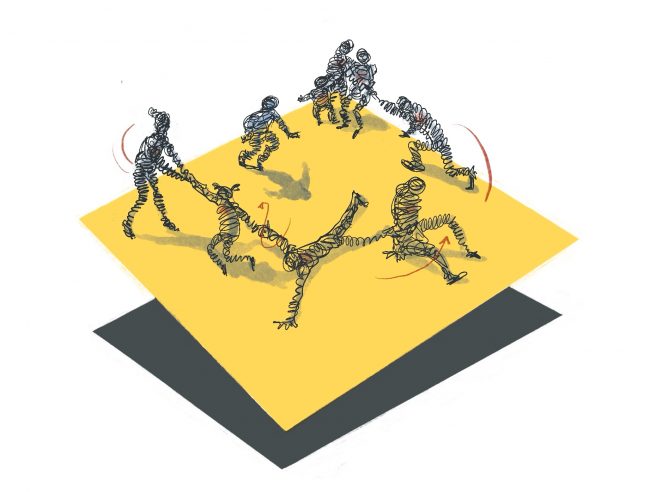
Note: Header image imagined from the text by artist Chris Glynn