The Data Illusion … Stop Pretending Data Is Easy
28 September 2026
By Peter Giles a Data Scientist in the BioResource Data Accelerator programme
A few years ago, a couple of colleagues said something that stuck with me. Everywhere they looked, other researchers seemed to have a smooth ride when it came to data.
Data access looked easy. Analysis looked easy. Results appeared quickly and neatly in presentations and papers. Meanwhile, their own projects felt like a constant battle.
Delays, governance issues, inaccessible datasets, unexpected problems, and, every now and again, a sinking feeling when months of work produced less than they’d hoped.
They wondered if they were just bad at data.
I don’t think they were.
I think they’d run head-first into one of the biggest myths in modern research: the idea that data is easy.
The uncomfortable truth is that data is hard. Really hard. Somehow, though, we’ve built a culture where nobody likes admitting it.
The data illusion
From the outside, data work looks deceptively simple.
You sit through a conference presentation and see a single slide with a beautiful graph, a p-value, and a striking conclusion. Ten years of effort gets compressed into thirty seconds. The audience nods. The presenter moves on.
What you don’t see is everything that happened beforehand.
Nobody shows the failed analyses. Or the datasets that turned out to be unusable. Or the three months spent trying to get access to data that everyone assumed was already available. Or the statistical rabbit holes. Or the endless moments staring at a result thinking, does this actually make sense?
Researchers are usually quite open about the pain of getting a lab experiment to work. We’ve all heard stories about assays failing, equipment breaking, samples getting contaminated, or recruitment targets being missed.
For some reason, data seems different.
We’re left with the impression that analysis was a quick final step. A few clicks. A few lines of code. Job done.
It rarely works like that.
The data literacy gap in the Biosciences
Part of the problem comes from the way we’ve trained people.
Compared with the physical sciences, bioscience has traditionally placed less emphasis on computational and quantitative skills. That’s not a criticism. It’s just the reality of how the disciplines evolved.
If you study physics, mathematics, or many areas of chemistry, you’re likely to spend years working with mathematical models, simulations, programming, and statistics. Those tools are built into the culture of the discipline.
In bioscience, it’s often possible to get surprisingly far without writing code or handling large datasets. Historically, the focus has been on understanding biological systems rather than computational ones.
The problem is that biology has changed.
Modern bioscience is now powered by genomics, bioinformatics, AI, electronic health records, imaging platforms, wearable devices, and high-throughput technologies that generate extraordinary amounts of data.
The expectations have shifted faster than the training.
Many bioscientists now find themselves working with datasets and analytical methods that would have been considered specialist a decade ago, but without the same quantitative foundation that researchers in the physical sciences often take for granted.
That isn’t a question of intelligence or capability. It’s a consequence of educational traditions that haven’t quite caught up with where the science is heading.
Data is often an afterthought
Another issue is that we still tend to treat data as something that can be sorted out later.
Research questions get refined. Collaborations are established. Funding applications are written. Ethics approvals are secured.
Then somebody asks a simple question.
“Can we actually get the data?”
That’s often when the problems start.
How long will access take?
Who owns the data?
What permissions are needed?
How good is the quality?
Who’s going to clean it?
Who’s going to analyse it?
Does anyone in the team actually have the skills required?
These questions should be central to project planning, but they’re often treated as operational details that can be worked out once the study is underway.
Unfortunately, “later” is usually where projects slow down.
What researchers discover is that the dataset isn’t complete, access is more complicated than expected, governance takes longer than anyone anticipated, or the analytical expertise simply isn’t available.
Instead of enabling discovery, data becomes the bottleneck.
Is data analysis “real science”?
There’s also a cultural issue.
Many researchers will happily spend thousands, sometimes hundreds of thousands, of pounds on laboratory equipment, consumables, patient recruitment, or sample collection. Yet budgets for data access, data management, and analytical expertise often attract far more scrutiny.
It’s almost as if data analysis sits outside the category of “real science”.
The assumption seems to be that the important bit is generating the data. Analysis is just what happens afterwards.
Press a few buttons. Produce a graph. Write the paper.
The reality is rather different.
A clinical trial, genomics platform, imaging study, or laboratory experiment can produce huge amounts of information. On its own, though, information isn’t knowledge.
The people who transform those outputs into evidence are analysts, statisticians, data scientists, and bioinformaticians.
Without them, even the most sophisticated experiments can struggle to produce meaningful conclusions. If we’re serious about data-driven research, we need to stop treating data expertise as an overhead and start treating it as scientific infrastructure.
Does anybody really understand data?
Sometimes data literacy reminds me of The Emperor’s New Clothes.
Everyone talks about becoming more data-driven. More data-literate. More evidence-based.
Yet surprisingly few people feel comfortable admitting they don’t fully understand what’s in front of them.
At meetings, charts are greeted with nods of approval. Analytical language gets repeated confidently around the room.
Acronyms fly past at speed.
Nobody wants to be the person who asks what seems like a basic question.
So the illusion continues.
Everyone assumes everybody else understands.
Often they don’t.
Like the Emperor’s courtiers admiring invisible clothes, researchers and leaders can end up reinforcing a collective belief that data is simpler and more universally understood than it really is.
When data professionals talk to each other
One thing I’ve noticed is that data professionals are actually very honest when they’re talking among themselves.
Conversations are full of uncertainty.
People discuss missing data, confidence intervals, assumptions, biases, model limitations, and all the reasons a result might not be as robust as it first appears.
Nobody is pretending certainty exists when it doesn’t.
Then the same analysis gets presented to a funder, executive board, policymaker, clinician, or public audience.
Suddenly the caveats disappear.
The uncertainty gets compressed into a single bullet point.
Nuance becomes a headline.
A complicated finding becomes a key message on a PowerPoint slide.
Some simplification is necessary. That’s just part of communicating.
The problem is that it creates the illusion that data work is straightforward. It hides the intellectual effort that went into producing the result in the first place.
What’s particularly frustrating is that the favour is rarely returned.
Data specialists are expected to explain their work in ways everyone can understand. Yet molecular biologists, clinicians, chemists, and laboratory scientists are rarely expected to simplify their disciplines to the same extent for analytical audiences.
As a result, the complexity of data work often disappears from view.
Why we need more honesty
Imagine if people were a bit more honest about the reality of working with data.
Imagine conference presentations that talked openly about failed analyses.
Imagine researchers discussing the dead ends as well as the successes.
Imagine organisations acknowledging that becoming confident with data takes years, not days.
I suspect we’d end up with a healthier culture.
People might feel more comfortable asking questions.
Imposter syndrome might ease a little.
And perhaps we’d stop making capable researchers feel inadequate for struggling with something that is genuinely difficult.
Stop pretending data is easy
Data is powerful.
Data is valuable.
Data can transform science and change how we understand the world.
But data is not easy.
The sooner we stop pretending otherwise, the better.
When someone says they’re struggling with data, our response shouldn’t be surprise or judgement.
It should be recognition.
Because behind every confident analyst, statistician, researcher, or data scientist is usually a long history of confusion, frustration, mistakes, false starts, and learning.
The people who look comfortable with data aren’t the people who found it easy.
They’re usually the people who’ve spent the longest wrestling with it.
And that’s probably the real lesson here.
Struggling with data isn’t evidence that you’re failing.
It’s evidence that you’re learning.
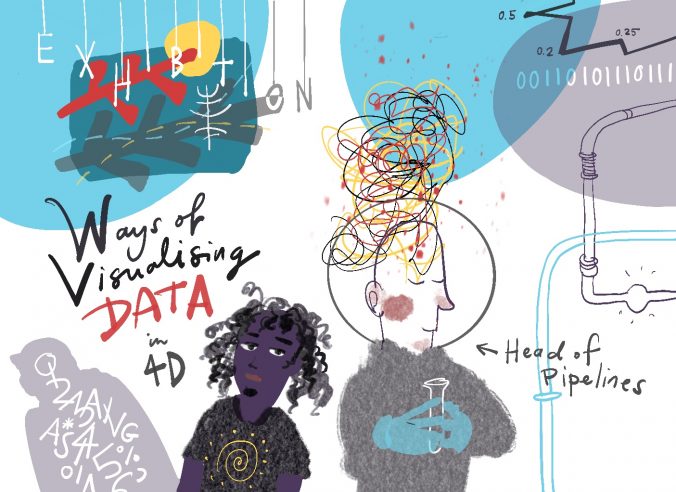
Note: Header image imagined from the text by artist Chris Glynn