What Welsh Parties Promised When Everyone Knew Who Would Win
3 March 2026
This is a joint post by Christian Arnold (University of Birmingham), Daksh Dewgun (University of Birmingham), Fraser McMillan (University of Edinburgh), and Jac Larner (Cardiff University). It is based on a working paper currently under review (draft available on request).
Manifesto week has arrived in Wales with parties setting out the bundle of policies they will pursue if they are able to form a government after 7th May. In this post we showcase some ongoing work that takes a look at the previous pledges that parties have made in all Senedd elections since 1999.
From 1999 to 2021, Welsh elections followed what statisticians might diplomatically describe as a low-entropy outcome distribution. Labour were always largest party by vote share and seat share. Election uncertainty was less about who would be the largest party, but how short of a majority would Labour be? This raises an obvious question. If everyone was generally confident Labour would win, why did parties bother writing detailed policy manifestos? We collected and digitised all 29 major party manifestos from 1999 to 2021, then used AI (cross-checked with human coders) to extract more than 10,000 individual pledges. The results tell us something interesting about how democratic competition works—or doesn’t—under conditions of sustained one-party dominance.
Where the Parties Stood
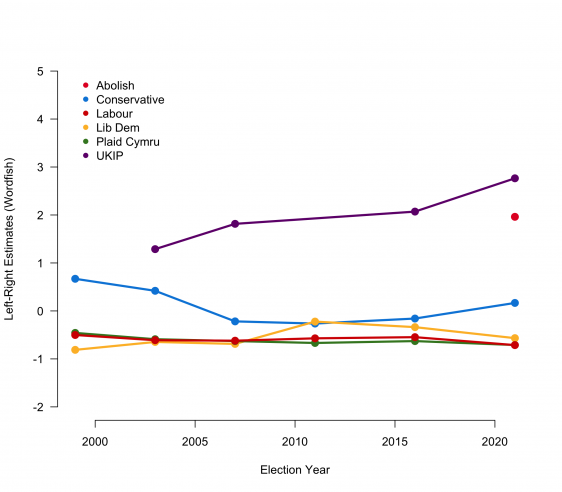
One way to understand Welsh politics during this period is to measure where parties positioned themselves from left to right. We used a commonly utilised quantitative text analysis tool (Wordfish scaling) to estimate each party’s position on the left-right spectrum, based on the language in their manifestos (we only looked at parties with elected representation and alter added Abolish as a robustness check). Results are displayed in Figure 1, with bigger numbers on the vertical axis denoting a more right-wing position and lower numbers a more left-wing position.
Labour, Plaid Cymru, and the Liberal Democrats spent the entire devolution era packed into the same ideological corner. Their positions barely shifted across six consecutive elections (though not the Liberal Democrats movement towards the Conservative during the coalition period). To some extent this simply represents parties operating instrumentally. If you wanted to govern Wales, or even be a plausible coalition partner to Labour, there was exactly one viable political space: the centre-left. If a party strayed too far from this space, they essentially locked themselves out of government.
The Conservatives sat alone on the centre-right in the early devolution years, though again a move leftwards is clearly visible in the later Bourne years where the party entertained entering a ‘rainbow coalition’ with other parties to oust Labour. After the departure of Bourne, the Conservatives again moved further to the right.
UKIP—which was a very minor player until 2016 when it won 7 seats and 13% of the regional vote—positioned itself much further right, with scores drifting more extreme over time. Along with the Abolish the Welsh Assembly Party operated entirely outside the system’s gravitational field.
More Promises, Not Fewer
Common sense might suggest that when elections become predictable, parties would bother less with detailed policy promises. Why would Labour tie its own hands with hundreds of specific pledges when defeat was unlikely? Why would opposition parties invest resources in comprehensive manifestos when victory was impossible? The data show exactly the opposite happened. Across all parties, promise-making intensified dramatically, reflecting similar trends around the democratic world.
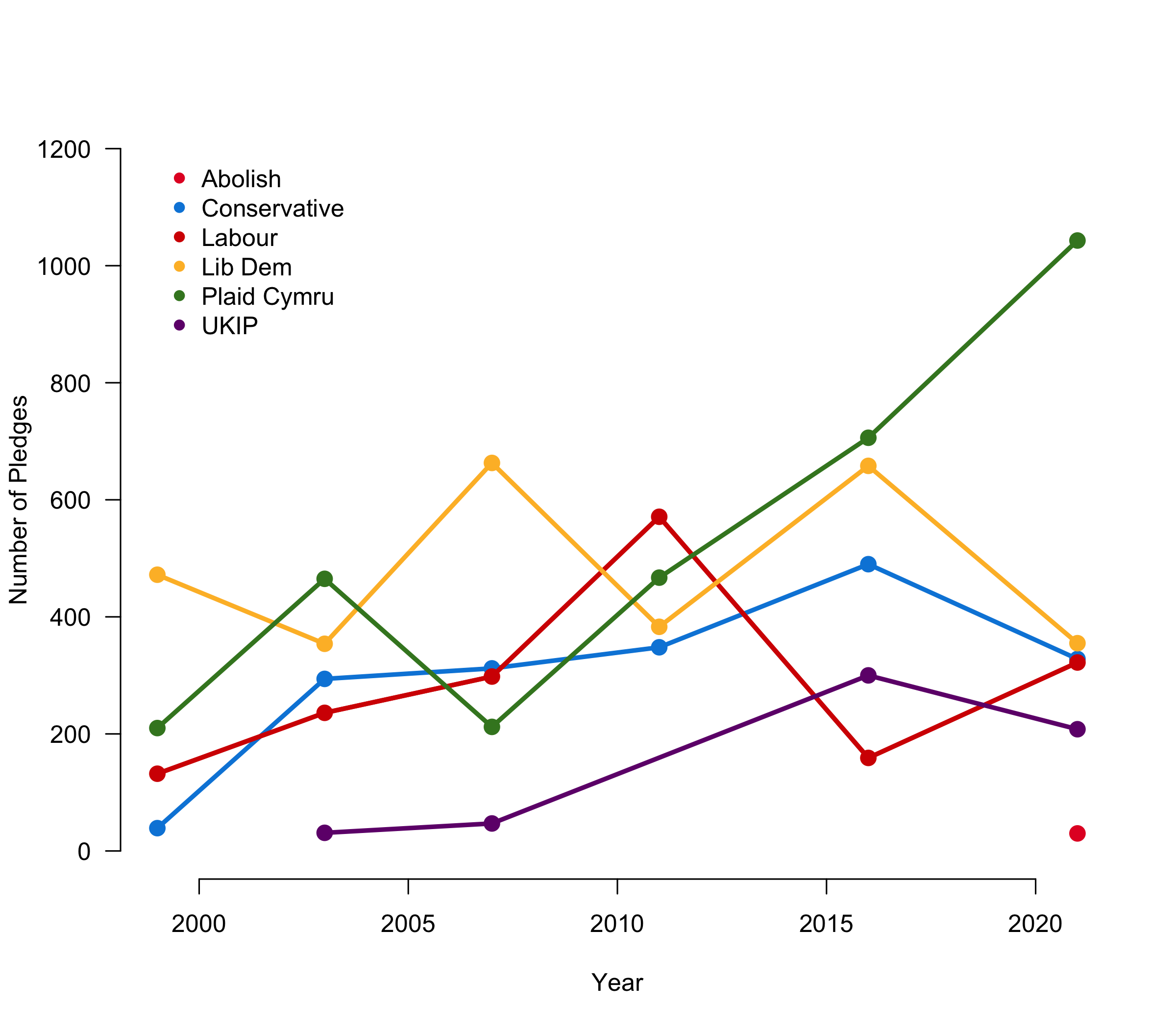
In 1999, the first devolved election, party manifestos contained a combined 900 or so pledges in total. By 2021, this had more than doubled to over 2,000 pledges (though the magnitude if this increase was driven by a single party). The growth was not limited to Labour, whose numbers varied while increasing on average—all parties increased their pledge-making. Manifestos were not just getting longer; they were dedicating more space to concrete commitments about what parties would do in office.
Several trends drove this increase. Part of the explanation is institutional. The Senedd’s powers grew substantially over this period, gaining legislative competence over more policy areas and, from 2018, the ability to vary income tax rates. More institutional capacity meant more things to have opinions about. There’s also a broader democratic trend: manifestos have been getting longer and more detailed across most democracies, regardless of how competitive local elections actually are. The Liberal Democrats are a particular case study: their characteristically lengthy manifestos reflect a one-member-one-vote internal culture where policy documents double as mechanisms for managing internal party coalitions, with pledges acting as peace treaties.
The most striking trajectory belonged to Plaid Cymru. After participating in coalition government with Labour from 2007-2011, Plaid’s manifesto detail grew substantially; by 2021, the party was making over 1,000 specific pledges. Perhaps this represents a party seriously preparing for government, or it just reflects an undisciplined kitchen-sink approach to manifesto writing. Either way, the pledges kept coming.
The Parties’ Promises: From ‘Same, But Better’ to ‘Systemic Change’
The substance of promises mattered as much as their number. We analysed what issues parties emphasised in their 10,000-plus pledges, revealing clear differences with Labour and opposition parties essentially writing different genres of manifesto. In Figure 3 we display the issues that parties discussed. Issues that appear to right of the dashed vertical line and coloured red are those that disproportionately featured in Labour manifestos, whereas issues that appear to the left of the line coloured dark grey are issues that disproportionately featured in opposition manifestos (those that cross over the dashed line essentially appeared in both with similar frequency).
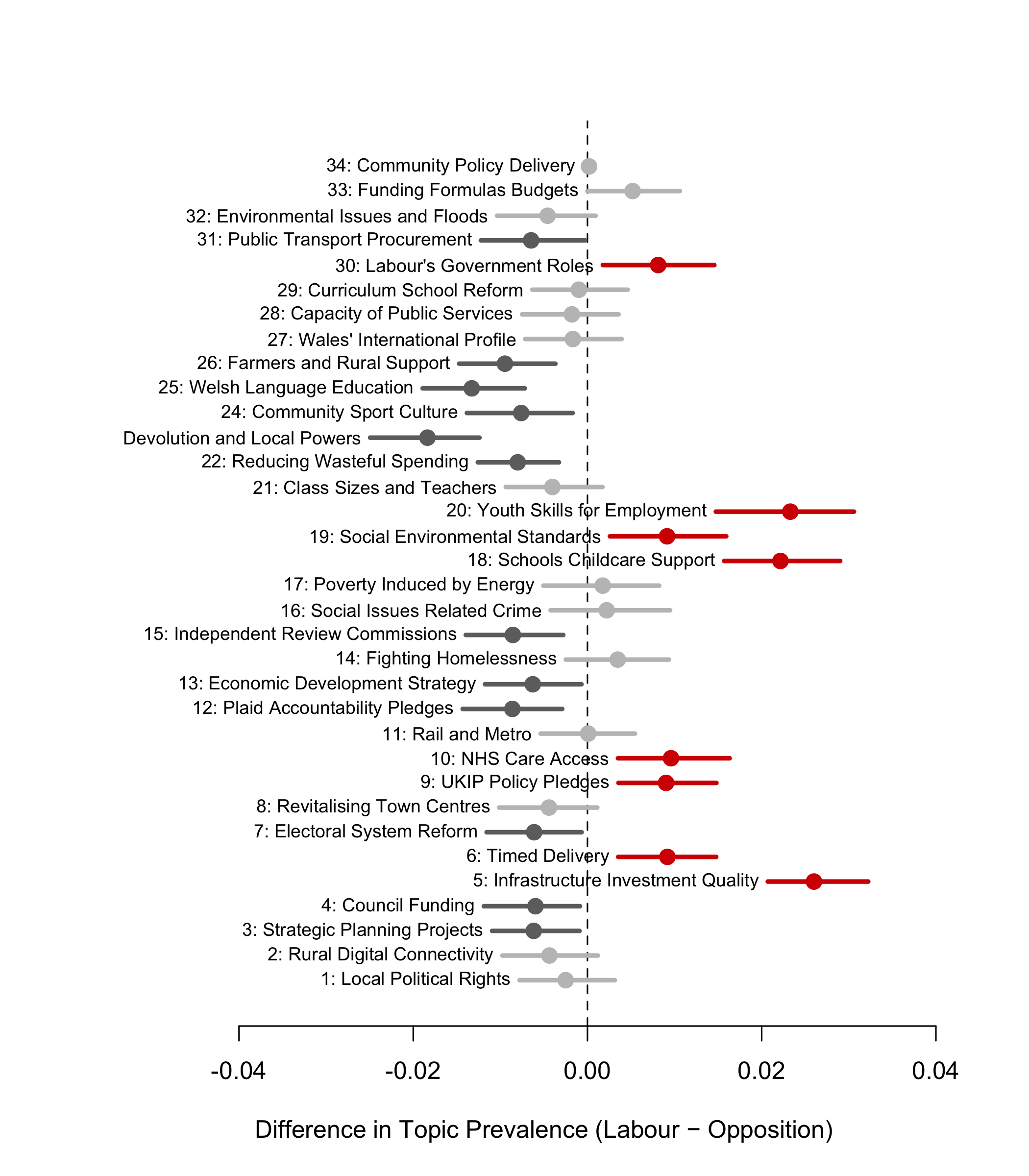
Labour’s pledges clustered heavily around public service delivery and spending: NHS investment, infrastructure, welfare programmes, support for students and workers, initiatives for young people. The party also devoted considerable manifesto space to emphasising its own record and its relationships with local councils and public bodies. It’s the incumbent’s playbook: same as before but better.
Opposition parties on the other hand went structural. Opposition manifestos devoted significantly more attention to constitutional reform; changing the voting system, devolving more powers from Westminster, redistributing responsibilities from Cardiff to local councils. They targeted farmers and rural communities, where Labour’s urban-industrial base left competitive space. And they promised lots of reviews, commissions, and reform programmes: the vocabulary of parties that want to change how government works rather than manage what government already does.
What Comes Next
The Wales we have described—predictable elections, Labour dominance, opposition parties struggling for distinctiveness within a narrow ideological space—may already be gone if current polling trends are to be believed. For now, the quarter-century from 1999 to 2021 offers a useful baseline: what democratic politics looks like when the result is baked in. Welsh politics is about to run the experiment in reverse.
- March 2026
- December 2025
- November 2025
- October 2025
- September 2025
- June 2025
- May 2025
- March 2025
- February 2025
- December 2024
- October 2024
- September 2024
- July 2024
- June 2024
- December 2023
- November 2023
- August 2023
- February 2023
- December 2022
- November 2022
- September 2022
- July 2022
- April 2022
- March 2022
- January 2022
- October 2021
- July 2021
- May 2021
- March 2021
- January 2021
- November 2020
- October 2020
- August 2020
- July 2020
- June 2020
- May 2020
- April 2020
- March 2020
- October 2019
- September 2019
- June 2019
- April 2019
- March 2019
- February 2019
- December 2018
- October 2018
- July 2018
- June 2018
- April 2018
- December 2017
- October 2017
- July 2017
- June 2017
- May 2017
- April 2017
- March 2017
- February 2017
- January 2017
- December 2016
- November 2016
- October 2016
- September 2016
- Bevan and Wales
- Big Data
- Brexit
- British Politics
- Constitution
- Covid-19
- Devolution
- Elections
- EU
- Finance
- Gender
- History
- Housing
- Introduction
- Justice
- Labour Party
- Law
- Local Government
- Media
- National Assembly
- Plaid Cymru
- Prisons
- Reform UK
- Rugby
- Senedd
- Theory
- Uncategorized
- Welsh Conservatives
- Welsh Election 2016
- Welsh Elections