General Election Voting Intention: Centre Left Fragmentation and the Reform UK Challenge
18 December 2025
This is a joint post by Jac Larner (Cardiff University) and Ed Gareth Poole (Cardiff University). They received substantive input from Richard Wyn Jones (Cardiff University) and James Griffiths (University of Manchester ), and questionnaire design support from Joseph Phillips (Cardiff University) and Ceri Fowler (University of Oxford).
In a separate blogpost, we analysed the latest reported vote intention for next May’s 2026 Senedd Election, where Plaid Cymru and Reform UK were leading (with a slight advantage to Plaid). Westminster voting intention tells a different story and requires separate analysis. In this blog, we consider survey data evidence for a different type of realignment that seems to be occurring in polling evidence for General Elections to the Westminster Parliament.
Between 28th November and 10th December we surveyed approximately 2,500 adults in Wales online via YouGov (click here for the data). This is separate to ITV Wales’ Barn Cymru polls and does not use YouGov’s MRP weighting method. Figure 1 illustrates the reported vote intention for a future Westminster parliamentary election. The headline figure for Reform UK is in line with previous polling; but the parties on the left are now more fragmented, with a notable increase in Green party support.
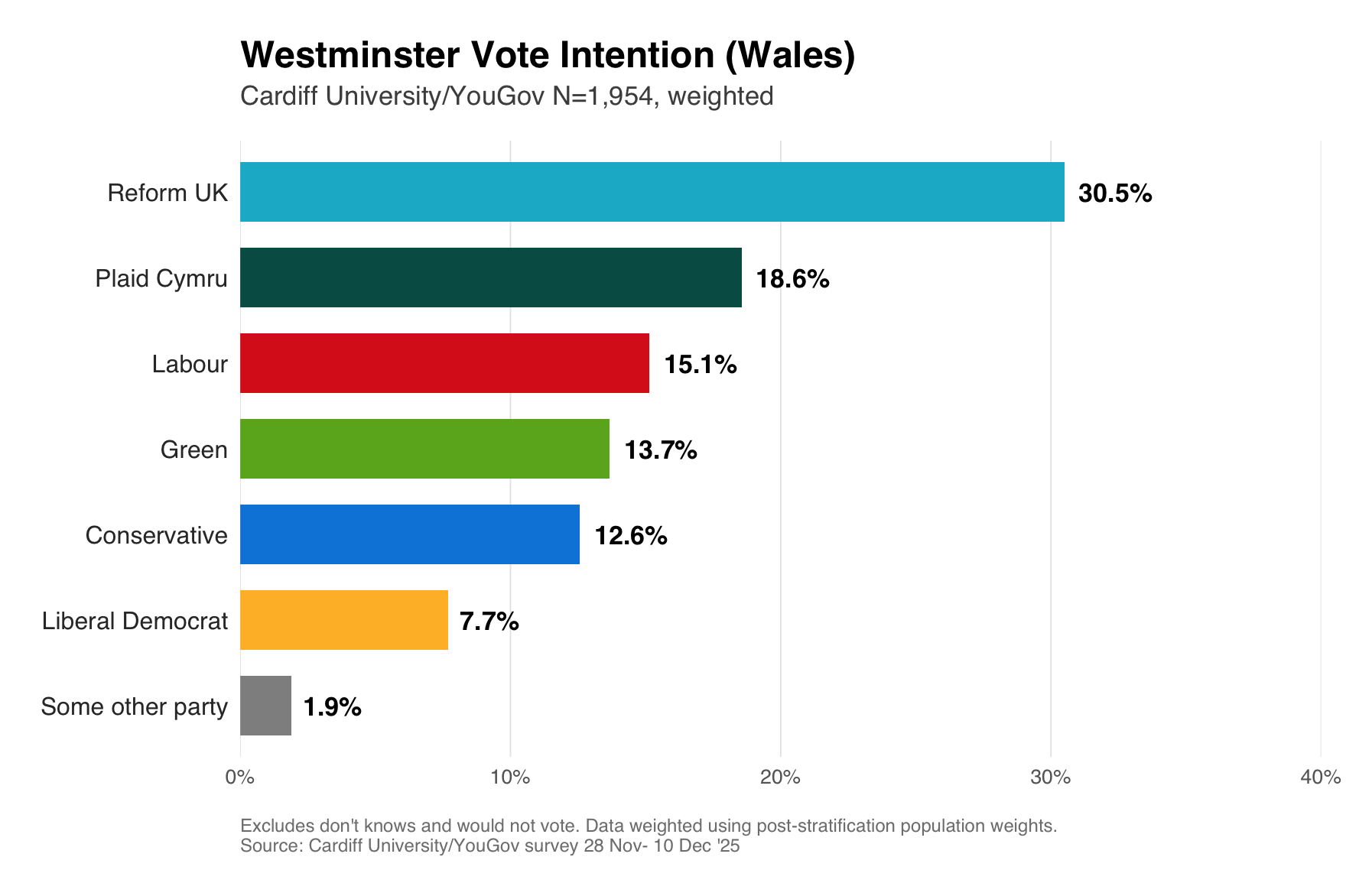
This evidence closely aligns with other Wales and UK-wide Westminster voting intention data which show a dramatic shift in the political landscape; one which has now been sustained for many months.
Contrasting Patterns: Senedd vs Westminster
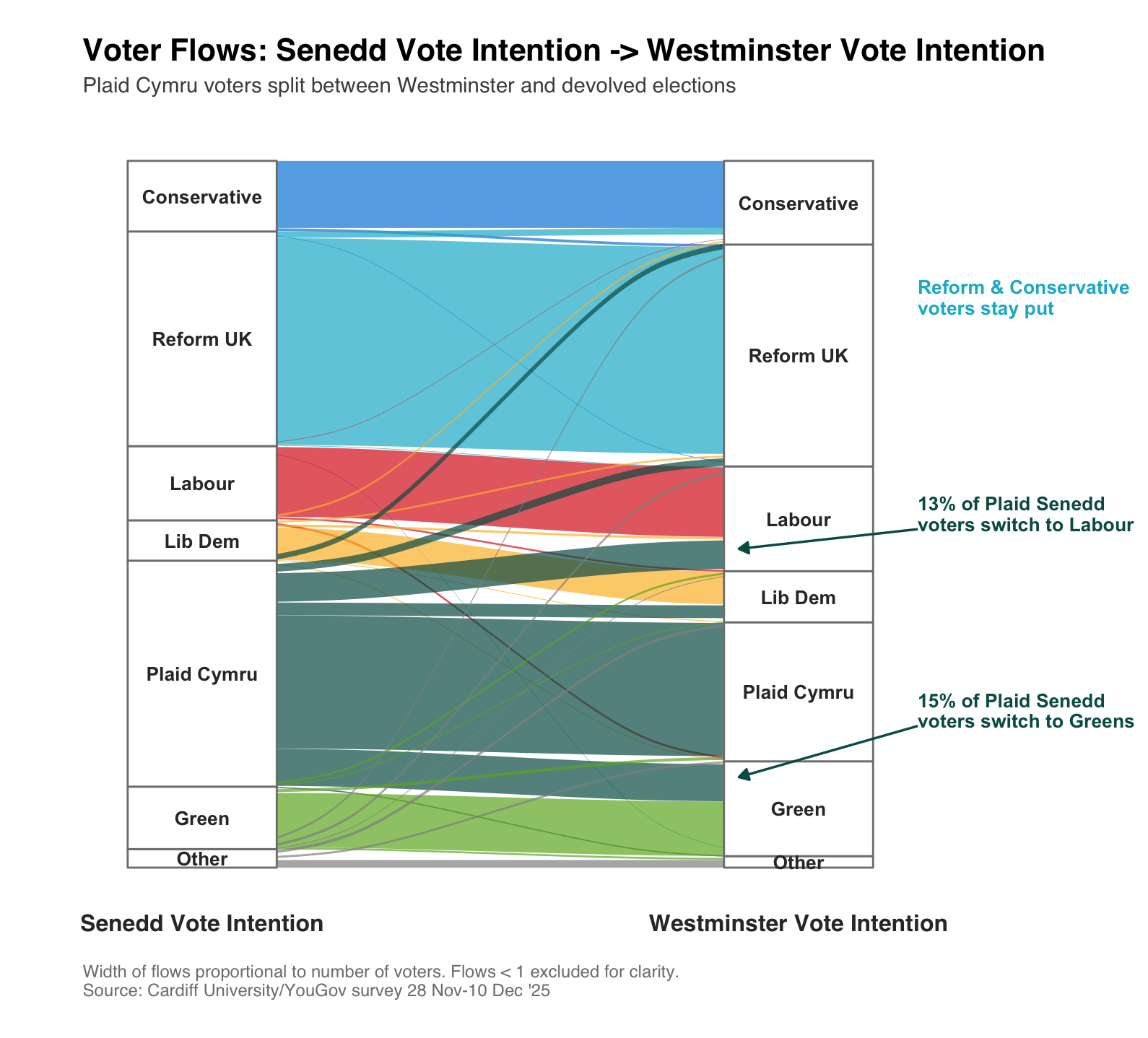
Figure 2 displays how individual respondents report they will vote in the next Senedd election vs a hypothetical Westminster election. The patterns are striking, with substantial portions of the electorate reporting different vote intention at different levels.
In our accompanying analysis of Senedd voting intentions, we saw a story of consolidation rather than fragmentation. That blog introduced an analytic lens based on two distinct coalitional blocs that operate in Welsh politics, ones which are structured primarily by national identity. Within the “Welsh/Left bloc” (Labour, Plaid Cymru, and Greens), we saw progressive, Welsh-identifying voters moving from Labour towards Plaid Cymru. Within the “British/Right bloc” (Conservatives, UKIP/Brexit Party/Reform UK, and Abolish), we witnessed conservative, British-identifying voters shifting from the Conservatives to Reform UK. We interpreted this as a kind of a sorting process, where voters appeared to be consolidating around the strongest apparent option within each ideological grouping.
Here we see fragmentation on the left (visualised below in Figure 3) and consolidation on the right. This is a pattern which if observed at the next UK General Election would have profound electoral implications.
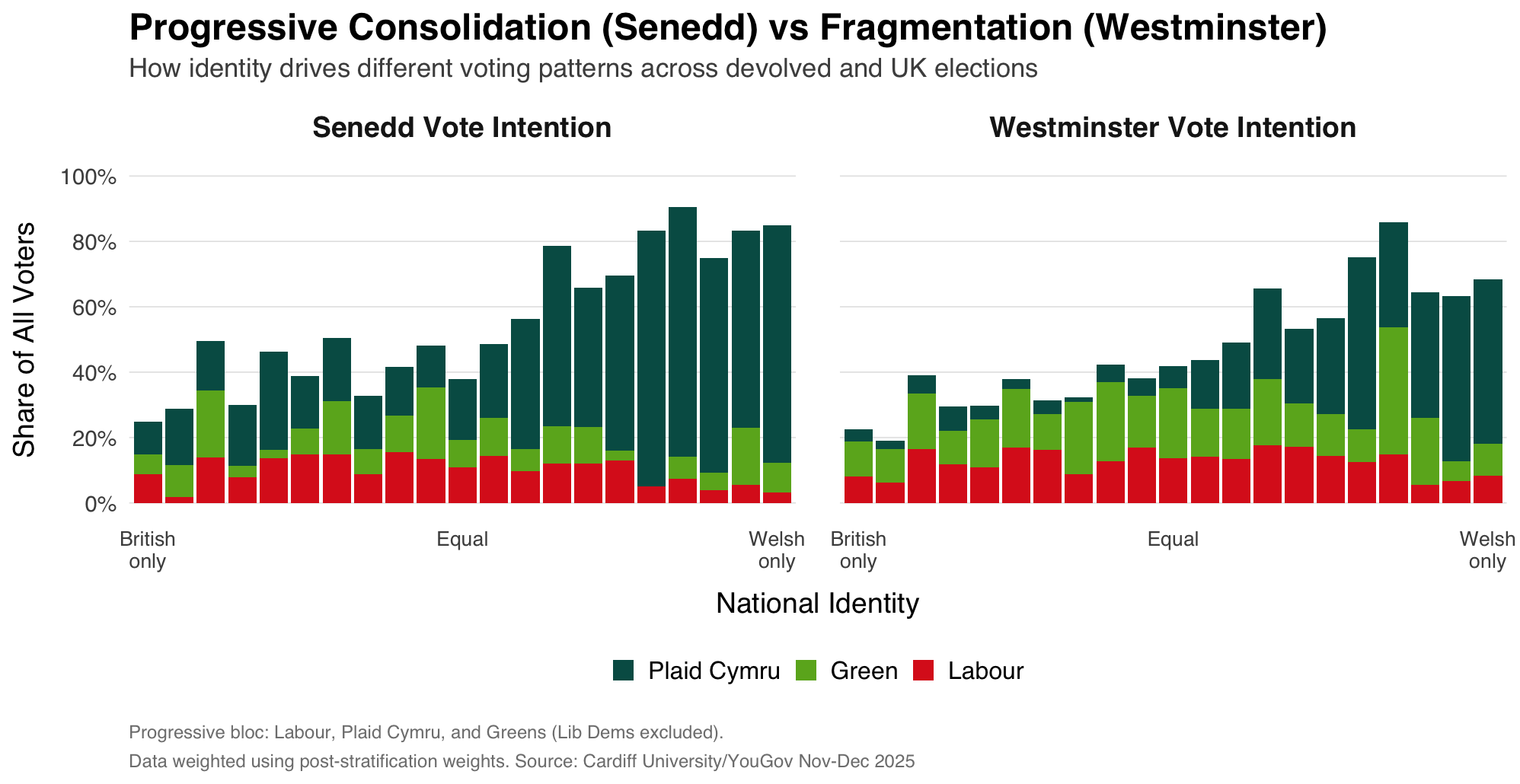
The Arithmetic of Fragmentation
Reform UK demonstrates a solid lead within a consolidated British/Right bloc, benefitting from Conservative support squeezed at just 13%. The Welsh/Left bloc, however, splits opposition votes across multiple parties: Plaid Cymru (19%), Labour (15%), and Greens (14%). Relative to the September ITV Wales/YouGov data (which uses a different method), the Greens have doubled their support from 7% to 14%.
Unlike the Senedd’s new voting system, which is based on an (albeit imperfect) version of List Proportional Representation, if this story of British/Right consolidation and Welsh/Left fragmentation were repeated it would be intensified by Britain’s First Past the Post electoral system. Under FPTP, a party can win a constituency with well under 30% of the vote if opposition support is sufficiently divided. Assuming Reform UK’s support is distributed relatively evenly, on a uniform swing virtually every seat in Wales could be competitive for the party. A 30% vote share, if efficiently spread, could translate into a disproportionately large number of seats when facing three or four divided opponents.
The Tactical Voting Dilemma
For voters opposed to Reform UK, tactical voting represents the most obvious counterstrategy – one of the explanations for the lopsided result in the Caerphilly byelection (which used FPTP). But to be effective, tactical voting requires clear information: voters must know which party has the best chance of defeating Reform UK in their own constituency. This is where the current polling data reveals a critical problem.
Unlike in Senedd elections, where Plaid has always outperformed its Westminster results, the Westminster picture is murkier. Does incumbent Labour remain the main challenger to Reform UK in the valleys, or has Plaid Cymru taken over that mantle post-Caerphilly? Are the Greens now competitive enough in urban seats to provide a vehicle for anti-Reform tactical voting? At present, voters lack the constituency-level data needed to make these calculations effectively.
This informational deficit contrasts sharply with the Senedd context, where evidence of consolidation behind Plaid Cymru appears to imply that strategic voting decisions are more straightforward. The fragmentation in Westminster voting intentions creates not just a mathematical problem for Reform’s opponents, but a coordination problem that may prove difficult to resolve before the next general election.
Implications
The polling suggests that at the next Westminster election, in the absence of voter consolidation into one dominant centre-left party or highly effective tactical voting coordination, Reform UK could achieve breakthrough results in Wales. Parties on the centre-left face a core challenge: how to somehow signal to voters that their party represents the strongest challenge to Reform UK in each constituency. How this coordination problem is resolved – or whether it can be resolved at all – may determine the electoral map of Wales for years to come.
_____________________
Data and cross tabs available here: https://github.com/jaclarner/Cardiff-YouGov_Dec25
- March 2026
- December 2025
- November 2025
- October 2025
- September 2025
- June 2025
- May 2025
- March 2025
- February 2025
- December 2024
- October 2024
- September 2024
- July 2024
- June 2024
- December 2023
- November 2023
- August 2023
- February 2023
- December 2022
- November 2022
- September 2022
- July 2022
- April 2022
- March 2022
- January 2022
- October 2021
- July 2021
- May 2021
- March 2021
- January 2021
- November 2020
- October 2020
- August 2020
- July 2020
- June 2020
- May 2020
- April 2020
- March 2020
- October 2019
- September 2019
- June 2019
- April 2019
- March 2019
- February 2019
- December 2018
- October 2018
- July 2018
- June 2018
- April 2018
- December 2017
- October 2017
- July 2017
- June 2017
- May 2017
- April 2017
- March 2017
- February 2017
- January 2017
- December 2016
- November 2016
- October 2016
- September 2016
- Bevan and Wales
- Big Data
- Brexit
- British Politics
- Constitution
- Covid-19
- Devolution
- Elections
- EU
- Finance
- Gender
- History
- Housing
- Introduction
- Justice
- Labour Party
- Law
- Local Government
- Media
- National Assembly
- Plaid Cymru
- Prisons
- Reform UK
- Rugby
- Senedd
- Theory
- Uncategorized
- Welsh Conservatives
- Welsh Election 2016
- Welsh Elections