AI’s debt-fuelled supply chains
20 October 2026
When financing structure becomes supply-chain structure
Opinion piece | Professors Aris Syntetos & Mike Wilson, PARC Institute of Manufacturing, Logistics & Inventory
The AI infrastructure boom is usually presented as a technology story. Increasingly, it is also a financing story, and therefore a supply-chain story. The way hyperscalers finance chips, data centres and capacity will influence who owns assets, who carries risk, how suppliers behave, and what happens if expectations change.
A technology boom is becoming a capital-market event
The scale has changed remarkably quickly. In its July 2026 Financial Stability Report, the Bank of England noted that the five major AI hyperscalers – Meta, Alphabet, Amazon, Microsoft and Oracle – accounted for only around 3% of the stock of outstanding US investment-grade (IG) debt at the end of 2025, but more than 15% of year-to-date issuance by early May 2026. What this means is that, while these companies do not yet dominate the stock of debt already outstanding, they are borrowing at an extraordinarily fast rate compared with everyone else. The same report noted that consensus estimates for their combined 2028 capital expenditure had moved from below $600 billion in late 2025 to above $1 trillion only months later.[1]
This is not simply a question of whether technology companies are borrowing more. New forms of project finance, special-purpose vehicles, leasing and other off-balance-sheet structures are increasingly being used to fund the physical infrastructure behind AI. Meta’s Hyperion data-centre development, for example, has involved roughly $27 billion of financing through a project-finance-style structure. More recently, Amazon has reportedly explored moving around $8 billion of Nvidia chips into a special-purpose vehicle and leasing them back. The boundary between technology investment, supply-chain finance and asset finance is becoming much less clear.[2], [3]
The exposure is not limited to debt. Hyperscalers are also building enormous future purchase commitments with suppliers and infrastructure providers. These commitments lock in future demand for chips, servers, energy and data-centre capacity, effectively transmitting financial expectations deep into the physical supply chain. If expected AI demand fails to materialise, the consequences may therefore be felt not only by the hyperscalers themselves, but also by suppliers, logistics providers and asset owners that have expanded capacity in anticipation of that demand.[4]
A further issue is the growing interdependence between customers and suppliers that these arrangements can create. Where a major customer invests in, finances or otherwise supports suppliers that then use that capital to expand capacity and sell back into the same ecosystem, financing becomes more circular and both opportunity and risk can become concentrated within a relatively small network of firms.
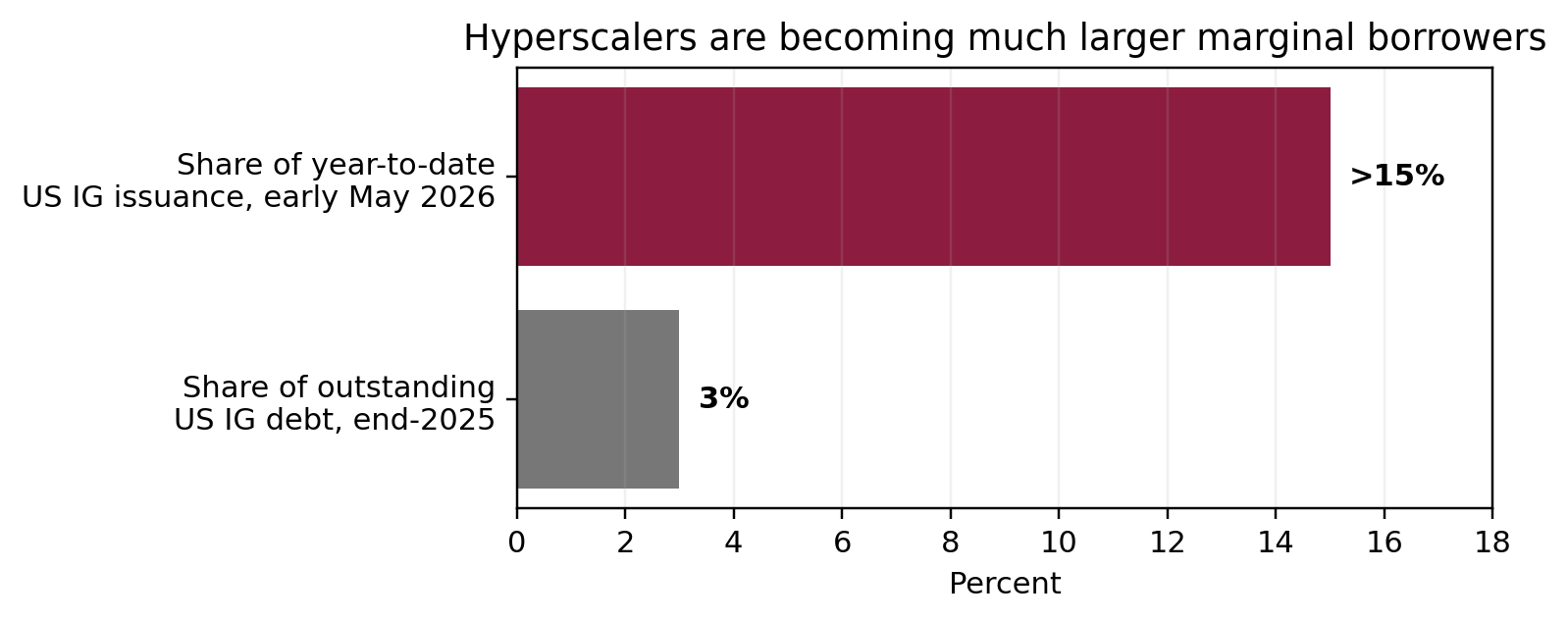
Figure 1. Five AI hyperscalers’ footprint in the US investment-grade debt market.[5]
Why this matters to supply chains
Every financial structure creates an operational structure behind it. Someone must own the chips and servers; someone must finance the inventory and equipment moving through the semiconductor and data-centre supply chains; someone must commit capacity in advance; and someone ultimately carries the downside if demand, technology or asset values move differently from expected. As AI investment becomes more leveraged and more distributed across financial vehicles, these responsibilities can become harder to see.
This matters because the assets are unusual. AI accelerators are extremely valuable and strategically important, while their economic life and residual value are uncertain in a market characterised by rapid technological change. Reuters recently reported that lenders are often working with three- to four-year depreciation assumptions for advanced GPUs even as suppliers argue for longer useful lives. That disagreement is not an accounting issue: residual value determines how much can safely be borrowed against an asset, how leases are priced, and who absorbs the loss if a newer generation makes existing equipment less attractive.[6], [7]
Inventory risk does not disappear – it moves
For supply-chain managers, the important question is therefore not simply “how much inventory is there?” but “who is financing it, who owns it, and who has promised to take it?” Financing can encourage enormous commitments upstream: semiconductors, memory, networking equipment, power systems, cooling equipment and construction capacity. Long lead times and capacity reservations can then make the chain look secure during growth, while simultaneously increasing exposure to a demand correction.
If expectations weaken, risk can move quickly from hyperscalers to data-centre operators, equipment lessors, suppliers, logistics providers and ultimately investors. That does not mean a collapse is inevitable. Many of the largest technology companies remain strongly rated and entered this borrowing cycle with relatively low debt ratios. It does mean, however, that supply-chain resilience can no longer be assessed independently of capital structure and financing arrangements.[8]
The circular supply-chain question
There is also a circular-economy dimension that deserves much more attention. If equipment is financed on the assumption that it retains value, then reuse, redeployment, refurbishment, repurposing and component recovery become part of the financial proposition, not merely an environmental afterthought. A credible second life can support residual values; weak recovery routes can destroy them. In that sense, circular supply chains may become a form of financial risk management for the AI economy.
The physical scale reinforces the point. The International Energy Agency expects global data-centre electricity consumption to rise from about 485 TWh in 2025 to around 950 TWh by 2030. Behind that growth sits a vast supply network of equipment, materials, energy infrastructure and logistics. Financing determines how quickly that network expands; operations determine whether the value created can be sustained.[9]
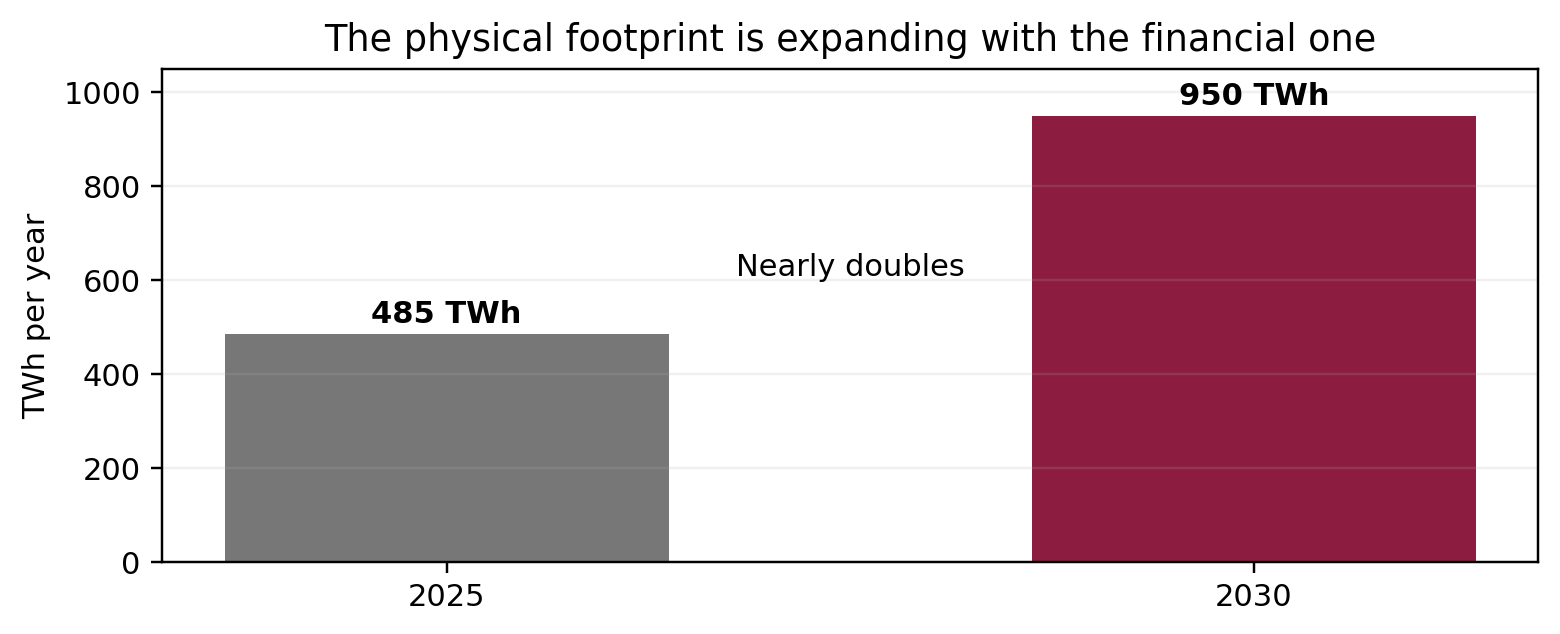
Figure 2. Global data-centre electricity consumption: 2025 estimate and 2030 central projection.[10]
A new research agenda
We think this creates a timely agenda for supply-chain research and practice. We need to understand how new financing models alter inventory ownership and incentives across the chain; how financial risk propagates through operational dependencies; how the useful life and residual value of AI infrastructure should be assessed under rapid obsolescence; and how circular strategies can recover value when equipment is displaced.
At PARC, our work has long sat at the interface of forecasting, inventories, risk and circular supply chains. The AI infrastructure boom brings those themes together in a new way. The central question is no longer only whether the investment can be financed. It is whether the supply chains created by that financing are resilient – financially, operationally and environmentally – when the assumptions underpinning them are tested.[11]
“The financing of AI infrastructure is becoming part of the architecture of the supply chain itself.”
[1]Bank of England, Financial Stability Report, July 2026: https://www.bankofengland.co.uk/financial-stability-report/2026/july-2026
[2]Reuters, 2 October 2026: https://www.reuters.com/business/retail-consumer/amazon-seeks-offload-8-billion-nvidia-chips-investors-ft-reports-2026-10-02/
[3] Reuters, 29 September 2026: https://www.reuters.com/commentary/reuters-open-interest/are-ai-credit-cracks-warning-or-buy-signal-2026-09-29/
[4] Financial Times, Robin Wigglesworth, ‘The hyperscalers’ exploding ‘purchase commitments’ reach $1.5tn’, October 2026: https://giftarticle.ft.com/giftarticle/actions/redeem/d58cd402-7bc6-4cb9-a057-93b84b345087
[5] Bank of England, Financial Stability Report, July 2026: https://www.bankofengland.co.uk/financial-stability-report/2026/july-2026
[6] Reuters, 1 October 2026: https://www.reuters.com/legal/transactional/nvidias-bet-that-its-chips-can-finance-ai-boom-gets-wall-street-reality-check-2026-10-01/
[7] Bank of England, Financial Stability Report, July 2026: https://www.bankofengland.co.uk/financial-stability-report/2026/july-2026; International Energy Agency, Key Questions on Energy and AI, 2026: https://www.iea.org/reports/key-questions-on-energy-and-ai/executive-summary
[8] Bank of England, Financial Stability Report, July 2026: https://www.bankofengland.co.uk/financial-stability-report/2026/july-2026
[9] International Energy Agency, Key Questions on Energy and AI, 2026: https://www.iea.org/reports/key-questions-on-energy-and-ai/executive-summary
[10] International Energy Agency, Key Questions on Energy and AI, 2026: https://www.iea.org/reports/key-questions-on-energy-and-ai/executive-summary
[11] PARC Institute, Research and Projects pages: https://www.cardiff.ac.uk/parc-institute-manufacturing-logistics-inventory/research and https://www.cardiff.ac.uk/parc-institute-manufacturing-logistics-inventory/research/projects
- AI’s debt-fuelled supply chains
- Disruptions to Global Supply Chains, Sustainability, and the Inventory Time Bomb
- Sustainability is Driving New Business Dynamics – Repurposing and Connected Collaboration Across Supply Chains
- Digital Technologies – Poison and Medicine for ReMakers
- RemakerSpace reshapes the future