COLIF: Achieving Impact through Cross-Institution Collaboration
3 August 2026
How can universities contribute in a meaningful way to their communities? How can researchers stay close to what people need? And how can civic partners make the most of the expertise around them?
In March 2024, as part of the Creating Opportunities through Local Innovation Fellowships (COLIF) pilot, the UKRI Economic and Social Research Council (ESRC) awarded £854,193 to five regional clusters of research organisations to work with industry and policymakers to create local opportunities and reduce regional inequalities.
Two years later, the COLIF pilot has successfully delivered place-based solutions, strengthened partnerships across institutions and sectors, and demonstrated the value of continuing this collaborative approach into the future.
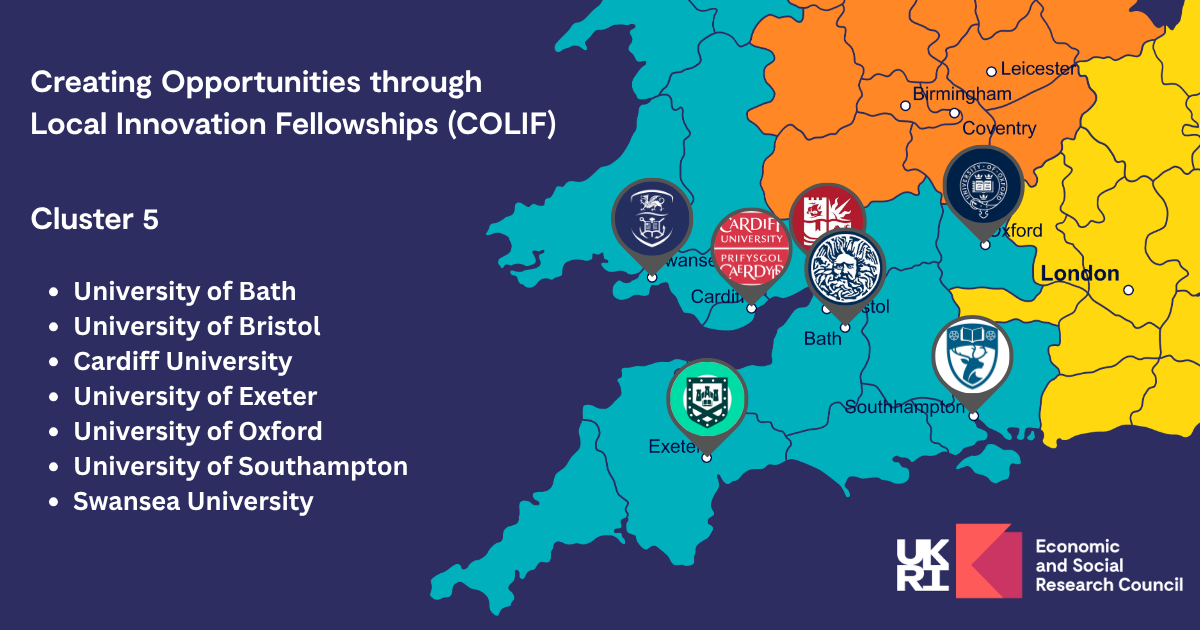
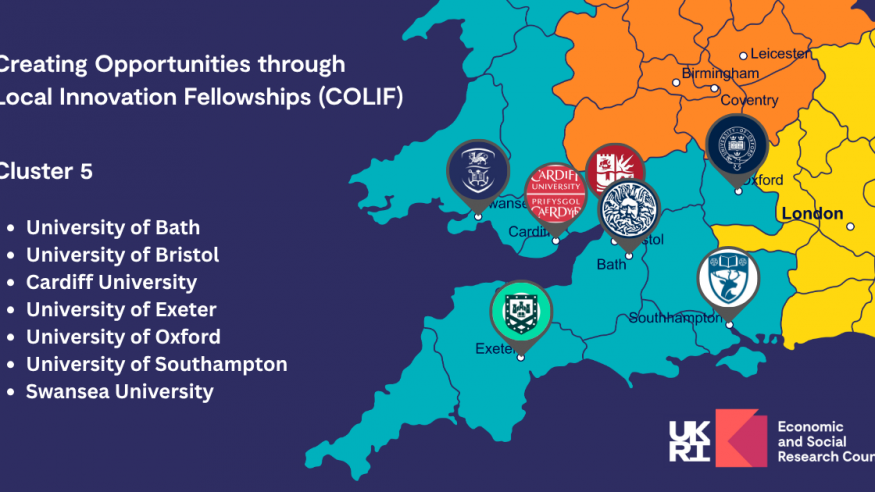
This blog focuses on Cluster 5, comprising the universities of Bath, Bristol, Cardiff, Exeter, Oxford, Southampton and Swansea, which brought together two project teams to explore ways of improving visibility and access to green skills and jobs in the Hampshire and Solent region, as well as how public, private and voluntary sector partners can work together to co-create inclusive employment opportunities in Oxfordshire and beyond.
What was done to help
Each project began with a civic partner identifying the key research questions, supported by a team of interdisciplinary academics and professional services colleagues from across the Central South, South West and Wales regions.
The first project team partnered with the New Forest National Park Authority to investigate what changes are needed to support the green employment sector. The team carried out a literature review of national and regional green skills policies across the UK, conducted a series of semi-structured interviews with careers advisors and professionals interested in green skills and jobs, and facilitated stakeholder workshops in which participants discussed green skills definitions and the barriers to skills development. Their work informed a new report that sets out recommendations organised around four key themes to improve the integration of green skills in education, industry, and public and third-sector organisations.
The second project team worked with the Oxfordshire Inclusive Economy Partnership to explore what is working well and what can be strengthened in relation to inclusive job opportunities. The team conducted a review of fifty academic studies and policy reports, carried out thirteen interviews with key stakeholders across the public, private and voluntary sectors, and consulted participants involved in seventeen Oxfordshire-based events and meetings on inclusive employment. This led to a new report that identifies six principles for embedding inclusion as an ongoing consideration for all stakeholders within a local economy.
The challenge
As COLIF represents a new way of working between universities, industry and policymakers, establishing cross-institutional collaboration agreements delayed project start times. This challenge was further compounded by different financial and administrative systems across institutions, which slowed delivery in the early stages.
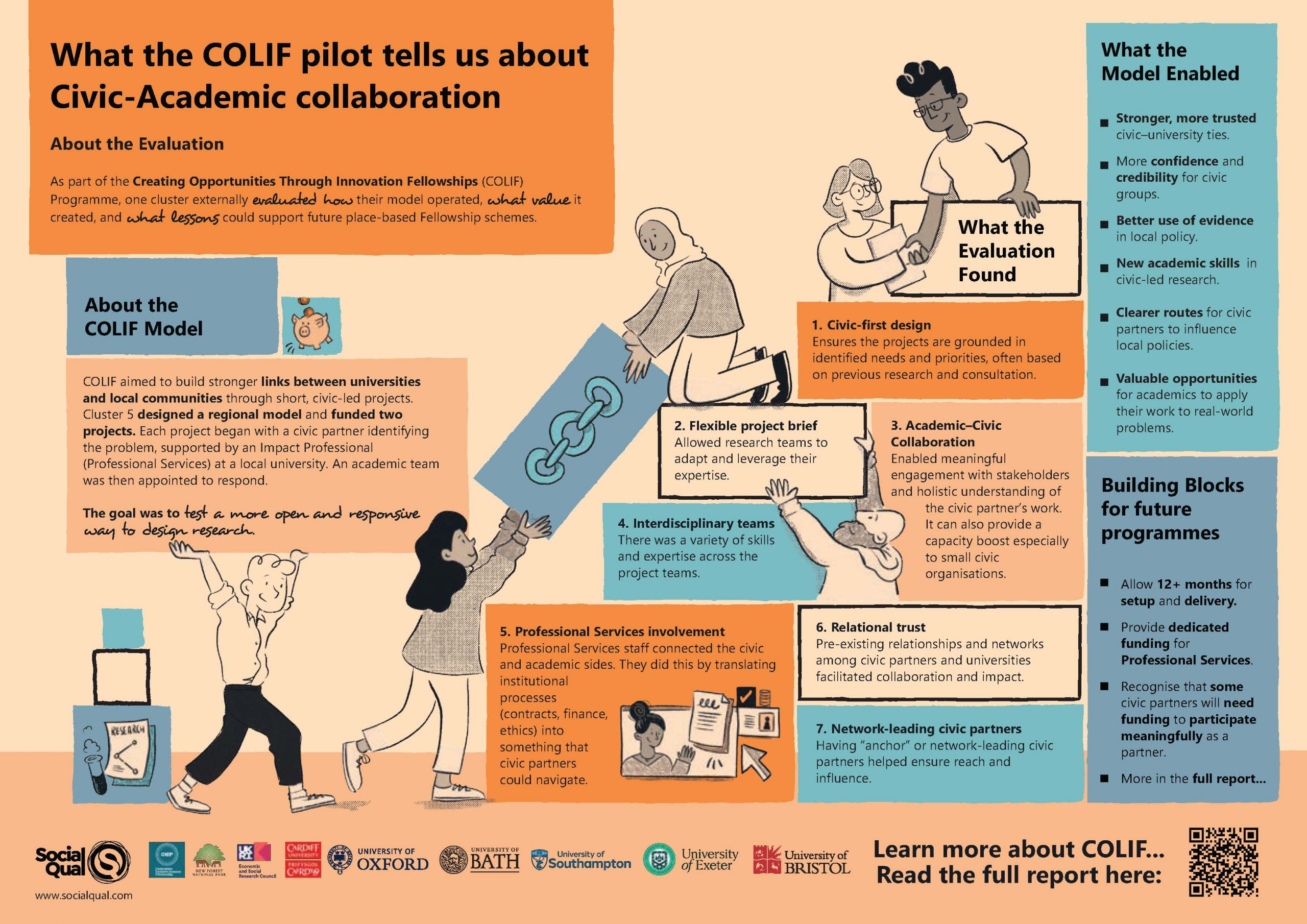
What the COLIF pilot tells us about Civic-Academic collaboration
In a similar vein, the geographical spread of the cluster members raised questions about how ‘local’ should be defined in practice, as well as how best to select projects that would ensure all seven institutions benefitted from the work.
The result
Despite these challenges, the flexibility of the COLIF model, with each of the five clusters taking a different approach to its implementation, enabled new and diverse projects to be delivered. This in turn supported greater knowledge exchange across the region and strengthened relationships between universities, project partners and policymakers.
By flipping the usual research model and placing the needs of civic partners first, the projects achieved strong engagement from a range of stakeholders and delivered place-based outcomes with tangible impact. The success of this approach also indicated an appetite for continued collaboration beyond the pilot phase.
As Aileen Marshall-Brown, Head of Engagement for the Social Sciences at University of Oxford, reflects on the COLIF pilot, “It has been fantastic to see inclusive employment, a key priority for our region, being addressed in this multi-university partnership. It highlights again the importance of researchers, policy makers and local voluntary and community organizations coming together to understand and address local policy challenges.”
Find out more:
- Read the Improving Visibility and Access to Green Careers in Hampshire and the Solent Region report
- Read the Partnering for Inclusive Employment: A Guide for Local Economies report
- Read the reflections and recommendations on the COLIF pilot, as part of the UKRI’s ESRC Impact Acceleration Accounts
Written by George Thomas, Bristol University, Senior Engagement and Impact Officer (Research) for COLIF
- AHRC
- BBSRC
- Cardiff Business School
- Case studies
- EPSRC
- ESRC
- Institutional Collaboration
- MRC
- Public Engagement
- School of Biosciences
- School of Dentistry
- School of Engineering
- School of English, Communication and Philosophy
- School of Geography and Planning
- School of History, Archaeology and Religion
- School of Law and Politics
- School of Medicine
- School of Psychology
- Welsh School of Architecture
- Making neighbourhood parks inclusive for teenage girls and young women in Cardiff
- COLIF: Achieving Impact through Cross-Institution Collaboration
- Driving Sustainable Fan Behaviour in Sport: Co-creating Evidence and Impact
- How can Wales secure greater public benefit from development?
- Fostering empathy for endangered animals through creative writing and drawing workshops