Seminar – Japan’s Immigration Policy: From the Nonpolitical to Politicization
8 April 2026
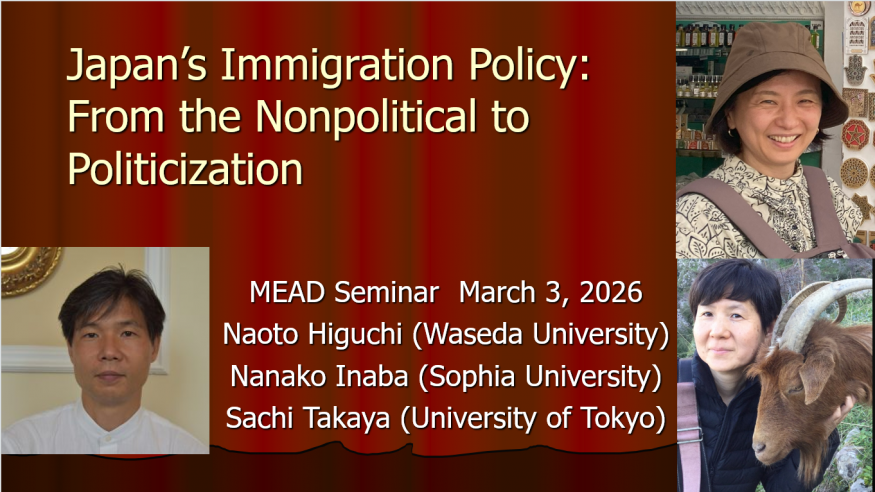
On 3rd March 2026, Professor Naoto Higuchi (Waseda University) and Professor Nanako Inaba (Sophia University) joined MEAD for an online seminar entitled ‘Japan’s Immigration Policy: From the Nonpolitical to Politicization’. They were also attending on behalf of a third co-author, Dr Sachi Takaya (University of Tokyo). We were very lucky to have Naoto and Nanako based in a similar timezone, during their ongoing fieldwork in Italy.
These three highly-esteemed Japanese scholars have worked on migration from the perspective of migrants themselves as well as those who oppose them. In this presentation, however, they shared their latest work on the politics of immigration with a focus on the ruling Liberal Democratic Party’s (LDP) strategies.
The background to this study is the recent rise to prominence of the so-called ‘foreigner problem’. In a country where necessary labour immigration has tended to be promoted quietly through back-door and side-door policy mechanisms to little public interest, many commentators have observed an abrupt change. There is now explicit talk of immigration in media, public and political discourse.
Our guest speakers demystified this phenomenon. Tracing the development of immigration policy in Japan from ‘quiet’ to ‘loud’ to ‘noisy’ politics, they demonstrated how media-driven controversies have facilitated a shift from a rights- and labour-oriented policy framework toward a law-and-order discourse. Their interviews with LDP politicians reveal the limits to Abe’s strategy based on clientelist concessions and meritocratic framing, within a party whose right-wing nativist segments he himself had fostered.
They also point to a threshold model explanation. In 2025, far-right challenger party Sanseito, having made sufficient gains in the Tokyo Metropolitan Assembly election, started to attract attention. Ahead of the Upper House election later that year, Sanseito took advantage of the lack of salient campaign issues to claim issue ownership over the ‘foreigner problem’. Although this ‘problem’ was manufactured to include the hot-topic issues of over-tourism and foreign investment by Chinese nationals, the result was attention to immigration policy. Unable to ignore Sanseito’s unprecedented (for a challenger party) Upper House electoral success, the LDP followed suit, placing immigration firmly on the agenda.
The result has been a new milestone for the mainstreaming of far-right politics in Japan. But Naoto, Nanako and Sachi also drew our attention to the forgotten victims behind this increasingly loud anti-immigration politics. Migrants and ethnic minorities in Japan have been framed as threats to public safety and national security, and their experience of the immigration debate has been one of fear and anxiety. In the end, it is the safety and security of these groups that is sacrificed for political gain.
Natalie-Anne Hall