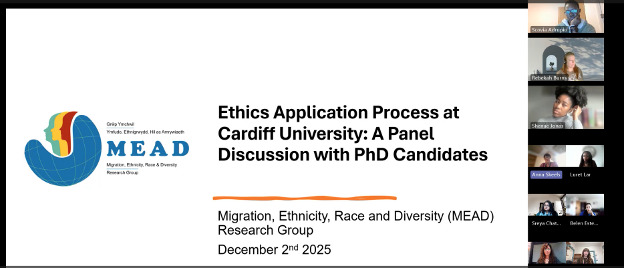
Ethics Application Process at Cardiff University: A Panel Discussion with PhD Candidates
15 December 2025
Overview
On the 2nd of December 2025, the Migration Ethnicity Race and Diversity (MEAD) Research Group at Cardiff University hosted a one-hour online panel discussion with postgraduate researchers (PGRs) on the Ethics Application Process. In attendance were 18 participants, comprising academics, PGRs, and postgraduate taught (PGT) students from within and beyond Cardiff University. The session was facilitated by Luret Lar, a third-year PhD student in the School of Social Sciences (SOCSI) at Cardiff University. Luret is also a member of MEAD.
The five panellists included the following PGRs: Scovia Adrupio, Shima Yekkehbash Heidari, Belen Garcia Gavilanes, Shenae Jonas, and Sreya Chattopadhyay, who shared their experiences at different stages of the ethics journey. Their research spans Social Policy, forced migration, slavery, labour markets, education, criminology and law across SOCSI, Cardiff Business School, and the School of Law and Politics. All panellists and the facilitator are funded by the Economic and Social Research Council (ESRC), UK, and the Welsh Graduate School for the Social Sciences (WGSSS).
Setting the Scene: An Interactive Session
The event opened with a Mentimetre word cloud activity capturing participants’ perceptions of the ethics application process. The most prominent word was “scary”, reflecting a familiar anxiety among researchers navigating ethics for the first time. This set an engaging tone for open, honest discussion.
Understanding the Ethics Application Process
Dr Natalie-Anne Hall, the convenor of MEAD and a member of the SOCSI School Research Ethics Committee (SREC) at Cardiff University, provided a concise walkthrough of Cardiff University’s ethics structure and expectations. Key points included:
- SREC operates under the Cardiff University Open Research Integrity and Ethics Committee (ORIEC), which oversees standards across most schools.
- Committees include academics, lay members offering external perspectives, and administrative staff; they meet monthly to review applications.
- Ethics processes vary across universities, but ORIEC sets the standard at Cardiff.
- Applicants download and complete forms in Microsoft Word and attach all supporting documentation—participant information sheets, consent forms, recruitment materials, and the mandatory research integrity training certificate. Some of these are not required for PGTs.
- WorkTribe, a new online submission platform, will be introduced in summer, 2026 to streamline submissions.
- Common pitfalls include unclear project summaries, insufficient methodological detail, and incomplete conflict-of-interest declarations.
Panel discussion
This involved discussions on four scenarios, and panellists agreed on the following:
- Tick box dilemma– All the necessary risky boxes that could potentially delay the response from the ethics team should be ticked.
- The never-ending revisions-Although this could be daunting, it is fine to pause, understand and assimilate the comments, then address them appropriately, with the support of supervisors.
- The interview that never was-The informed consent process is crucial and must not be overlooked in any research. Non-consenting participants cannot be included in any study or have their data used if they request that informal conversations be acceptable as research data.
- The Supervisor’s signature- At Cardiff University, students usually have more than one supervisor, who can sign the ethics forms in the absence of one. Additionally, other lecturers, the Head of School, the Graduate Office, and other support systems can advise and provide support.
Emerging Conversations
Discussion also explored broader ethical issues:
- Accessible consent can take many forms—email confirmations, digital tick boxes—provided participants receive all essential information and documentation.
- Ethics dumping was highlighted by Anna Skeels (MEAD), referring to conducting research in countries with less rigorous review processes to bypass stricter standards elsewhere.
- The panel emphasised that ethics is an iterative process, particularly around consent, participant protection, and data handling. While sometimes viewed as restrictive, these procedures safeguard both researchers and communities.
Concluding Thoughts from the Panellists
Drawing from experiences across the Global South and Global North, panellists emphasised the value of shared learning and contextual awareness. Despite differences in research environments, all agreed that clarity and explicitness are essential in ethical practice.
Their closing advice addressed the “scary” perception directly:
- “Embrace the process.”
- “If it needs time, give it time.”
- “Prepare for multiple eventualities, including unanticipated situations in the field.”
These reflections underscored ethics not as a hurdle, but as a thoughtful, evolving component of responsible research.