Dementia Awareness Week 2025
7 May 2025

Dementia, diagnosis and support
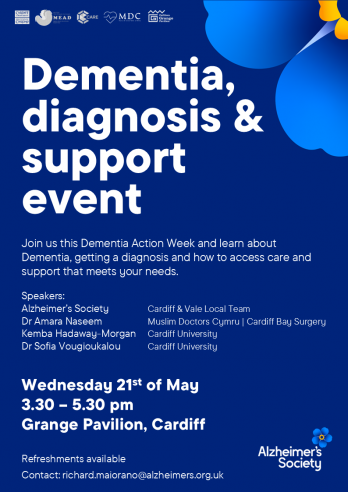
On Wednesday 21st of May, the Alzheimer’s Society and the Cardiff University Centre for Adult Social Care Research (CARE) and the Migration, Ethnicity, Race and Diversity (MEAD) research group with special guests from Muslim Doctors Cymru and NHS Wales held a community engagement for Dementia Action Week. This very popular event, running for three years in a row in the Grange Pavillion was aimed for people who want to know more about recognising the signs of dementia, the different types of dementia, how to obtain lasting power of attorney to protect a loved one and how to get involved in research as an adviser or a participant.
The Alzheimer’s Society Cardiff and Vale team introduced the 12 risk modifiable factors that can lower one’s risk of developing dementia later on in life and different types of dementia to help people be able recognise the symptoms.
Dr Amara Naseem from Muslims Doctors Cymru & Cardiff Bay Surgery talked about the early signs of dementia and advised participants on how to talk to their GP if they have any concerns.
Kemba Hadaway-Morgan, a doctoral candidate at the School of Social Sciences, Cardiff University and qualified social worker provided information about how people caring for people with dementia can get a lasting power of attorney and how that can help them as their loved ones’ dementia progresses. A Lasting power of attorney (LPA) is a legal tool that lets people choose someone they trust to make decisions for them. There are two different types of LPA: property and affairs LPA and health and welfare LPA.
Dr Sofia Vougioukalou, Research Fellow and dementia thematic group lead at CARE and member of the population health and social care division at the Centre for Trials Research at Cardiff University introduced dementia care research projects that she’s being involved in explained the processes of public involvement, research participation and dissemination, and how people can get involved as paid advisors or research participants.
This year we held a listening exercise with the community to find out more about culturally relevant information and support the participants would like to see in the community.