WCRC 2026: Reflections on Learning, Listening, and the Power of Community
25 March 2026
The joy of the WCRC conference is twofold. First the science, which is always impressive, along with the innovation, ambition and a desire to push boundaries which is shared there. An inspiring cocktail to partake in. I also find it interesting to catch up with what is happening across Wales in what was my ex-stomping ground, and to use the knowledge gained and inspiration sparked to support my current role in teaching. Second, it’s a wonderful place to catch up with friends and ex-colleagues who I haven’t seen for ages (for some it was last year’s conference).
Unfortunately, I missed the very beginning of Monday’s WCRC conference, because, despite the meticulous planning, I headed to the wrong venue and only realised when I rechecked the e-mail having been told by the reception staff that there isn’t a castle suite at the ICC in Newport!! Opps. So, despite being up early, the 50+mile detour which saw me having to back-track and retrace my route to get to the correct venue which is very close to home, meant I arrived late. Sigh. When I got there, I had to slip quietly into the back of the hall during the second half of the opening presentation on AI use in radiotherapy. From what I heard the message was that you can only get so far using AI with only an image, but if you add in words from notes and letters, you remove the glass ceiling, and the algorithms can make smart (useful) predictions. Agents (machine learning models) are already here and when provided with reliable sources of information (that bit seemed to be the important bit), they can make powerful tools that help with day-to-day decisions.
After the opening talk, came 3 lighting talks and then I managed to put up my poster before seeking out ex-colleagues to catch up with over the refreshment break. Needless to say, I was laughed at for my dippiness first thing, but that was a small price to pay for a proper catch up.
As the day unfolded, with more wonderful talks which covered the advances related to immunotherapy, dealing with neurotoxicity side effects, and delivering drugs to the brain, among other things, two themes lingered with me more than the technical details. The first was the sheer depth of learning that comes from listening to patient representatives. The second was a more complex notion of the role of communities in shaping policy, and the challenges of ensuring those who most need representation are actually represented.
The standout talk of the day was the patient story delivered by Molly Fenton. We often talk about “patient voice” in research and healthcare, but hearing someone speak with such clarity, honesty and courage brings the idea into sharp focus. Molly didn’t just describe living with a low‑grade glioma, she highlighted the silences, the missed conversations, and the deeply human side of navigating health information that is so often overlooked. Her’s is an example of the type of story I want our medical students to hear and learn from. I intend to tune into her podcast series that she promoted (thegliobabes). Her insistence that our periods (menstrual periods) are a “window into our health” and should not be ignored, was so relevant for my recent year 1 teaching. She also highlighted that stigma persists only when we avoid speaking about important topics, and that was powerful. More than anything, she reminded us that expertise isn’t confined to academic spaces. Sometimes our most important learning comes from those with lived experience. We MUST be willing to listen without assuming we already understand.
The second reflection is one that I’m still turning over in my mind, and that was the call for more meaningful citizen involvement in policymaking. It’s something I wholeheartedly agree with in principle. Policies are stronger, fairer and more grounded when they are shaped with the people they serve. Yet I’m finding it hard to shake the worry that it’s too easy to fall into the trap of listening only to the communities that are most available, not the communities that are most affected. The fact that poverty and chronic stress erode cognitive capacity and reduce people’s ability to participate in these processes was highlighted, and this is just one of the reasons that those living with the greatest inequalities often have the least bandwidth to attend meetings, join panels, or contribute to consultations. Yet it is their voices that are precisely the ones we need most urgently. It’s a conundrum that needs solving, but I’m not sure how, although rethinking how we seek out those voices is going to be part of the solution. We need processes that meet people where they are, that reduce the barriers to participating, and that recognise that representation isn’t just about who shows up, it is about who can show up. Otherwise, we risk unintentionally reinforcing the very inequities we claim and aim to address. This is something I’ve been discussing with those rolling out the new “women’s health” clinics and support services in the Cardiff East cluster, which is perhaps why this topic struck me during the conference.
A further two thoughts on the conference. First, the power of public speaking skills to convey a message. Again, Molly Fenton needs a mention, as her ability to captivate the audience was phenomenal. The other was Dr Ben Newland, a Senior lecturer at the school of pharmacy in Cardiff Uni, whose talk used a personal story to engage the audience and frame the ‘why’ for his research looking at developing “sponges” to slow-release drugs into tumour resection sites. My final thought is the fast-paced evolution of medical practice, that is informed by research. Dr Mark Wills, consultant neurologists, highlighted the range of neurotoxic side effects for cancer therapies, and mentioned, several, like HLH, as being something new, that they are still learning about as it was not something that was seen much 12months + ago. Dr Wills concluded that this is a “rapidly changing space”. I was left wondering how much our current medical students, who are so focused on learning content to pass the exams, can appreciate how quickly practice is changing, and how do we best prepare them for this. I guess I worry our current system might be falling short.
Anyhows, I thoroughly enjoyed this year’s WCRC conferences, as I was stretched, not just intellectually, but ethically and socially. The conference was a reminder that progress in cancer research (and I postulate this is relevant to all medical fields), isn’t just measured in clinical breakthroughs, but it is also measured in how thoughtfully we listen, how intentionally we include, and how willing we are to question the assumptions baked into our systems. Only by doing this can we maximise our ability to be adaptable and responsive to the needs and challenges.
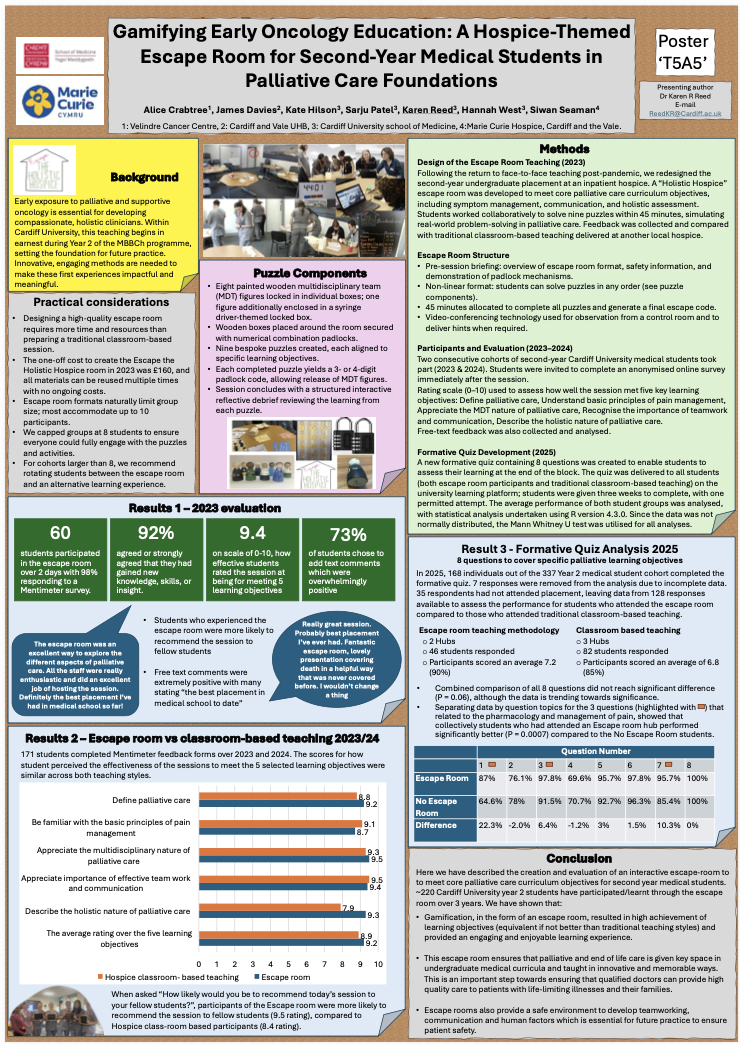
FYI – the poster I presented at the conference. It is a privilege to have played a small part in this fab project. All credit to the palliative care teams who developed such an engaging learning experience. It has inspired other aspects of my teaching practice.
- WCRC 2026: Reflections on Learning, Listening, and the Power of Community
- Why Tackling Gender Inequality Still Matters
- Diabetes & Menopause: What Everyone Should Know (and Why Oestrogen Matters)
- Personal Reflection: Initiating and Organising “Menopause in Focus” at Cardiff University
- Supporting introverted medical students.