Bridging Borders with Active Travel: A Cross-Nation Perspective on Walking, Wheeling and Cycling in the UK
1 November 2025
Active travel – walking, wheeling and cycling – is more than just a way to get from A to B. It’s a powerful tool for improving public health, reducing carbon emissions and tackling social inequalities. Across the UK, governments are increasingly recognising its value, embedding active travel into climate, transport and health strategies. But how do these efforts compare across the four nations? And what can we learn from each other?
A recent cross-nation report led by Cardiff University, commissioned through the PolicyWISE Active Travel Cluster, set out to answer these questions. The team systematically mapped definitions, data practices and policy approaches across England, Northern Ireland, Scotland and Wales, to understand what is currently happening and identify recommendations based on best practice.
Why Definitions Matter
One of the first observations related to definitions. While all four nations include walking and cycling in their active travel frameworks, the inclusion of wheeling, scooting and mobility aids varies. Wales, for example, focuses on ‘purposeful journeys’ like commuting to work or school, while Scotland embraces a broader ‘people-powered’ approach.
These differences aren’t just semantic, they shape who gets counted, what gets funded and how inclusive our infrastructure becomes. Co-creating a single definition could help ensure that disabled people, older adults and those using mobility aids are fully represented in active travel policies and data.
Diverse Policy Landscapes
Each UK nation has taken a distinct path toward promoting active travel:
- England has centralised delivery through Active Travel England.
- Northern Ireland favours a phased, place-based approach, with strong community engagement and a 10-year infrastructure plan.
- Scotland integrates active travel into climate adaptation, spatial planning and health frameworks.
- Wales legislates active travel through the Active Travel (Wales) Act, supported by statutory mapping and targeted funding.
These varied approaches offer rich opportunities for cross-nation learning. What works in one context might inspire innovation in another.
Data: The Backbone of Progress
Robust data is essential for tracking progress, evaluating impact and making evidence-based decisions. Yet, the authors found that data collection across the UK is patchy and inconsistent.
Self-reported surveys dominate and objective measures like GPS tracking and accelerometers are underused due to cost and complexity. Local authority capacity to collect and analyse data varies, with Scotland and Wales showing more structured monitoring linked to funding.
The report also highlighted data gaps: limited longitudinal data, underrepresentation of disabled and older adults and a lack of metrics on health and environmental outcomes. Without this data, it’s hard to demonstrate the value of active travel investments, or to ensure that they’re reaching those who need them most.
What the Research Tells Us
A rapid review of 133 published studies revealed that most research has focused on adults and commuting patterns. Children’s school travel is also well-studied, but older adults and disabled people remain largely invisible in the literature.
Combined infrastructure and behavioural interventions, like cycle lanes paired with education campaigns, were found to be the most effective in sustaining active travel uptake. Objective data (e.g., from sensors or wearables) is more accurate than self-reporting, but still rare.
The takeaway? We need more inclusive, long-term research that captures the full spectrum of active travel behaviours and outcomes.
Recommendations for a Smarter Future
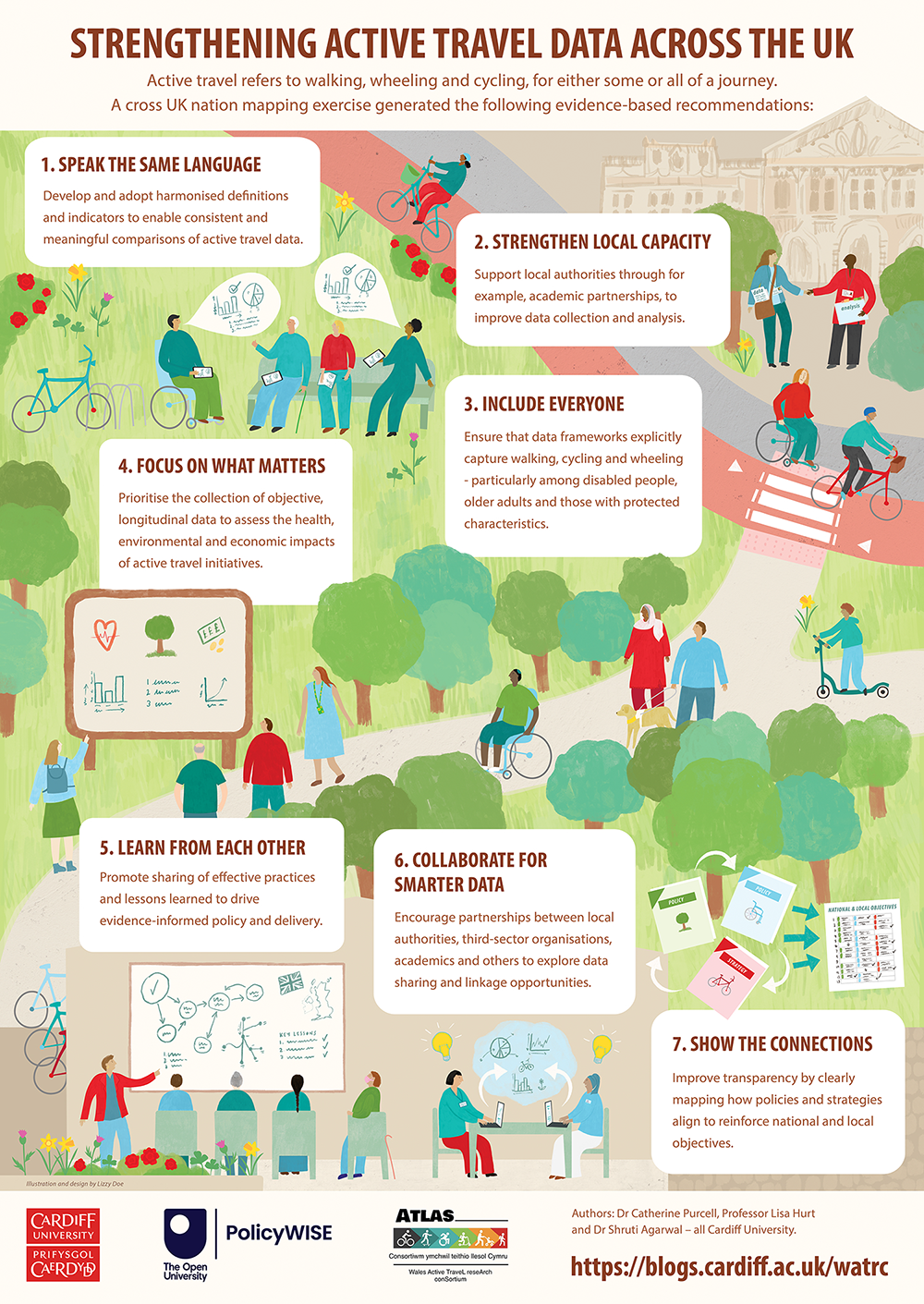
The report offers seven key recommendations to help the UK nations move forward together:
- Harmonise definitions and indicators to enable meaningful comparisons and shared learning.
- Support local authorities through academic partnerships and tools like the Active Travel Scheme Sketcher and Sustrans Evaluation Toolkit.
- Ensure inclusive data collection that captures walking, cycling and wheeling among diverse groups.
- Invest in objective and longitudinal data to assess health, environmental and economic impacts.
- Promote cross-nation sharing of best practices and lessons learned.
- Enhance collaboration between local authorities, third-sector organisations and stakeholders to improve data sharing.
- Improve policy coherence by mapping and linking related documents to show how strategic goals align.
Looking Ahead
As England develops its third Cycling and Walking Investment Strategy (CWIS3) and Wales transitions to regional transport funding, the timing is ripe for a more joined-up approach. Scotland’s 2030 Vision for active travel and Northern Ireland’s 10-year delivery plan also offer strong foundations for future collaboration.
Ultimately, fostering a culture of active travel requires more than infrastructure, it demands a shared understanding of what works, who benefits and how we measure success. This report is a vital step toward that goal, offering a roadmap for more inclusive, evidence-informed and impactful active travel policy across the UK.
To download the full report please click here.