Navigating Research Careers with the Vitae Researcher Development Framework 2025
9 December 2025
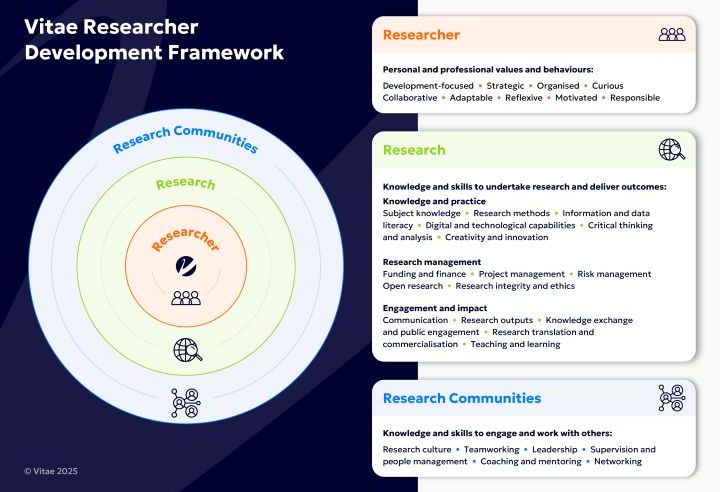
In an era where research is increasingly interdisciplinary, collaborative, and impact-driven, the professional development of researchers has never been more critical. Enter the Vitae Researcher Development Framework (RDF) 2025, a refreshed and reimagined version of the original 2010 framework, designed to support researchers in navigating their careers with clarity, purpose, and adaptability.
What Is the Vitae RDF 2025?
The Vitae RDF 2025 is a sector-leading framework that articulates the knowledge, skills, behaviours, and values of effective researchers. Developed through extensive consultation with stakeholders—including researchers, universities, funders, and employers—the RDF 2025 reflects the evolving landscape of research and the diverse roles researchers play in society.
The framework is structured around three concentric domains:
- Researcher – Personal and professional values and behaviours.
- Research – Knowledge and skills to undertake and deliver research.
- Research Communities – Skills to engage, collaborate, and contribute to broader research environments.
Each domain is broken down into sub-domains and descriptors, which are further divided into phases representing progressive levels of development. This phase-based approach allows researchers to identify where they currently stand and what growth might look like in each area.
Why the RDF Matters: Key Benefits
The RDF 2025 offers a multitude of benefits for researchers at all career stages—from postgraduate researchers to senior academics and professionals working in research-adjacent roles.
1. Clarity and Structure
The framework provides a common language for researcher development, making it easier to identify, articulate, and reflect on skills and competencies. This is particularly useful in interdisciplinary settings or when transitioning between sectors.
2. Self-Assessment and Reflection
Researchers can use the RDF to benchmark their current capabilities, identify strengths, and pinpoint areas for growth. The phase model encourages reflective practice and supports continuous learning.
3. Career Planning
Whether aiming for an academic post, industry role, or policy position, the RDF helps researchers map out career trajectories and align development activities with long-term goals. It supports both vertical progression and lateral movement across sectors.
4. Support for Supervisors and Institutions
The RDF is not just for individual researchers. It’s a valuable tool for supervisors, HR professionals, and career advisors, helping them guide and support researcher development in a structured and meaningful way.
5. Alignment with Research Culture
The updated framework emphasizes values such as research integrity, open research, and knowledge exchange, aligning with broader initiatives to foster healthy and inclusive research cultures.
Using the RDF for Career Development Planning
One of the most powerful applications of the RDF 2025 is in career development planning. Here’s how researchers can make the most of it:
1. Development Needs Analysis
Tools like the RDF Planner and Development Needs Analysis (DNA) help researchers assess their current skills and identify gaps. This structured reflection enables targeted development and avoids the overwhelm of trying to tackle everything at once.
2. Creating a Personal Development Plan
Using the RDF descriptors and phases, researchers can build a personal development plan that aligns with their career aspirations. This might include attending workshops, seeking mentorship, or gaining experience in leadership or public engagement.
3. Tracking Progress
The RDF encourages researchers to document their development journey, which is useful for Performance Development Reviews (PDR), funding applications, and job interviews. It helps articulate achievements in a way that’s relevant across disciplines and sectors.
4. Institutional Integration
Many universities, including Cardiff, map their training programs to the RDF, making it easier for researchers to find relevant opportunities. This integration supports a coherent and strategic approach to professional development.
5. Preparing for REF and Beyond
The RDF 2025 is also being used to support institutional planning for the Research Excellence Framework (REF) 2029, particularly in areas related to people, culture, and environment. It offers a structure for evidencing how institutions support researcher development and foster inclusive research cultures.
Final Thoughts
The Vitae RDF 2025 is more than a framework—it’s a strategic tool for empowering researchers to take control of their careers. By offering clarity, flexibility, and a shared language, it supports individuals and institutions alike in building a thriving research ecosystem.
Whether you’re just starting your PhD or leading a research team, the RDF 2025 invites you to reflect, plan, and grow. In a world where research is increasingly complex and collaborative, this framework helps ensure that researchers are not only equipped to succeed but also inspired to make meaningful contributions to society.