Meet the Researcher: Dr Lucy Robinson, ESRC Postdoctoral Fellow, School of Social Sciences
14 April 2026
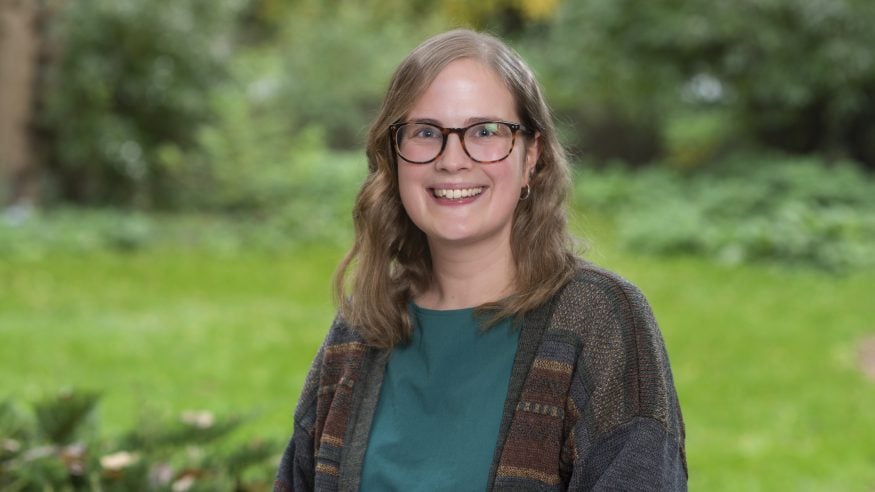
In the first of our ‘Meet the Researcher’ series, we’re delighted to introduce Dr Lucy Robinson, an ESRC Postdoctoral Fellow based in the School of Social Sciences at Cardiff University. In this blog, Dr Robinson reflects on her current research, her achievements, and her academic career journey.
Can you tell us a little about yourself and your research interests?
I am Dr Lucy Robinson, based in the School of Social Sciences, and I have the great privilege of currently undertaking the ESRC Postdoctoral Fellowship here at Cardiff University.
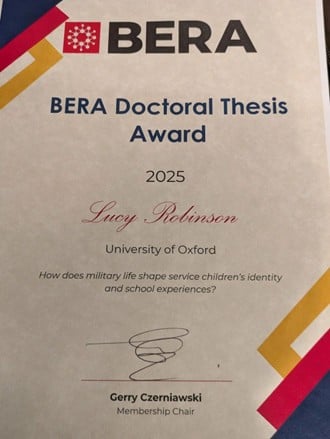
My ESRC-funded doctoral research (undertaken at the Department of Education, University of Oxford) involved working creatively with groups of service children to explore how military life shapes their identity and school experiences. I was very honoured to receive BERA’s 2025 Doctoral Thesis Award and the Centre for Evidence for the Armed Forces Community’s Early Career Researcher Award in recognition of my work.

My primary research specialism is service children, alongside my complementary interests in research ethics and creative research methods. I am passionate about undertaking research which develops both foundational knowledge and understanding and informs policy and practice; ultimately contributing to improving service children’s lives.
My pathway into academia was fairly conventional and in recognising that privilege, I am conscious of always doing what I can to help support the development of others and demystify the doctoral – and now postdoctoral – experience. Given that the 2026 WGSSS ESRC Postdoctoral Fellowship Competition has just opened, I thought it was the perfect time to contribute my reflections of, and insights into, this scheme via this Q&A style blog post.
What is the purpose of your fellowship?
The purpose of my one-year impact-orientated fellowship is to consolidate my PhD through developing publications, networks, and research and professional skills. At the time of writing, I am now around halfway through my fellowship. The first six months have been very busy but also incredibly rewarding for me. To give you a flavour of what I have been doing, here are five of my highlights so far:
1. I presented a conceptualisation – ‘the service child identity’ – derived from my doctoral research at CIMVHR Forum 2025 and immediately following that, undertook a short institutional visit to Queen’s University in Canada. There, I was warmly welcomed and supported to better understand the translation of research into practice alongside developing learnings from, and connections with, academics interested in service children and military families in a Canadian context. Three of us are also now working on a joint publication – watch this space!
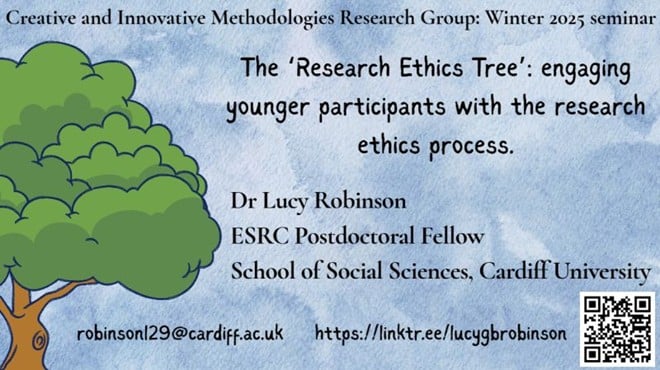
2. I have continued in my efforts to share a key output of my PhD, my ‘Research Ethics Tree’, which is an interactive tool designed to support the ethical engagement of children and young people in research. Pleasingly, this has led to the tree being adopted in the youth work practice of a leading military charity, Forces Children Scotland and the associated article being in the journal’s most read list!
3. I delivered the workshop (more forthcoming!) – ‘Understanding, supporting and promoting service children in English state schools’ – to trainee teachers based at several universities. Service children are an overlooked cohort in schools, and very few initial teacher training providers consider their unique experiences or needs. Delivering these workshops, and receiving such strong feedback about their utility, has cemented my resolve in continuing to translate this aspect of my research into professional development opportunities for teachers.
4. I worked with the CEO of a service children’s grant-giving educational charity, the Armed Forces Education Trust (of which I am a trustee of) to co-lead the strategic development of how the charity will understand, measure and communicate impact going forward. As part of this, I contributed to the development of a Theory of Change model for the charity alongside re-designing four surveys to more appropriately collect and analyse data from their grant recipients. This was a brilliant opportunity to apply my research knowledge and skills to address an issue in a real-world context.
5. I attended BERA’s AGM, award ceremony and keynote lecture in November. As part of the afternoon, I formally received two awards for my doctoral research (one being the 2025 Doctoral Thesis Award and the other being for my ePoster which I presented at BERA’s 2025 conference). I was really honoured to receive these awards given how supportive BERA has been of my professional development as an ECR.
How/when did you decide it was the right time for you to apply for a fellowship? What attracted you to this particular fellowship call?
During the months prior to the submission of my doctoral thesis, I began to think carefully about what my next step could be. A friend of mine had previously undertaken the fellowship (albeit in a different discipline) and a chat with her, alongside reading more about the scheme and previous fellows, solidified my decision to apply. I very much knew that I wanted to ‘do more’ with my PhD and the remit of this scheme aligned perfectly with this.
What was the very first thing you did once you had decided you wanted to apply for this fellowship?
The very first thing I did was double-check my eligibility! This fellowship is designed for those who are in the immediately postdoctoral stage of their career, and there are certain criteria that applicants need to meet. Fortunately, the ESRC provides very comprehensive guidance (their ‘Call Specification’) alongside a set of answers to Frequency Asked Questions about the scheme. It is worth taking the time to read carefully through these documents before you launch into the application process.
Why did you pick Cardiff University?

The scheme requires all fellows to have a mentor based at the research organisation where the fellowship is held. Having become familiar with the work of Professor Dawn Mannay during my first year of my PhD and later having the privilege of speaking to her at the first International Creative Research Methods Conference, I knew she would be a brilliant mentor. Dawn was also the external examiner for my doctoral thesis, so it made a lot of sense to choose her and Cardiff University. Having Dawn as a mentor means I am really well supported to stay on track and achieve my objectives. In our meetings, I can run ideas past her and seek feedback (and reassurance!) when needed.
Adjusting to a change in institutions took a little bit of time, but I can honestly say that all the staff at Cardiff University have been so welcoming, friendly and supportive. I have truly had a warm ‘Welsh Welcome’ – diolch yn fawr! I have also been really impressed by the range and quality of professional development opportunities offered by the University – a core part of the fellowship – and I have already benefited from engaging in several.
What advice would you give to someone considering applying for the fellowship?
The application process for the fellowship is rigorous and multi-faceted. Therefore, it’s important to give yourself plenty of time to carefully craft and refine your proposal. There are lots of word limits to adhere to which can be tricky to begin with but really push you to write concisely and clearly. Don’t be afraid to ask for feedback from mentors and peers. Even if you are unsuccessful with your application, you still will have learnt a great many things and developed your skillset – ready for success with a future application!
How do you switch off when you want to leave your fellowship behind for a little while?
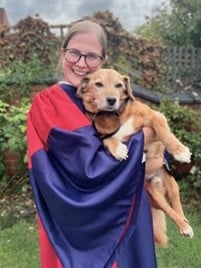 I love spending time with my dog, Hughie, who my sister and I rescued during the second year of my ‘dogtorate’. Hughie has been a constant companion of mine since and never fails to make me smile. I also love being outside – whether that’s walking or tending to my garden. Since moving in with my partner, I’ve had to leave my beloved allotment behind, so instead we’re working on a micro veg plot. Here’s hoping we’ll get a bumper crop this year!