Centre for Digital Humanities and Cultures Research Launch Event, 8th May 2025
30 May 2025
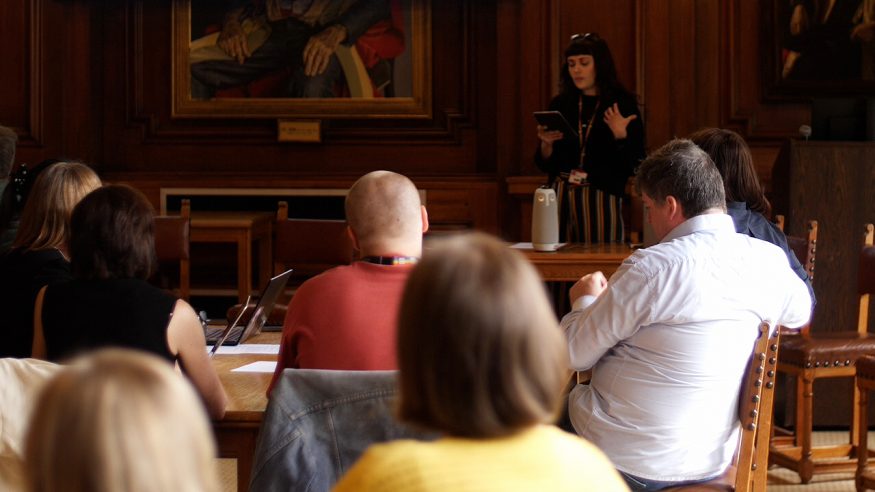
On 8th May 2025, colleagues from across the University came together to Launch the Centre. In the morning session, researchers and library service staff delivered lighting talks to introduce themselves, while the afternoon session saw colleagues brainstorming their vision for the Centre’s future.
In this post, Postgraduate Research Student Dan John shares his reflections on the day:
The Centre for Digital Humanities and Cultures Research launched with a very promising start to the day, with an excellent turnout of seasoned academics, professional and library services staff, and eager students in the early stages of their own research.
To new and interested parties, the Centre for Digital Humanities and Cultures Research is a collective space where researchers from all disciplines are welcome to engage and contribute to the ever-growing field of digital humanities: be that with digital history, engagement with literature in digital spaces, new media and video games, or emerging technologies such as AI and data collection software. The list goes on and on!
Lightning Talks
Propelling the Library into the 21st century:
We started off our series of lightning talks with two back-to-back presentations from Cardiff University’s excellent library service. Alison Harvey of Special Collections talked us through how the archives here at Cardiff have had a substantial investment in new technologies via the Welsh Government, which has allowed them to acquire an A0 scanner, a Phase One camera system, and easy-to-use book cradle scanners that protect the spine of those sensitive books while also producing a clean, flat image as though it were laid out perfectly flat. This is excellent for both digitisation and preservation processes. Furthermore, these tools are available internally and externally, which will allow more of the wider public to access and use our extensive collection of material here at Cardiff.

Following on from Alison’s walkthrough, Kellie Snow talked us through the Cardiff University Research Data Repository, which is accessible to research staff and also postgraduate researchers here at the university. This convenient service allows researchers to share their project data with the world, while also meeting funder, publisher and university requirements. In addition to this, the service allows the researcher to obtain a DOI for their dataset, making it much more convenient for citation purposes in future work.
Playing with History, Engaging the Old and the New:
As the day went on, we heard from a number of speakers from both the Schools of History, Archaeology and Religion (SHARE) and English, Communication and Philosophy (ENCAP) on what they are currently up to and where their research is going.
Professor Anthony Mandal (ENCAP) has supervised the creation of digital databases such as the British Fiction 1800-1829 database, as well as the Database of Mid-Victorian Illustration. His current digitally based projects include The Feminist History of Women’s Literature in the British Isles: The Orlando Volumes (CUP), and The Palgrave History of Gothic Publishing: The Business of Gothic Fiction, 1764-1835 (Palgrave Macmillan). In addition to this, Anthony also highlighted in his talk that the precursor to this Centre, the Digital Cultures Network, was able to establish a new book series: Bloomsbury Studies in Digital Cultures, which has since published 14 books, with many more still in the pipeline. Knowing this, there is potential for our Centre for Digital Humanities and Culture to do great things, and potentially open doors for excellent research publications and collaborations in the future.
Mr Dan John, a recent addition to the PGR network, spoke to us about his joint venture between SHARE and ENCAP to explore how ideology and ideological practices are portrayed in dystopian video games, focusing on the open-ended role-playing game (RPG) as a genre. His current case studies include the Fallout franchise (1997-present), and Disco Elysium (2019), both of which allow the player to explore alternative histories with significant potential for engagement and impact, based on the choices they make.
Dr Ian Rapley (SHARE) walked us through his current research on the history of the East Asian boardgame ‘Go’, which has required him to blend conventional historical analysis of writing about the game with structured queries of a database of 120,000 professional games, with the goal being to trace the game’s strategic development. This, as Ian noted himself, caused him to amusingly bridge himself over to the digital humanities by accident! But nevertheless, his research provides an interesting insight into how we are combining traditional historical inquiry with modern digital methods.
In addition to this, we had a very interesting discussion with Dr Yutaka Yoshida (SOCSI) on his projects surrounding digital vigilantism and online romance scams. The former investigates the growing number of ‘Vigilante YouTubers’ in Tokyo, who independently research and confront suspects with their crimes, often uploading these directly to their channel. The latter, on the other hand, investigates victims of online romance scams, reconstructing narratives about their past and future, and how being a victim of these scams has altered their identities and outlooks on life.

Finally, last but certainly not least, Dr Maria Fragoulaki spoke to us about the Media and Ancient History (MAH)project, which explores the intersections between ancient historical texts and contemporary media. In particular, projects such as “Tweeting the War”, which investigates the appropriation of ancient Greek historians in contemporary debates surrounding the war in Ukraine. This research highlights that history, even from the ancient era, does not exist in a vacuum – it still influences thought and debate even now in the digital age.
Emerging Technologies and Digital Humanities:
We also had a number of lightning talks from a wide range of academics that seek to further apply and use new technologies in fascinating ways.
First, PGR Serena Rattu (SHARE) walked us through her investigations into how museums can more effectively use their physical spaces and aid in the acquisition of knowledge to a variety of potential visitors through technology – such as using a blend of audio and visual techniques to allow for an immersive experience, along with making what is already present more accessible, such as placards that are easier to read and access.

Then, Dr Esther Wright explained her role in the establishment of the Historical Games Network, which periodically hosts events that bring game makers, academics, and cultural heritage professionals into conversation with each other. She also shared her work (with Dr. Daniel J. Finnegan) on the Cardiff Heritage Jam, which brings together students from SHARE and the school of Computer Science and Informatics to make games centred around local history and heritage in South East Wales. As shown in the linked article, the jam has resulted in the creation of a number of historical digital games that are free to play, but it has also given students of both disciplines the opportunity to branch out of their usual subject skills.
Dr Sean Roberts (ENCAP) highlighted the software that he has been developing, which will aid any academics that seek to utilise video games as a source of research. This software enables the user, provided that they have access to the game files of that particular video game, to extract and order the dialogue data for ease of analysis. This is a great step forward from other methods, which often relied on the researcher’s own skills with technology or relied on the user doing multiple playthroughs of a video game to access specific dialogue branches.
And to round off this section, Dr Bailin Deng (COMSC) presented his research surrounding 3D reconstruction from photos. In the past, we would have to rely on very specific sets of photos taken from multiple angles in the same lighting conditions, but with the technology that is being developed here, we can begin to create 3D models of objects from internet photos taken by tourists. Not only does this circumvent the need for consistent photo sequencing, but it also allows us to potentially map out objects that no longer exist, yet have photos taken of them in the distant past.
Future Plans
After a lovely lunch, many colleagues from across the University came together for a discussion on where we wish to take the Centre next. We had a productive chat amongst us, and the main aspect we took away from this is that we would love to maintain momentum and continue to enable researchers to communicate with one another.
If you’re looking to add a digital element to your research, or if you are simply curious about where the Centre is going, please watch this space and get in touch with us!
But for now, keep an eye on this space and stay tuned!