Geoffrey the Giraffe and the Blue Nose Trial: Inspiring the Next Generation of Clinical Researchers
26 February 2026
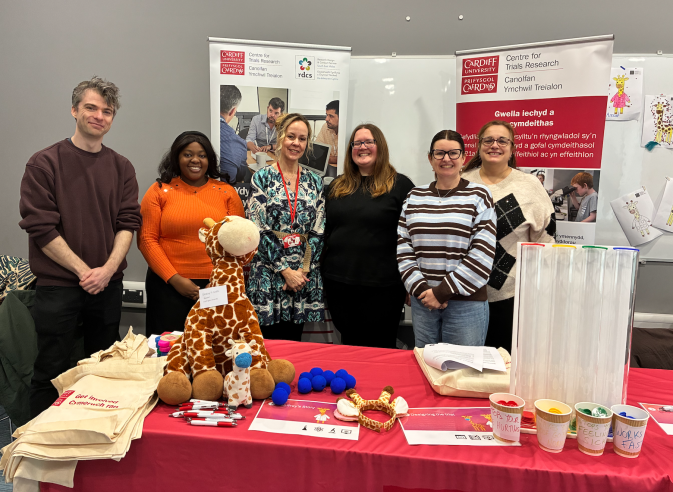
On Monday 16 February 2026, a small team from the Centre for Trials Research (CTR) attended the Be A Scientist engagement event held at Sbarc. Be A Scientist is now in its fourth year, inspiring young people aged 7-12 to consider a future career in Science, Technology, Engineering, and Mathematics (STEM). Susan Monkton and her colleagues in Impact & Engagement do a brilliant job of providing teams from around the University with an opportunity to share their research with a young audience. Almost 800 tickets were booked for this year’s free to attend event, and we welcomed at least 180 children and their grown-ups to our CTR stand.
This was our second year hosting a stand at Be A Scientist, and we were excited to bring Geoffrey the Giraffe back for another chapter in his journey through the world of clinical trials. In 2025, Geoffrey was a participant in a trial testing a new (fictional) bandage. This year, he had a chance to play the part of a Chief Investigator, designing and running a trial of a new treatment his lab had developed for the (again fictional) giraffe disease ‘Blue Nose’.
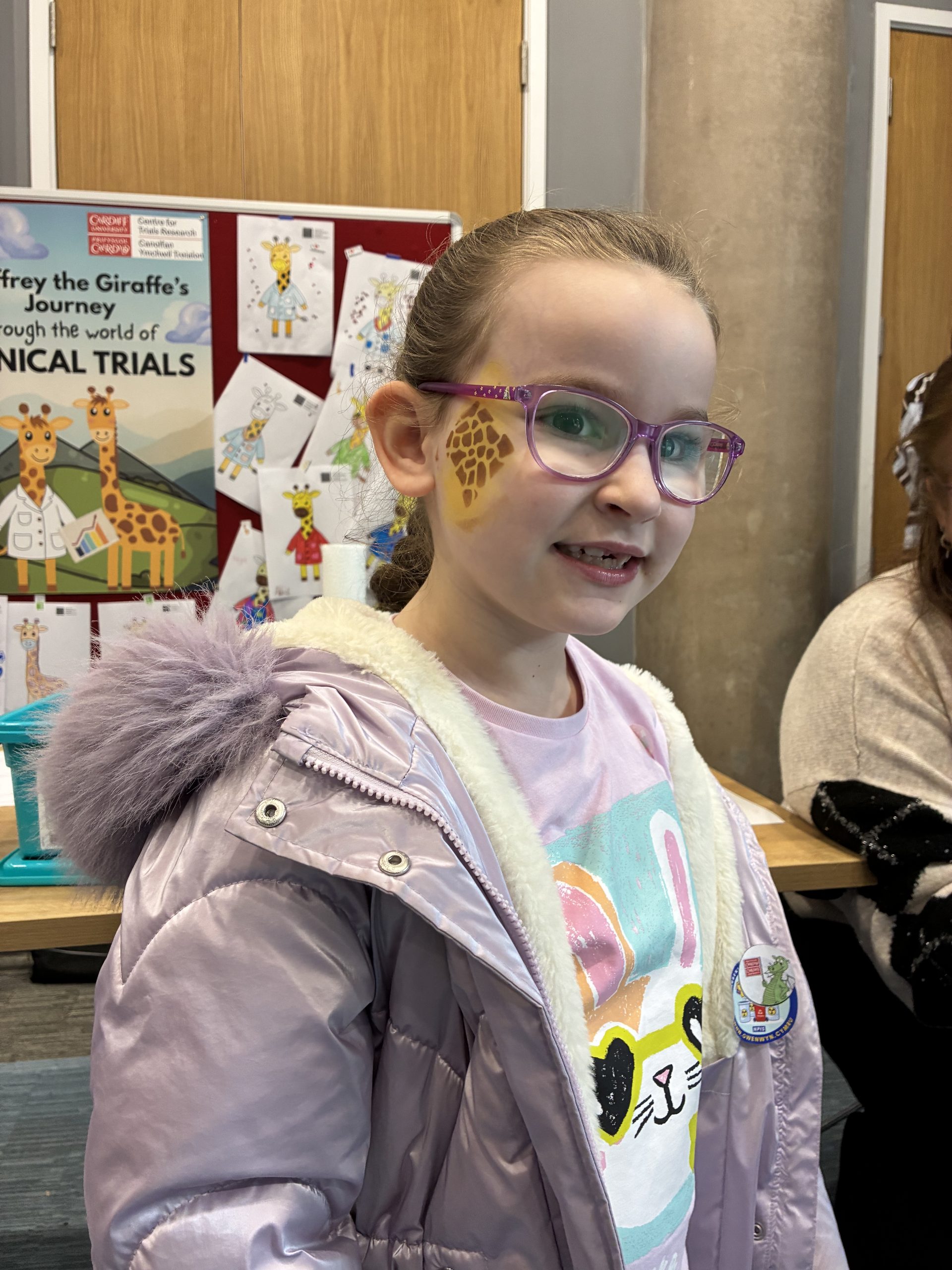
Visitors to the stand took on the role of public contributors to the trial, getting into character as giraffes with the help of wearable giraffe ears, blue foam noses, and the chance to have their face painted in a giraffe design. With imaginations sufficiently stimulated, we asked the young giraffes to help with:
Deciding the primary outcome for the trial – visitors could vote using tokens on what they thought the most important benefit of the new treatment could be. The vote was close, but a faster recovery compared with the current standard of care came out on top with 54 votes, followed by a reduction in side effects (46 votes), faster resolution of the blueness of the nose (42 votes), and faster pain relief (38 votes).
Agreeing how the Investigational Medicinal Product (IMP) was delivered – visitors were asked to consider whether a capsule or liquid medicine would be more acceptable. 30 visitors voted for swallowing a pill, 67 for drinking a liquid, and 25 for something else. The ‘something else’ ideas included using a cream, having an injection, eating leaves, and wrapping a pill in lettuce! A cream applied to the nose was the most common ‘something else’ suggestion.
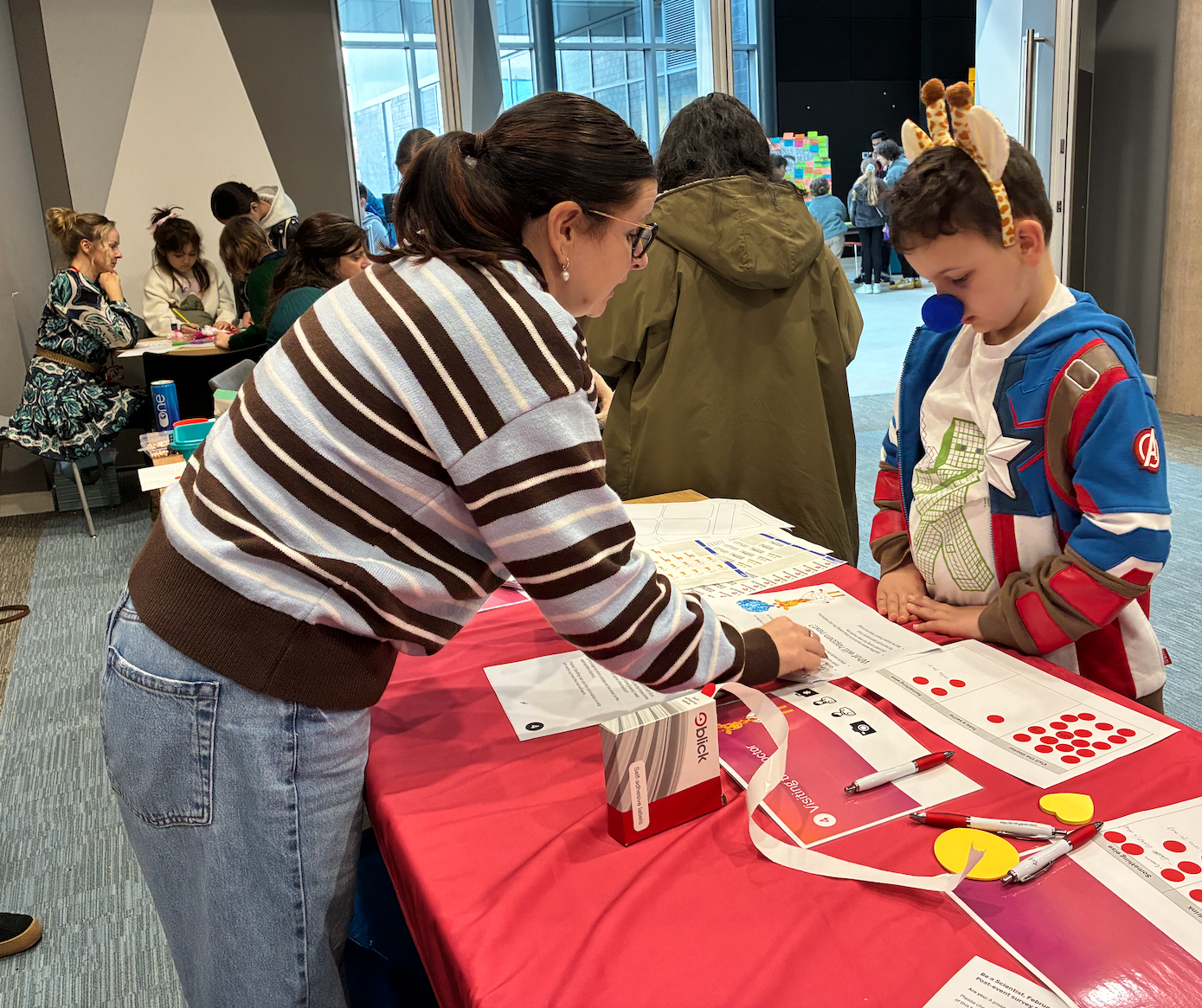
Influencing the conduct of the trial – visitors considered whether they would prefer to visit their GP for follow-up appointments or send in a selfie from the comfort of their sofa at home. 65 visitors said they would be happy to visit their doctor and 30 said they would rather take a selfie. We were surprised by how many children preferred the GP visit, with many seeing a benefit in having a chance to discuss their recovery with their doctor – though some did also mention getting a day off from school as a potential benefit of this strategy!
‘I would go to the doctor three times in a week if it made me feel better and helped the drug work better too!’
We also collected other ideas and 16 visitors gave suggestions including having a video call and completing an online quiz.
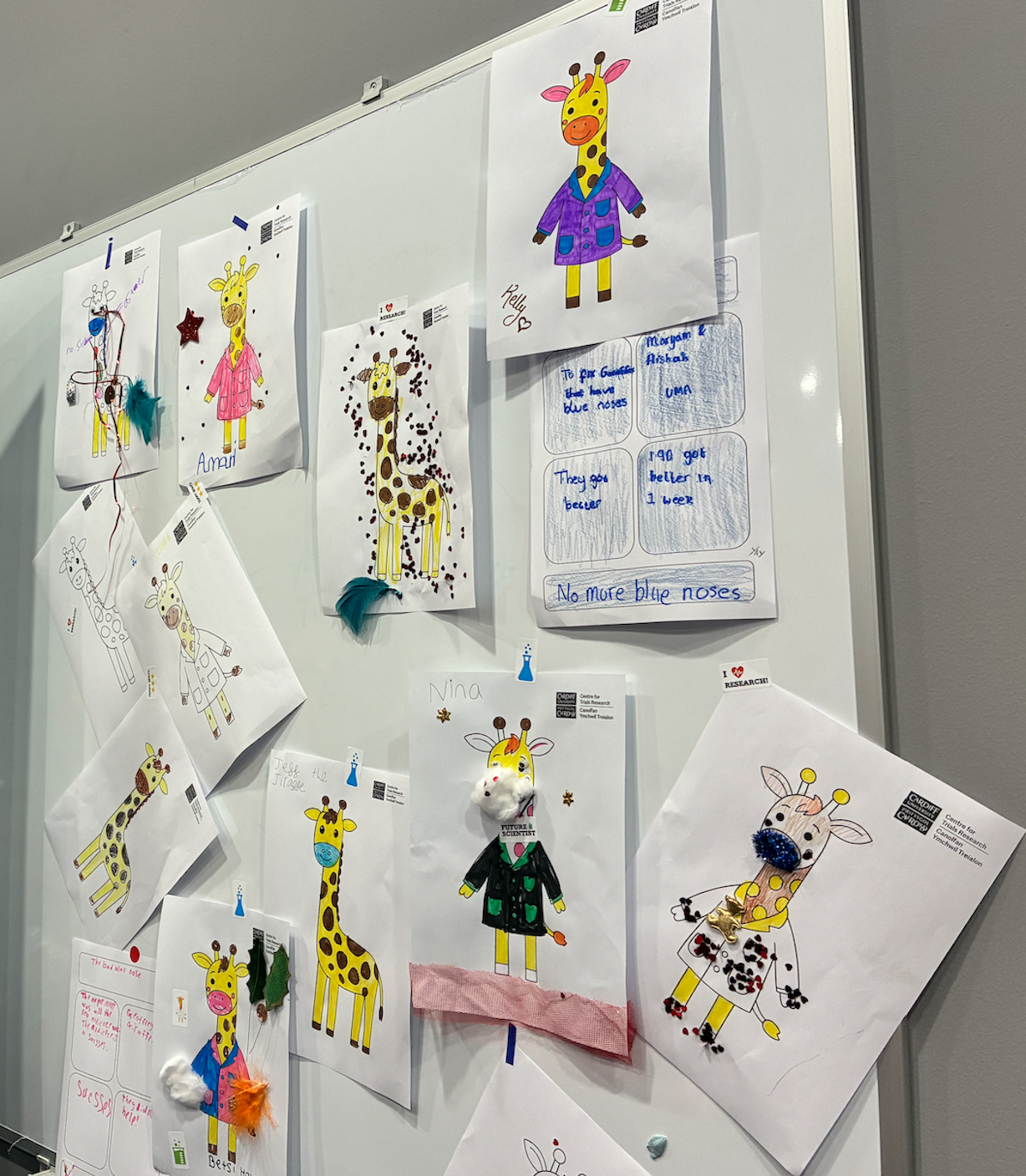
Contributing to dissemination – at the end of Geoffrey’s story, we presented visitors with a mock poster showing the results of the trial. This was deliberately unengaging, and children then had a chance to create their own more appealing poster using coloured pens, stickers and collage materials. We encouraged them to include their own role in the trial and how they had made a difference. Children enjoyed embellishing their posters, depicting Geoffrey with medical items that you might see a doctor use in hospitals (a syringe, a face mask, and a lanyard), and clearly signposted readers to key messages:
‘Testing new blue nose treatment!’
‘No sick and faster!’
‘190 got better in 1 week!’
We were consistently impressed by how enthusiastically visitors embraced the concept, and how deeply the children thought about the questions Geoffrey asked them. Our creative activities were so popular that we had to add a third and then a fourth table to our stand, highlighting how science and creativity can exist in the same space. Adults valued the simple way the concept of the trial was explained, and also appreciated the insight for their children into what being a scientist might actually involve.
Children are the researchers, trial managers, and trial participants of the future. Most of the children we met at Be A Scientist had not heard of clinical trials before, so this event represents a great opportunity to make their first impression of medical research a positive and engaging one. We look forward to taking part again next year!
The Geoffrey the Giraffe Team – Linda Adara, Elinor Coulman, Christabel Gono, Kelly Lewis, John Lindley, Nuria Marquez Almuina, Sarah Rawlinson, Sofia Vougioukalou. Special thanks to Kim Munnery for support with graphics for the stand materials.

- February 2026
- December 2025
- October 2025
- June 2025
- May 2025
- April 2025
- March 2025
- February 2025
- December 2024
- November 2024
- October 2024
- September 2024
- July 2024
- June 2024
- May 2024
- April 2024
- March 2024
- December 2023
- November 2023
- September 2023
- July 2023
- June 2023
- April 2023
- March 2023
- February 2023
- December 2022
- November 2022
- October 2022
- September 2022
- August 2022
- July 2022
- June 2022
- May 2022
- April 2022
- March 2022
- February 2022
- January 2022
- November 2021
- September 2021
- July 2021
- June 2021
- May 2021
- March 2021
- February 2021
- December 2020
- November 2020
- September 2020
- August 2020
- July 2020
- January 2020
- December 2019
- October 2019
- September 2019
- July 2019
- June 2019
- May 2019
- April 2019
- February 2019
- December 2018
- November 2018
- October 2018
- September 2018
- August 2018
- July 2018
- June 2018
- May 2018
- April 2018
- March 2018
- December 2017
- October 2017
- August 2017
- July 2017
- June 2017
- May 2017
- April 2017
- March 2017
- February 2017
- January 2017
- December 2016
- October 2016
- August 2016
- June 2016
- April 2016
- March 2016
- February 2016