2026
July
The 41st International Symposium on Combustion (ISOC) will take place in Kyoto, Japan, between the 26th and 31st of July 2026. The main organizers have planned the inclusion of several mini symposia to the Symposium agenda. These special sessions will follow and build upon the topics and themes of each of the Invited Topical Review presentations.
CEAT is very proud to announce that the mini symposium on Future Fuels for Energy Conversion, organised by Dr. Paul Papas (RTX Technology Centre, USA) and Prof. Mara de Joannon (IRC, Italy), will have Prof. Agustin Valera-Medina as panel moderator (large heating and power systems). Invitees to the panel include Prof. Ghenadie Bulat (Head of Future Technologies, Siemens), Prof. Jaqueline Chen (Senior Researcher, Sandia Laboratory), and Prof. Cheng Yi-Bing (Head of Hydrogen Technologies, Foshan Xianhu Laboratory).
We wish great success to Prof. Valera-Medina. Further details can be found in:
https://www.combustionsymposia.org/event/92fa0bc5-3a88-4b8f-b049-dab1592050f1/mini-symposia
2025
June
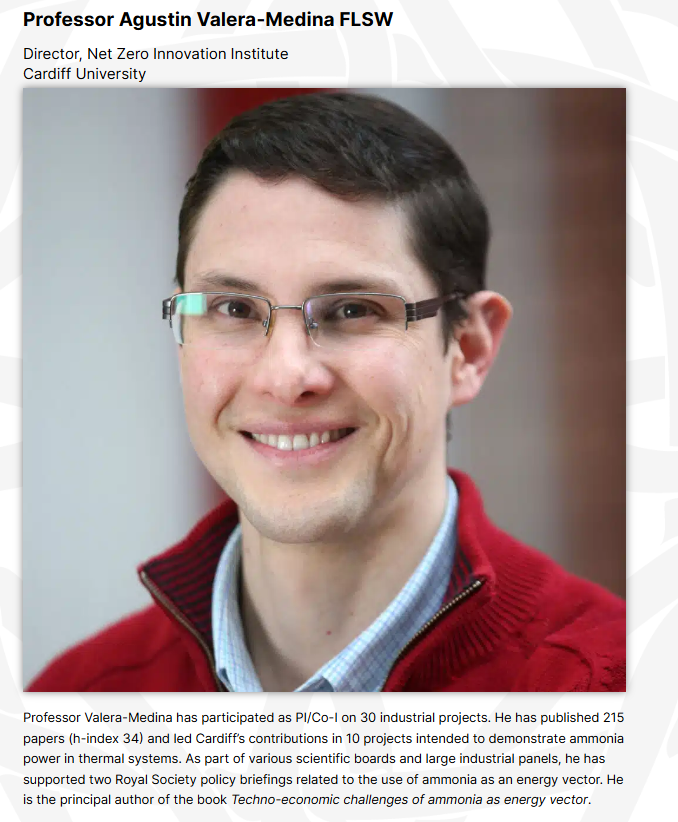
Professor Agustin Valera-Medina, CEAT’s Director, has been awarded a fellowship by the Mexican Academy of Engineering, one of the highest honours in the field of engineering in Mexico.
Founded in 1959, the Mexican Academy of Engineering is a non-governmental, non-profit organisation regarded as the Mexican counterpart of the UK’s Royal Academy of Engineering. Comprising some of the most distinguished engineers and scientists across Mexico and Latin America, the Academy works to advance engineering and technological development across the region and beyond. It also provides expert scientific advice to public and private sectors and engages in policy discussions as part of the broader Mexican Academy of Sciences.
Professor Valera-Medina is internationally recognised for his work on ammonia technologies and energy systems. He has led or contributed to over 33 industrial projects, collaborating with global companies including PEMEX, Rolls-Royce, Siemens, Airbus, and Ricardo, securing over £35 million in funding. With 230 published papers and an h-index of 44, he is a leading expert in sustainable energy, particularly in the use of ammonia as an energy vector.
Currently, he serves as Principal Investigator on major international projects such as SAFE-AGT, FLEXnCONFU, OceanREFuel, MariNH3, and CAIPIRINH3A. These projects aim to demonstrate the viability of ammonia in turbines, internal combustion engines, and industrial heating systems. He also chairs the UK’s ISO/TC 67/14 committee on Ammonia Firing and has contributed to key Royal Society policy briefings on ammonia energy.
In addition to his academic and industrial roles, Professor Valera-Medina is Co-Director of the Net Zero Innovation Institute and Director of the Centre of Excellence on Ammonia Technologies (CEAT) at Cardiff University. He was recently named a Fellow of the Learned Society of Wales (2024).
May
Latest Research Posters Presented at 12th European Combustion Meeting 2025
Cardiff University’s CEAT (Centre of Excellence on Ammonia Technologies) researchers presented the CAIPIRINH3A project at the 12th European Combustion Meeting 2025 held at Edinburgh, Scotland UK on 7-10 April 2025. This prestigious forum brings together leading researchers and experts from over 40 countries to share knowledge in combustion science and related disciplines, aiming to facilitate the transition to a carbon-neutral society while meeting societal energy demands.
Dr. Aravind Balakrishnan and Mr. Ziyu Wang shared two significant posters part of CAIPIRINH3A project on the plasma assisted combustion of ammonia. The first poster focused on a novel strategy for combustion enhancement of NH3-air mixture using Gliding Arc Plasma (GAP), while the second poster was about Numerical investigation on the combustion characteristics of premixed NH3-air flames using GAP. The results showed that there is a 40-80% reduction in NOx with the application of plasma. Both these studies provide critical insights into the potential of GAP technique for advancing ammonia combustion technologies, offering promising applications for sustainable energy systems.
CAIPIRINH3A remains focused on developing pioneering research in liquid ammonia-based systems. As interest in these technologies accelerates worldwide, their work is becoming increasingly vital to achieving a sustainable energy transformation.
2024
November|
We would like to Congratulate Prof. A Valera-Medina, CEAT Director, and Dr. Hua Xiao, associate professor at Jiao Tong Guangzhou and alumni from Cardiff University, on the recent announcement that they are now within the 2% Top most cited researchers worldwide (Certificate verified from sources like Elsevier and Stanford University). These certificates demonstrate the high impact and quality that our team and alumni have achieved on the subject of ammonia energy, a subject that will keep CEAT operating to decarbonise the world’s economy.
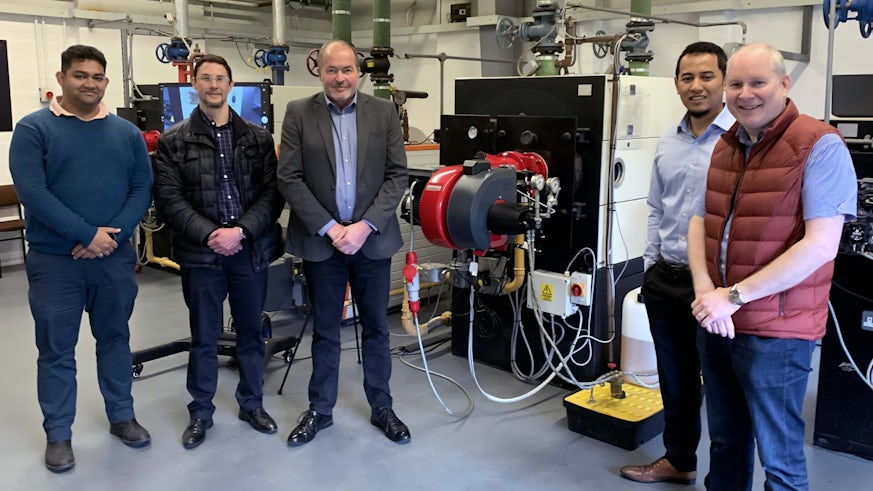
In terms of research, AMBURN has reached a new milestone. Latest experiments have confirmed power outputs up to 250kW using a smaller version of the AMBURN burner. The unit has demonstrated stable operation, low emissions and high versatility (operating from 2 to 250kW), hence showing the capabilities of the team in the development of industrial burners for their use with net zero fuels. It is anticipated that the system, once scaled up, will reach the desired 1 MW condition whilst mitigating emissions in the post-combustion zone, thus maximising efficiency and reducing equipment costs.

250kW flame under stable conditions.
April| Prof. Agustin Valera Medina is a Fellow of the Learned Society of Wales.
January | Happy New Year from all CEAT members.

2023
November | New Journal Emerges from Symposium on Ammonia Energy

October | The Net Zero Innovation Institute officially launched
October | Enhancing UK research and innovation clusters

September | Workshop on Ammonia Combustion Chemistry

July | Achieving net zero using ammonia
Follow us on social media 👍