Are all the Gefs dead? What one talking mongoose can teach us about the Disenchantment of the World (Isabelle Doyle)
11 March 2026
Our modern age is, by many accounts, a disenchanted one – comparatively lacklustre and drained of supernatural substance from the time of the Reformation onwards. This, as Max Weber suggested, is a sign of the gradual disenchantment of the world, with saints and miracles being relegated to the periphery and replaced by science, mathematics, and technology as dominant frameworks for understanding reality. Life before was charged with meaning that transcended material explanation.
But does the rise of scientific materialism really mean the death of these other worldviews? This article will explore how one talking mongoose enchanted the Isle of Man, how this is likened to the enchantment of saints, miracles, and Reformation views about ghosts, and how something so small can represent possible re-enchantment.
The Mongoose
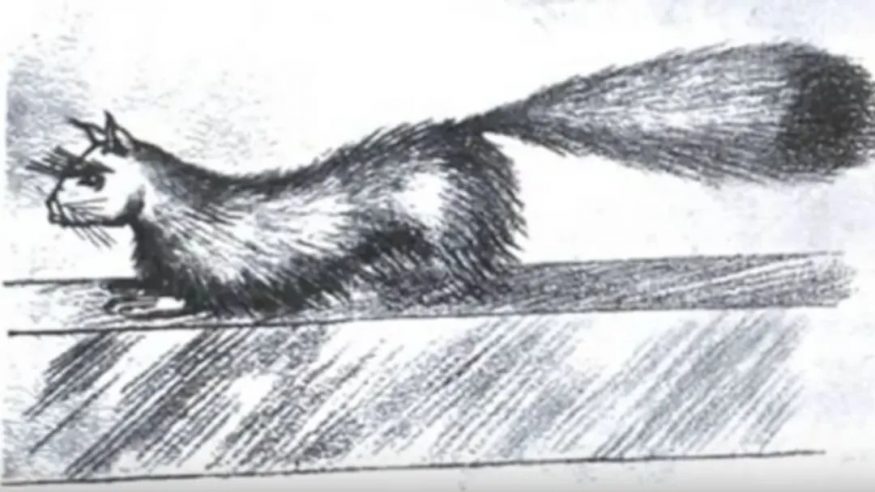
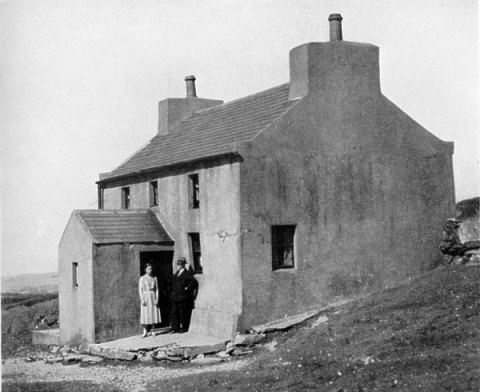
Enter Gef: a talking mongoose from the Isle of Man. Gef made his home in a farmhouse at Cashen’s Gap, where he lived with the Irving family—James, Margaret, and their daughter Voirrey. The strange encounters began in 1931. Gef’s presence was elusive and liminal: at times visible, at others entirely unseen. Frequently benevolent but prone to sudden bursts of rage, sometimes violent, even homicidal. He once threatened a sceptic, Arthur Morrison, declaring he would “blow his brains out with a 3d cartridge.” He would throw things, such as needles, or knock things over in the fashion of a poltergeist, but was an enigma in how he assimilated into Irving family life; he would walk with them, read the newspaper with James, and hold Margaret’s hand.
Gef was, by all accounts, unfathomable. It’s best to let his own words speak to truly grasp him.
Gef had not always been able to talk; he claimed to have picked it up, and with this gift was quite eloquent. He offered contradictory accounts of his identity. At times, he called himself “an earthbound spirit.” Other times, he insisted he was no spirit at all, but rather “a little extra, extra clever mongoose,” arguing, “If I were a spirit, I could not kill rabbits.” And yet, elsewhere, he described himself as a ghost. His self-portrayals veered wildly—from the fantastic (“the fifth dimension”) to the mundane (“I am a marsh mongoose”). Ultimately, Gef resisted categorisation. As he once put it: “I know who I am, but I shan’t tell you.”
He therefore preserved his mystique, fostering intrigue about himself while seemingly caring little to provide clear answers.
The enchantment of Cashen’s Gap
His undecipherable nature and wily personality only added to his allure and fame that began in 1931 and ceased in 1945, the year the Irvings moved away. Many locals claimed to have encountered Gef. In 1932, James Irving submitted a voluntary statement signed by three men, with fifteen people overall vouching for the experience. Everyone seemed to have a unique story; Jack Tearle reported stolen sandwiches, Charles Morrison claimed to have heard Gef speak twice, and Captain Dennis witnessed a large packing needle thrown into a teapot. The ‘cult’ surrounding Gef caught mass amounts of attention, eventually leading to visits from psychic researcher Harry Price and parapsychologist Nandor Fodor. Due to his supernatural nature, Gef’s mere existence enchants the landscape he inhabited.
As the poet W.H. Auden once observed, ‘When we are truly enchanted, we desire nothing for ourselves, only that the enchanting object or person shall continue to exist.’ That bore true for the enchanting of Cashen’s Gap. The Irvings accepted no money and rarely let people in. Perhaps because Gef was not made into a spectacle, he retained the admiration of the wider community.
Then what separates Gef from the saints?
But how does Gef compare to traditional sources of enchantment, like saints and miracles? Is it too far-fetched to suggest that Gef, the talking mongoose, might be a kind of modern-day saint?
He performed his kind of miracles: moving objects, becoming invisible, speaking across great distances. His powers, while mischievous and occasionally threatening, were arguably no more implausible than Saint Joseph of Cupertino’s reported ability to levitate. Like saints, Gef attracted pilgrims, visitors, psychic researchers, and fascinated locals. Moreover, the plasticine paw prints and hair samples, although scientifically traced to the Irvings’ dog, resemble relics in their symbolic power.
It’s furthermore undeniable that Gef had devout believers; devotion to Gef persisted for decades. Voirrey, the Irvings’ daughter, maintained until her death in 2005 that Gef had been real, not a hoax. By all but official veneration, Gef fits many qualities of a saint.
In many ways, however, Gef has become more relevant for his role as an enduring part of history rather than a supernatural entity. Perhaps what disenchants the world is not a lack of the miraculous, but a disconnection from divinity. Gef may not have drawn power from God, but he was nonetheless miraculous in his own special way.
A return to enchantment
Even more than the saints, Gef resembles the idea of the Protestant ghost, another liminal figure born out of post-Reformation belief. In this way, he does not escape the theological framework entirely. His story occupies a space between sacred and secular, religious and folkloric, rational and absurd. The ghosts of the post-Reformation world were not the spirits of the dead but instead angels or demons pretending to be such. Gef falls more in line with actions considered demonic, which provides a fair framework to view Gef’s story through. Perhaps he is a ‘ghost’ as he claims, in the Protestant sense that a ghost is a demon, or perhaps he is the absurd ‘fifth dimension’ and ghosts and demons are a way for humans to rationalise the unreal.
Was it a hoax? Does it matter?
But can Gef be considered real? In scientific terms, it would seem unlikely. The paw prints did not match, the hair was from the Irvings’ dog, Mona, and no other mongoose has ever been found to talk. By all modern ‘rationality’, Gef is not real.
Despite this, as we have previously explored, by pre- and post-Reformation standards, Gef’s existence is explainable. Now, does this therefore show the gradual decline of enchantment? No. In fact, the very tension between belief and disbelief can be enchanting in itself. The mystery generates wonder for sceptics and believers alike. The fascination lies in the pursuit: the “thrill of the chase.” That such a creature could be believed to exist at all reveals not a loss of enchantment, but a shift in how it is expressed. The notion that Gef was the product of Voirrey’s ventriloquism further encapsulates this. He is an illusion in our sense, and yet also by his description.
In the modern day, we’d like to think of ourselves as ‘reasonable people’, so Gef is categorised as a hoax, and all evidence to the contrary is ignored. The Reformation was seen as an emancipation from superstition, resulting in an intellectual disdain for the paranormal.
However, this approach is not as scientific as we would insist. By ignoring the evidence of Gef’s existence, the testimonies of believers, by discounting the possibility that the dog hair may be one of the elusive Gef’s tricks, we toss out all that does not fit with our present worldview. The magic has not ceased; we have shunned it and actively chosen not to believe.
We all know the many ways magic still lingers in little ‘unreasonable’ ways: salt over the shoulder, umbrellas only to be opened outside, or seven years bad luck from a smashed mirror.
Concluding Remarks
Believers and sceptics have always co-existed, just as modernity coexists with enchantment – indeed, the modern can increase wonder as much as it disproves it.
This case, therefore, demonstrates that while the explanations for the supernatural have changed over the years, the world has not been wholly disenchanted and never was. Cases such as Gef the Talking Mongoose highlight the varying ways Western society has attempted to rationalise ghosts, as the deceased, as angels/demons, as hoaxes. But it is this exact rationalisation that devalues the enchantment; this is the true impact of the Reformation, laying the groundwork for society to consider itself ‘rational’ and thereby above a ‘childish’ belief in the supernatural. The enchantment has always been present; it is we who must allow ourselves to be enchanted – at least occasionally, for there is value in enchantment as well. And modern Britain is – now 38% of adults believe in ghosts, and that number is only rising. Enchantment is very much alive.